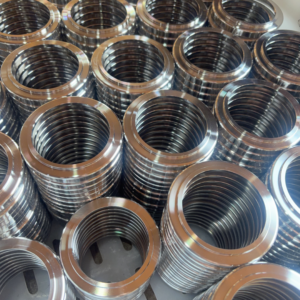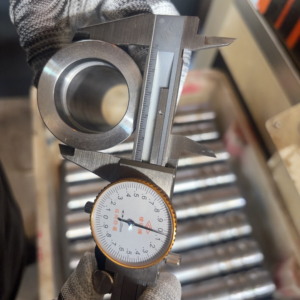
Stainless steel parts is a wide label. It covers a turned shaft, a threaded adapter, a stamped bracket, a dowel pin, and a machined valve body, all of which behave differently on the shop floor and carry different price tags. Buyers usually search the term before they know which family they need, which is why the answer cannot be a single product list. This guide maps the part families, the grade choice behind each one, the tolerances worth writing on a drawing, the documents to ask for, and the questions that separate a machining factory from a trader. At Xinghe we machine stainless steel parts to drawings every week, and the same five details decide whether a job runs clean or comes back as a rejection: grade, thread callout, critical dimensions, finish, and inspection scope.
Key Takeaways
- Grade drives machinability more than any other decision: 303 cuts roughly twice as fast as 316, and that difference shows up in unit price.
- Most stainless part failures trace back to a missing callout, not a bad machine: an undefined thread class, an unfinished surface, or a tolerance applied across the whole part instead of one mating diameter.
- Passivation is not cosmetic. It restores the chromium oxide layer that machining disrupts, and it belongs in the drawing, not in a post-order email.
- Ask for three documents before approving a batch: material certificate, first article inspection report, and the gauge record for every thread.
What Counts as Stainless Steel Parts
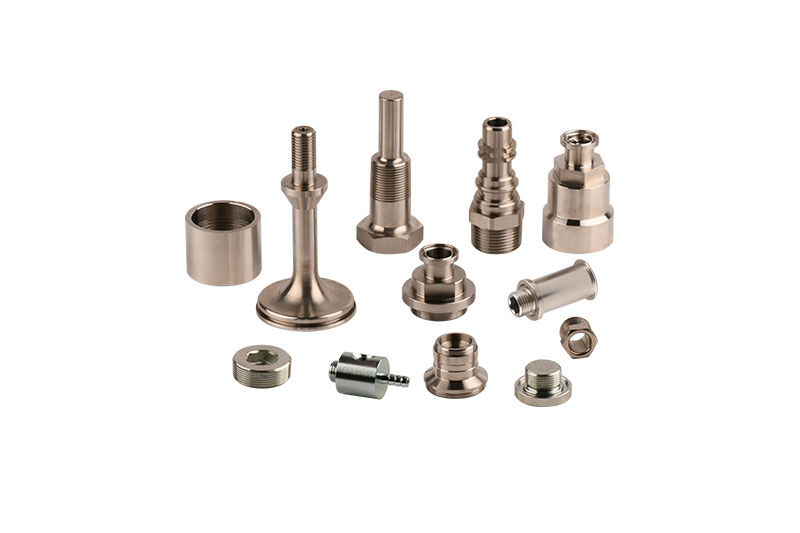
The term spans six part families in most industrial supply chains. Each one is made a different way, and each one fails for a different reason, so it helps to place your part before comparing quotes.
| Part family | Typical grades | Usual process | What buyers get wrong |
|---|---|---|---|
| Shafts and pins | 303, 304, 316L, 17-4PH | CNC turning, Swiss turning | Calling out hardness without saying where it applies; ignoring straightness after turning. |
| Bushings and sleeves | 303, 304, 316L | Turning, boring, honing | Specifying an ID tolerance without a mating shaft tolerance, so the fit is decided by luck. |
| Fittings and adapters | 304, 316, 316L | Turning plus threading, some forging | Mixing NPT and BSPP in one assembly; omitting thread seal or engagement depth. |
| Fasteners | 304, 316, 316L, 410 | Cold heading, turning, thread rolling | Specifying 316 for a joint that galls, when 303 or an anti-seize callout would solve it. |
| Housings and brackets | 304, 316L, 17-4PH | CNC milling, sheet forming | Ignoring wall thickness, so the part distorts during machining or welding. |
| Valve and pump components | 316L, 17-4PH, 420 | Turning, milling, grinding | Leaving sealing faces at general surface finish, then chasing a leak in assembly. |
Two categories get mislabeled as stainless steel parts but are really finishing jobs or stock items: a catalog fitting with a special plating, and a standard fastener bought by the box. Neither needs a drawing review, and neither should be quoted as a machining project.

303 vs 304 vs 316 vs 17-4PH: Choosing the Grade
Grade selection is the first cost decision, and it is usually made too casually. The three austenitic grades look similar on a spec sheet and behave very differently under a tool. Machinability figures below are rough percentages against a free-cutting carbon reference (B1112 at 100%), a comparison commonly used in machining references.
| Grade | Key addition | Machinability | Corrosion | Weldability | Best for |
|---|---|---|---|---|---|
| 303 | Sulfur, free-machining | High (~78%) | Moderate | Poor | High-volume turned parts: shafts, pins, threaded inserts, spacers |
| 304 / 304L | 18% Cr, 8% Ni | Medium (~45%) | Good | Excellent | General parts, food equipment, housings, brackets; 304L when welded |
| 316 / 316L | 2–3% Mo added | Lower (~36%) | Excellent, chloride-resistant | Excellent | Marine, chemical, pharmaceutical, washdown and salt exposure |
| 17-4PH | Copper, precipitation hardening | Low, heat treated after machining | Good | Limited | High-strength parts: actuator components, valve stems, aerospace hardware |
| 430 | Ferritic, no nickel | Medium | Moderate | Limited | Cost-sensitive decorative and non-welded parts |
Three practical rules come out of that table. First, if a part is turned in volume and corrosion is mild, 303 saves real money per piece; the sulfur that makes it cut freely is also why it should not be welded. Second, if the part will be welded, move to the L grades (304L, 316L) — low carbon prevents carbide precipitation at the weld and the resulting corrosion at the seam. Third, do not default to 316. It costs more and machines slower, and it only earns that premium where chlorides, salt, or aggressive chemistry are actually present. For a direct comparison of material families outside stainless, see carbon steel vs stainless steel for custom fittings.
How Stainless Steel Parts Are Machined
Stainless steel work-hardens. Cut it with a rubbing tool and the surface gets harder under the tool, which wears the edge and pushes the next pass further out of tolerance. Every process choice below exists to avoid that.
- CNC turning: the default for round parts — shafts, pins, bushings, adapters, hex bodies. Bar stock feeds through the spindle and the part comes off with diameters, grooves, and threads in one setup.
- CNC milling: pockets, slots, flats, cross-holes, and port faces. Cast or forged blanks are often milled rather than cut from solid to save material.
- Turn-mill: milling features on a turned part without a second fixture. Fewer setups means less accumulated error and usually a shorter lead time.
- Swiss turning: small, slender parts where deflection would ruin the diameter. Guide-bushing support keeps length-to-diameter ratios workable.
- Thread rolling: forms threads by displacement instead of cutting them. Stronger thread flanks and no chip problem, limited to diameters the roller can reach.
- Forming and forging: for shapes where removing material is wasteful. Hot-forged bodies are then machined on the sealing faces and threads.
The tooling side matters as much as the machine. Sharp, coated carbide with positive rake, rigid setups, generous flood coolant, and feeds high enough to keep the edge cutting rather than dwelling — that combination is what holds ±0.01 mm on a production run instead of only on the first article. Our own floor runs more than 60 CNC machines, and the parts that give the most trouble are almost never the complex ones; they are the thin-wall parts where the drawing left 0.8 mm of wall and expected no movement.
Working on a stainless part that keeps failing at assembly? Send the drawing and the failure mode to our engineering team before the next batch. Most thread and sealing problems are visible on paper, and fixing the callout costs nothing compared with scrapping a run.
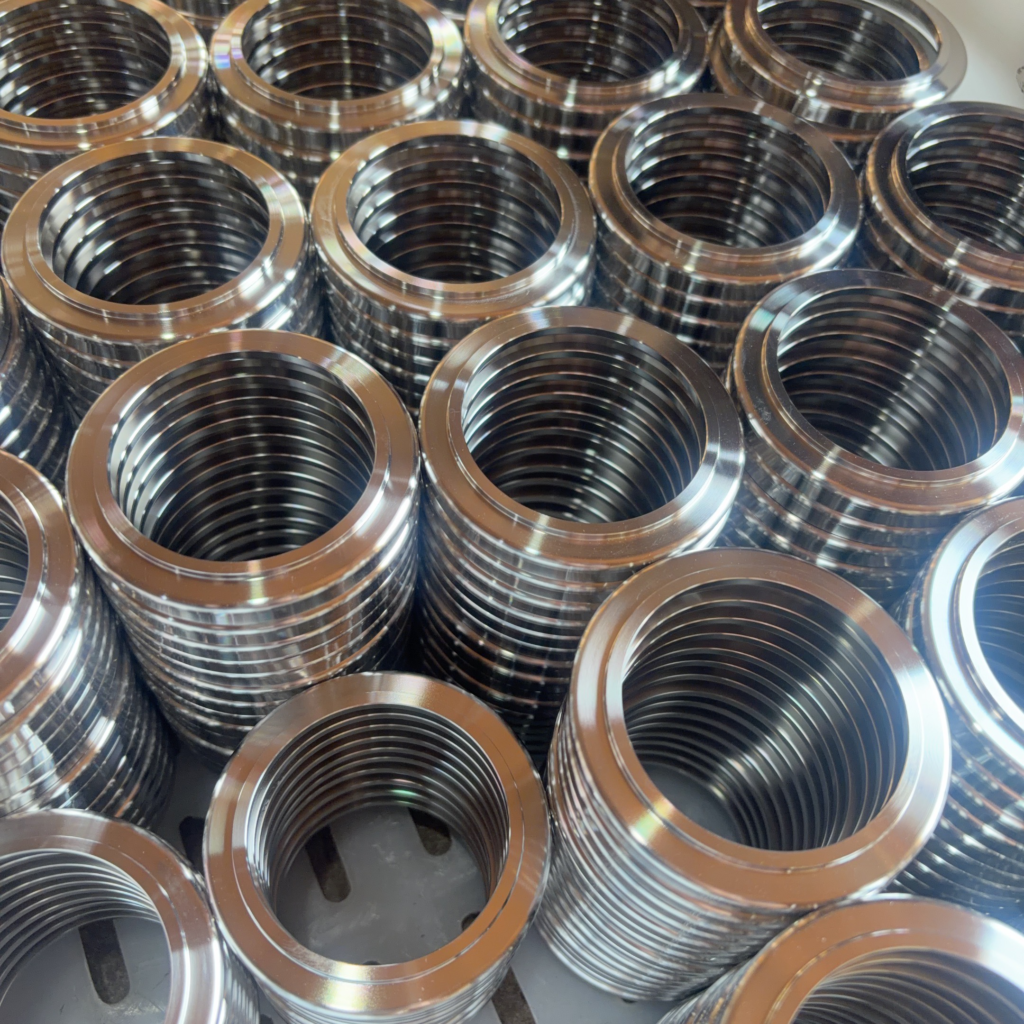
Tolerances: What Belongs on the Drawing
A tolerance is a cost instruction. Put ±0.01 mm on every dimension and you have asked for a slower process everywhere, including the three dimensions that do not matter. The table below shows a workable split between general and critical features.
| Feature | Typical callout | Notes |
|---|---|---|
| General dimensions | ISO 2768-m unless noted | Covers non-functional lengths, chamfers, and clearance features |
| Mating diameters | ±0.02 mm | Fit-critical bores and shafts; state the mating part tolerance too |
| Sealing faces and bores | ±0.01 mm plus flatness | O-ring grooves need depth and width control, not just diameter |
| Threads | Class 6H / 6g, or NPT / BSPP per standard | Gauged with Go/No-Go; thread class belongs in the note block |
| Surface finish | Ra 1.6 µm machined, Ra 0.8 µm sealing | Only call Ra 0.4 µm where a seal or sliding fit demands it |
| Concentricity / runout | 0.02–0.05 mm TIR | Needed on stepped shafts and bushings, not on spacers |
Two details are worth spelling out because they cause most of the back-and-forth. First, geometry tolerance (GD&T) without a datum reference is not inspectable — pick the functional face or diameter as datum A and build from there. Second, if a part is turned and then passivated, the finish can move the surface by a few microns; on a sealing bore, say whether the tolerance applies before or after finishing.
Stainless steel parts Surface Finish and Passivation
Machining leaves free iron and embedded tool debris on the surface. Left there, it becomes the starting point for pitting, especially in chloride service. Passivation removes that contamination and lets the chromium oxide layer re-form evenly, typically to ASTM A967. It is specified on the drawing, not negotiated later.
- Passivation: the baseline for machined stainless parts. Cheap, invisible, and the first thing a corrosion failure traces back to when it is missing.
- Electropolishing: removes surface material rather than contamination, improving Ra and cleanability. Common on medical and hygienic parts, and it changes dimensions slightly.
- Bead blasting: uniform matte finish and a way to hide machining marks; it can trap media, so specify cleaning after.
- Brushed or polished: appearance-driven, mostly on visible hardware.
Threaded stainless parts carry one extra risk: galling, where mating threads seize during assembly. It is a material and finish interaction rather than a tolerance error, and it is common enough that we keep a separate note on passivation and galling on stainless threads. If your assembly seizes on the line, the fix is usually a lubricant callout, a different grade pair, or a rolled thread rather than a tighter tolerance.
Inspection and Documents to Ask For
Inspection scope is a line item in the quote, so it has to be decided with the order. For most industrial buyers, four records cover the requirement.
- Material certificate to EN 10204 3.1, tied to the heat number actually used. A mill certificate for “304” without a heat number is not traceability.
- First article inspection report with every drawing dimension numbered and measured, including the ballooned drawing.
- Thread gauge record for each thread size in the batch, Go and No-Go, plus the gauge calibration date.
- Surface and functional test results where specified: salt spray hours, hardness, leak or proof pressure.
Spectrometer verification (PMI) closes a gap that certificates cannot: it confirms the bar in the machine is the alloy on the paperwork, which matters when 304 and 316 look identical on the shelf. On our floor the sequence is IQC on incoming bar, IPQC during machining, and FQC before packing, with the inspection record signed and shipped with the parts rather than filed and forgotten.
DFM Rules That Cut Cost on Stainless Parts
Stainless is less forgiving than aluminum, so a few millimetres of design change can remove a whole operation. These are the rules we apply when reviewing a drawing, expressed as numbers rather than adjectives.
- Wall thickness: keep 1.0 mm minimum, 1.5 mm preferred on turned parts. Thin walls vibrate, and vibration shows up as taper and chatter marks.
- Internal corners: radius at least equal to the tool radius plus 0.1 mm; 0.5 mm is a practical floor for milled pockets.
- Holes: 1.5 mm minimum drilled diameter; depth-to-diameter of 10:1 for through holes, 5:1 for blind holes before the cost steps up.
- Threads: standard sizes and 1.5× diameter engagement. A custom thread profile is a tooling purchase, not a note.
- Tolerance strategy: tight where it functions, general everywhere else. One ±0.01 mm diameter on a part with ±0.05 mm general tolerance is normal; ten of them is a different quote.
- Setups: features on one face cost less than features on four. Cross-holes that can be drilled in the same setup usually pay for themselves.
None of these rules changes what the part does. They change how many times it has to be fixtured, and that is where the cost lives.
Stainless Steel Applications: Which Grade Goes Where
| Industry | Usual grade | Why, and what to watch |
|---|---|---|
| Marine and offshore | 316 / 316L | Molybdenum resists chloride pitting. Watch crevice corrosion under washers and in blind threads. |
| Food and beverage | 304, 316L | Cleanable, non-porous surfaces. Electropolish where product contact is continuous. |
| Medical and laboratory | 316L, 17-4PH | Corrosion resistance plus cleanability; 17-4PH where strength or edge retention is needed. |
| Chemical processing | 316L, duplex on request | Media compatibility decides; passivation and weld quality decide service life. |
| Automotive and exhaust | 304, 409, 441 | Thermal cycling rather than corrosion is the driver; grade follows temperature, not appearance. |
| Semiconductor and vacuum | 316L, electropolished | Outgassing and surface finish matter more than strength; specify cleaning and packaging. |
If your part sits in more than one of these environments — a marine valve body with a food-grade seal, for example — write the harsher one as the requirement and let the other follow. Suppliers quote to the strictest callout on the drawing, so ambiguity only adds cost.
Sourcing Stainless Steel Parts: Ten Questions
Most sourcing problems are predictable, and they surface in the first call if you ask directly. These ten questions separate a machining factory from a reseller, and each one has a verifiable answer.
- Which grades do you machine in-house, and which do you buy finished?
- How many CNC machines run on your floor, and how many are turning versus milling?
- What tolerance do you hold on a production run, not on a sample?
- How do you verify incoming bar — certificate only, or certificate plus spectrometer check?
- Who gauges the threads, with what, and how often are the gauges calibrated?
- Can you supply a first article report with a ballooned drawing?
- Is passivation done in-house or subcontracted, and to which standard?
- What is your MOQ for a machined part, and what drives it — setup, material, or finishing?
- What is the sample lead time from an approved drawing, and the production lead time after that?
- If a revision lands mid-batch, how is the change recorded and what does it cost?
Two answers are worth treating as red flags. A supplier who cannot name the tolerance they hold in production is quoting from a brochure. A supplier who quotes a custom stainless part at catalog pricing with no setup line has either misunderstood the drawing or intends to subcontract it. Neither is necessarily dishonest, but both cost you a revision cycle.
For reference on what a factory-direct relationship looks like on our side, the OEM/ODM program page lists the workflow from drawing review to shipping, and the stainless steel pipe fittings category shows the part families we produce most often. A representative example of a turned part is this 303 stainless steel shaft machined to print; fasteners and pins sit under stainless fasteners.
Frequently Asked Questions
What is the difference between stainless steel parts and stainless steel components?
In practice, nothing. Both describe individual parts made from stainless steel. “Components” tends to appear in assembly contexts and “parts” in sourcing contexts, but buyers use them interchangeably, and suppliers quote them the same way.
Which stainless steel grade is easiest to machine?
303. Added sulfur breaks up chips and reduces tool wear, which is why it dominates high-volume turned parts. The trade-off is lower corrosion resistance and poor weldability, so it is a poor choice for welded or chloride-exposed assemblies.
Is 316 always better than 304 for stainless steel parts?
No. 316 resists chlorides better because of its molybdenum, but it machines slower and costs more. Choose 316 for marine, chemical, and washdown service; choose 304 for general industrial, food, and indoor applications where chlorides are not present.
What tolerance can machined stainless steel parts hold?
On CNC lathes and mills, ±0.01 mm is routine for critical diameters and ±0.02 mm for general features, with tighter callouts possible on selected features after review. The practical limit depends on part size, wall thickness, and how many features need that precision.
Do stainless steel parts need passivation after machining?
Yes, for any part exposed to corrosion, food contact, or chloride service. Machining embeds free iron in the surface, and passivation removes it so the chromium oxide layer can re-form. Specify the standard, usually ASTM A967, on the drawing.
Send Your Drawings for a Fast Quote
Yuhuan Xinghe Machinery Factory. machines stainless steel parts to customer drawings in Yuhuan, Zhejiang: turned shafts and pins, bushings, threaded fittings and adapters, fasteners, and valve or pump components, in 303, 304, 304L, 316, 316L, and 17-4PH. We run more than 60 CNC machines, hold ±0.01 mm on critical features, verify material by spectrometer, gauge every thread with Go/No-Go, and work to ISO 9001 with IQC, IPQC, and FQC records shipped with the order. Material certificates and MTR are available per heat lot.
Send STEP, IGES, CAD, or 2D PDF files with material, thread standard, finish, and quantity. Our engineers review manufacturability and reply with a quote within 24 hours. Samples typically run about 10 working days from an approved drawing, and production orders usually start around 2,000 pieces. Email :info@sspipefitting.com