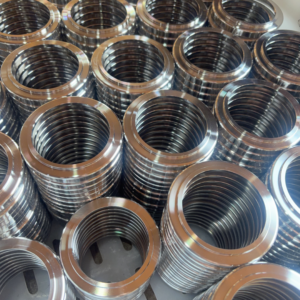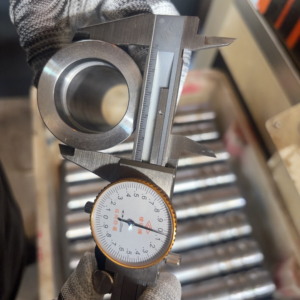
Quick Engineering Takeaway: Austenitic 304 stainless steel is non-magnetic in theory, but high shear stress during centerless grinding, turning, and thread cutting converts Face-Centered Cubic (FCC) austenite into ferromagnetic Body-Centered Tetragonal (BCT) strain-induced martensite. Electromagnetic demagnetizers cannot fix this crystallographic phase transformation. Reversing magnetism in SS 304 pipe fittings requires high-temperature solution annealing (1,010°C to 1,120°C) or upgrading the raw material to AISI 316L.
Why Machined SS 304 Pipe Fittings Become Magnetic
Stainless steel 304 (AISI 304 / 1.4301) is widely specified across fluid handling, semiconductor lines, food processing, and instrumentation assemblies for its corrosion resistance and mechanical strength. In engineering theory, austenitic stainless steel is classified as non-magnetic. However, in production reality, when precision CNC machining suppliers manufacture custom fittings—such as threaded hex nipples, male-to-female adapters, hose barbs, or sanitary connectors—customers are often surprised to discover that finished components attract a magnet, particularly around cut threads, sharp transitions, and chamfers.
A client recently commissioned a batch of custom SS 304 pipe fittings based on customer-supplied technical drawings. The dimensional inspection report, thread pitch tolerances, and surface roughness passed without issue. However, prior to final shipment release, the client added an unexpected specification: the finished parts must exhibit zero magnetic permeability.
Austenitic stainless steels rely on nickel (nominally 8.0% to 10.5%) to stabilize austenite, a Face-Centered Cubic (FCC) crystal structure. In a fully annealed, undisturbed thermodynamic state, the FCC lattice exhibits a relative magnetic permeability close to 1.0, meaning it is non-magnetic.
However, AISI 304 is a metastable austenitic alloy. When subjected to mechanical deformation or high shear stress below its recrystallization temperature, the FCC austenite matrix undergoes a physical phase transformation into Body-Centered Tetragonal (BCT) or Body-Centered Cubic (BCC) strain-induced martensite (alpha prime martensite). Martensite is ferromagnetic. Every mechanical operation in a machine shop contributes to this phase shift:
-
- Centerless Grinding (Bar Stock Preparation): Before raw bar stock feeds into bar feeders on CNC lathes, it passes through centerless grinders to achieve tight outer diameter tolerances (such as h7 or h9) and roundness. The grinding wheels impose localized compression, shear, and friction, creating a work-hardened, weakly magnetic boundary layer on the bar surface.
- CNC Turning and Parting: During precision turning, single-point cutting inserts induce severe plastic deformation along the primary and secondary shear zones. High chip loads and tool pressure cause localized strain-induced martensitic transformation directly beneath the machined surface.
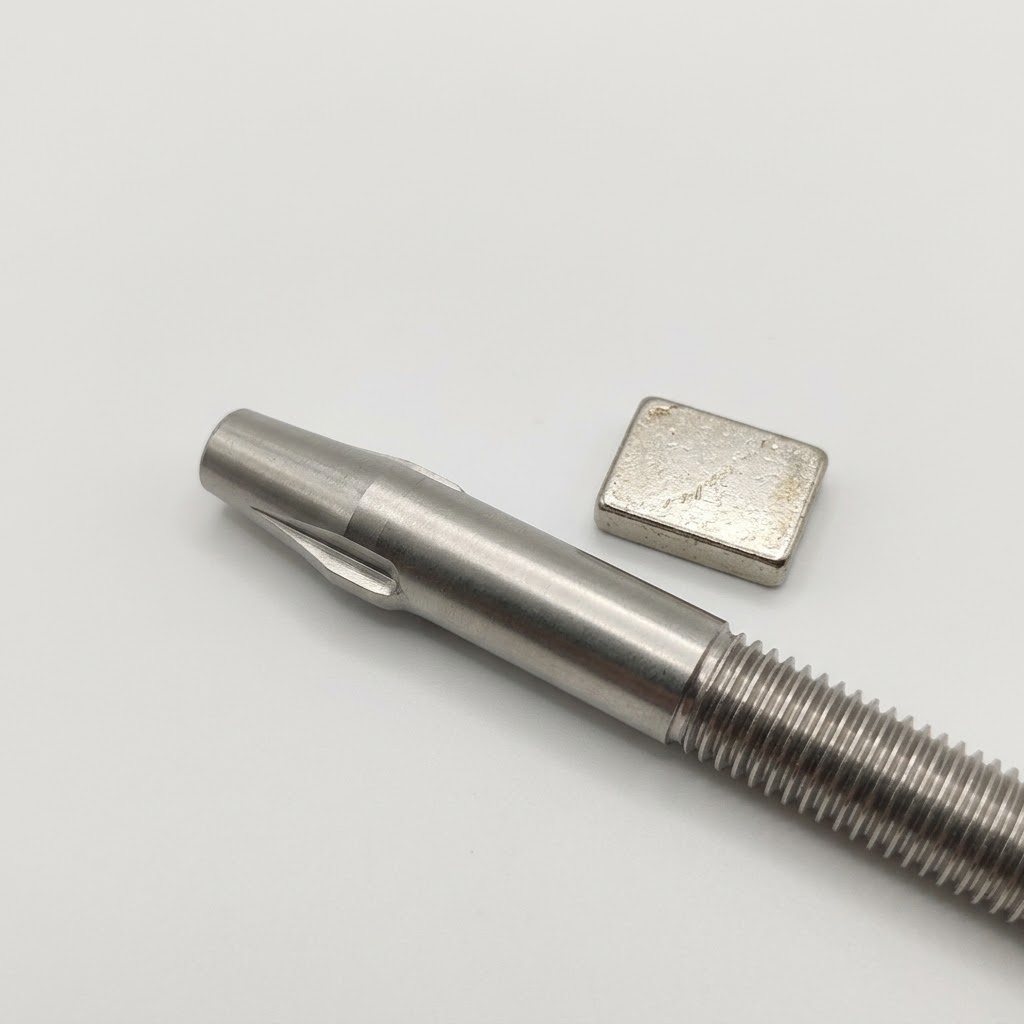
- Single-point threading and Thread Milling: The most concentrated magnetic response occurs along the thread crests and flanks. Thread-cutting inserts generate extreme localized friction and shear force within a compact geometry. Cold work concentration is highest at the thread profile, which is why a neodymium test magnet snaps firmly onto threads while showing negligible pull on the unmachined flats.
Even if certified non-magnetic, bright-drawn annealed bar stock is loaded into the spindle, the cutting action of turning inserts and threading tools converts microscopic surface regions of austenite into ferromagnetic martensite.
SS 304 Pipe Fittings Tests : Can Standard Demagnetizers Remove Stainless Magnetism?
When faced with residual magnetism on finished steel components, machinists commonly turn to an electromagnetic coil or tunnel demagnetizer (demag table). To evaluate this solution, our engineering team conducted an in-house verification test on finished custom SS 304 pipe fittings displaying magnetic pull around the threads:
| Test Parameter | Inspection Setting & Result |
|---|---|
| Test Subject | Custom CNC Turned SS 304 Threaded Pipe Fitting |
| Initial State | Pull force detected on thread flanks via Neodymium N52 magnet (Gauss reading: > 15 Gauss) |
| Equipment | Industrial AC Tunnel Demagnetizer (Variable decaying alternating magnetic field) |
| Procedure | Workpiece passed slowly through active coil at steady feed rate, repeated 3 cycles |
| Final Test Result | The magnetic pull remained unchanged. Field strength around threads did not drop. |
Why do demagnetizers work on carbon steel but fail on austenitic stainless?
-
- Carbon Steel and Alloy Tool Steels: Carbon steels feature a stable ferritic or martensitic structure. When magnetized by a chuck or magnetic inspection system, their magnetic domains become uniformly aligned. An AC demagnetizer applies a reversing, decreasing magnetic field that randomizes those magnetic domains, effectively neutralizing the net external magnetic field.
- Austenitic Stainless Steel (SS 304): The magnetism in machined SS 304 is not caused by aligned magnetic domains within a soft magnetic material. It is caused by a microstructural phase change. The crystal structure itself has physically converted from non-magnetic FCC austenite into permanent ferromagnetic BCT martensite.
An electromagnetic pulse cannot alter the crystallographic lattice of a metal. Passing machined 304 fittings through a demagnetizing coil is completely ineffective.
SS 304 Pipe Fittings Metallurgical Solution: How to Solve Magnetism with Solution Annealing
To eliminate magnetism from custom SS 304 fittings, the strain-induced martensite must be reversed into austenite. This requires thermal processing via high-temperature solution annealing.
-
- Soaking Temperature: Heat the parts to 1,010°C to 1,120°C (1,850°F to 2,050°F) in a vacuum or protective atmosphere furnace.
- Holding Time: Maintain temperature based on wall thickness (typically 30 to 60 minutes) to allow precipitated chromium carbides to fully dissolve back into solid solution and permit the BCT martensite lattice to recrystallize into FCC austenite.
- Rapid Quenching: Rapidly cool the components (water quench or rapid inert gas quench) through the sensitization zone (450°C to 850°C). Fast cooling prevents chromium carbide precipitation at grain boundaries, preserving both intergranular corrosion resistance and the fully non-magnetic FCC state.

The Surface Finish Trade-Off: Loss of Luster
While solution treatment fully eliminates magnetic pull, it changes the exterior appearance of the machined parts:
-
- As-Machined Finish: Sharp tool marks, bright metallic luster, low Ra values.
- Post-Annealing Finish: High-temperature exposure alters surface chemistry. Even with protective atmosphere or vacuum furnaces, the original mirror-bright CNC turned finish turns matte, slightly milky-white, and dull.
- Secondary Surface Correction: If high cosmetic shine is mandatory, parts must undergo secondary operations such as chemical pickling and passivation, electropolishing, or glass bead blasting to restore clean, uniform surface aesthetics.
SS 304 Pipe Fittings Engineering Comparison: Non-Magnetic Strategy Matrix
| Approach | Magnetic Elimination | Cosmetic Impact | Dimensional Stability | Practical Viability for Custom Fittings |
|---|---|---|---|---|
| AC Coil Demagnetizer | 0% (Fails) | None (Retains bright finish) | 100% Stable | Not viable; cannot reverse physical martensitic crystal structure. |
| Buying “Non-Magnetic” Raw Bar Stock | 0% Post-Machining | None | 100% Stable | Futile; mechanical cutting and grinding reintroduce martensite immediately. |
| High-Temperature Solution Annealing | 100% Effective | Surface turns matte/milky-white; requires re-passivation | Minor thermal relaxation risk on ultra-thin walls | The correct engineering standard for pure SS 304 non-magnetic requirements. |
| Material Substitution (SS 316L / Brass) | High (316L has higher Ni/Mo stability; Brass is fully non-magnetic) | Bright CNC finish preserved | 100% Stable | Recommended if budget, corrosion requirements, and design tolerances allow. |
Sourcing Checklist for SS 304 Pipe Fittings Projects
When placing manufacturing orders for custom fittings requiring low magnetic permeability, include these parameters in your initial Request for Quotation (RFQ):
-
- Specify Maximum Magnetic Permeability: Do not write “non-magnetic” on drawings. Specify measurable thresholds, such as relative permeability under 1.02 or an exact maximum Gauss reading using a calibrated magnetometer.
- Account for Secondary Annealing in Tolerancing: High-temperature cycles relieve internal stresses, which can cause micro-movement on thin-walled custom fittings, NPT/BSPT tapered threads, or tight concentricity limits.
- Approve Surface Finish Criteria: Confirm whether a matte, heat-treated passivation finish is acceptable, or whether secondary bead blasting or electropolishing is required.
- Evaluate Material Substitution Early: If thermal processing adds prohibitive lead time or cost, evaluate whether AISI 316L (which has higher nickel content and resists strain-induced martensite much better than 304) or naval brass satisfies the application.
Need technical support for custom thread standards, tight tolerances, or non-magnetic stainless fittings? Contact our engineering team for free CAD/STEP drawing evaluations and DFM feedback within 24 hours.
Frequently Asked Questions (FAQ)
Can we simply purchase certified non-magnetic SS 304 raw material to avoid this issue?
Yes, raw material mills can supply bright-annealed, non-magnetic SS 304 bars. However, this does not solve the problem. The moment those bars are ground on centerless machines, turned, cut, and single-point threaded in a CNC lathe, the localized cutting pressure transforms surface austenite into ferromagnetic martensite. Purchasing non-magnetic raw material is useless if aggressive subtractive machining follows.
Can an industrial demagnetizing machine demagnetize stainless steel?
No. Demagnetizers work by disorienting aligned magnetic domains in ferromagnetic materials like carbon steel and iron. In machined SS 304, magnetism is caused by a metallurgical phase transformation (austenite to martensite), not domain alignment. An electrical demagnetizer cannot change metal crystal structures; only thermal solution annealing can reverse martensite back to austenite.
Does strain-induced magnetism compromise the corrosion resistance of 304 fittings?
In mild industrial environments, the small amount of surface martensite generated by CNC machining has a negligible effect on general corrosion resistance. However, in aggressive chemical, high-chloride, or marine environments, strain-induced martensite slightly increases susceptibility to pitting and stress corrosion cracking (SCC). Proper solution annealing followed by chemical passivation restores maximum corrosion performance.
Why is 316L less magnetic than 304 after identical CNC machining?
AISI 316L contains higher levels of nickel (10.0% to 14.0%) and added molybdenum (2.0% to 3.0%). Nickel is a strong austenite stabilizer that significantly raises the alloy’s stacking-fault energy. This makes the austenitic crystal lattice much more stable under high shear loads, dramatically reducing the formation of strain-induced martensite during cold work and threading.
Partner with an Experienced Precision CNC Machining Supplier
Manufacturing high-performance custom fittings requires more than reading dimensions off a print—it demands a deep understanding of metal behavior under tooling pressure. Whether your assemblies call for strict magnetic permeability control, custom BSP/NPT/Metric thread geometries, or specialized post-machining passivation, working with a knowledgeable manufacturer prevents assembly delays.
Ready to scale your production with reliable, zero-defect pipe fittings and custom turned components? Send us your CAD/STEP drawings today for a rapid quote within 24 hours!