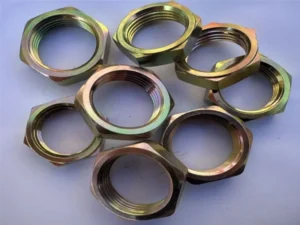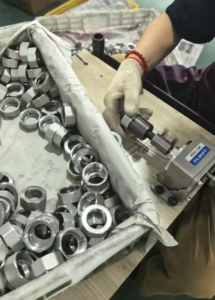
In international mechanical engineering blueprints and fluid component procurement, few specifications generate as much confusion as the overlap between SAE 1010 material, material S10C, and C1010. Overseas purchasing managers and mechanical designers regularly issue drawings specifying these designations interchangeably for components ranging from heavy-duty structural fasteners to fluid-handling components.
When manufacturing a custom carbon fitting—whether a high-pressure hose adapter, straight union, or hydraulic hex plug—material selection dictates both pressure integrity and production economics. Within the broader carbon steel pipe fitting market, global procurement standards have shifted from accepting loose commercial tolerances to demanding full raw material traceability, verified chemical composition, and zero-defect machining quality.
Behind these specifications lies a fundamental shop-floor reality: 1010-grade plain low-carbon steel offers supreme cold heading plasticity, but it is notoriously gummy and prone to chip tearing during single-point lathe operations.
Below is an authentic manufacturing perspective from our precision CNC machine shop detailing international equivalents, elemental chemistry, comparative steel grades, authentic product lines, and practical shop-floor routing for zero-defect production.
1. What is 1010 Grade Steel?
1010 grade steel is a standard, plain low-carbon structural steel characterized by a nominal carbon content of 0.10%. Because it contains minimal alloying additions, its physical and mechanical properties are governed entirely by its ferrite-pearlite matrix:
-
High Ductility & Elongation: Exhibits fracture elongation exceeding 20% to 28%, allowing extreme cold plastic deformation without internal micro-cracking.
-
Exceptional Weldability: The low carbon equivalent (CE) allows resistance, MIG, TIG, and friction welding without pre-heating or post-weld stress relief.
-
Moderate Tensile Strength & Soft Matrix: Features an ultimate tensile strength typically between 320 and 420 MPa, a yield strength around 180 to 220 MPa, and an as-rolled hardness generally below 130 HBW.
These core physical characteristics make 1010-grade steel the premier choice for cold-headed fasteners, automotive stampings, and high-volume fluid line components across the industrial carbon steel pipe fitting market.
2. 1010 Steel Equivalent: Global Material Cross-Reference Standards
Procurement teams sourcing globally often question whether regional European or Asian steels satisfy strict American or Japanese engineering calls. When a customer blueprint calls out 1010 steel equivalent grades, the following specifications are chemically and functionally interchangeable:
In commercial manufacturing, supplying mills provide an authenticated Material Test Report (MTR). Provided the chemical heat analysis and elongation boundaries align with the drawing’s parent standard, these designations serve as direct functional substitutes.
3. 1010 Steel Chemical Composition Breakdown
The hallmark of 1010 steel chemical composition is tight control over carbon and tramp impurities to maximize formability while sustaining baseline structural integrity:
| Element | Symbol | Standard Range (wt. %) | Shop-Floor Impact on Forming & Machining |
|---|---|---|---|
| Carbon | C | 0.08 – 0.13% | Keeps the ferrite matrix soft and ductile for cold heading, but causes severe chip stickiness and built-up edge during lathe turning. |
| Manganese | Mn | 0.30 – 0.60% | Deoxidizes during melting, refines grain boundaries, and increases tensile strength without lowering cold workability. |
| Phosphorus | P | ≤ 0.040% (JIS/GB ≤ 0.035%) | Maintained at strict minimums to prevent cold embrittlement during flaring, crimping, or deep extrusion. |
| Sulfur | S | ≤ 0.050% (JIS/GB ≤ 0.035%) | Kept low to eliminate hot cracking during forging and welding. The absence of added sulfur means it lacks free-machining chip breakage. |
| Silicon | Si | 0.15 – 0.35% (or ≤ 0.10%) | Deoxidizing agent used during steel melting to stabilize grain uniformity. |
| Iron | Fe | Balance (~99%) | Base iron matrix. |
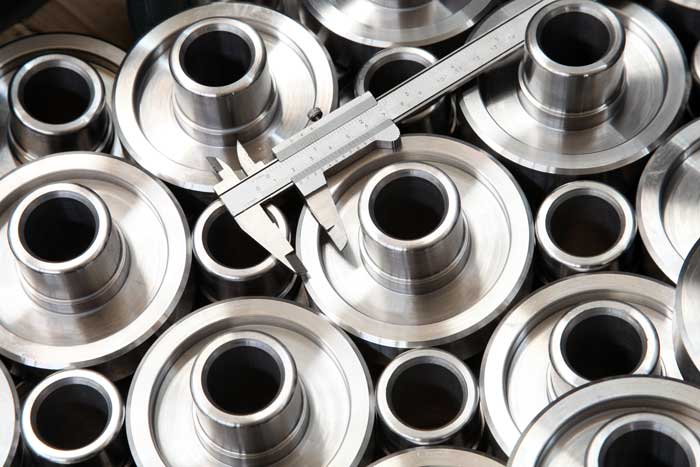
4. Critical Material Comparisons: 1010 vs. Similar Structural Steels
Designers frequently evaluate 1010 against nearby structural and plain carbon grades when balancing raw material availability and component strength.
What is the Difference Between 1008 and 1010 Steel?
The fundamental difference lies in carbon concentration and tensile yield:
-
1008 Steel: Carbon is capped lower (typically 0.06% to 0.08%, max 0.10%). It is exceptionally soft, displaying higher uniform elongation. It is used primarily for severe cold deep-drawing, stamped sheet brackets, and thin-gauge enclosures.
-
1010 Steel: Carbon ranges from 0.08% to 0.13%. This marginal addition increases shear resistance and yield strength, making 1010 far better suited for structural fasteners, bolts, and threaded fluid adapters that must withstand assembly torque without necking.
What are the Key Differences Between A36 and 1010 Steel?
While both are weldable low-carbon steels, their governing philosophies differ:
-
ASTM A36: A structural steel standard governed by mechanical performance rather than pure chemistry. It allows carbon up to 0.25% to 0.29% and guarantees a minimum yield point of 36 ksi (~250 MPa). It is primarily produced as hot-rolled plates, wide-flange beams, and structural channels.
-
SAE 1010: A precision chemical composition grade. Carbon is locked below 0.13%, delivering vastly superior cold malleability. While A36 is designed for welded bridges and building frames, 1010 is processed as cold-drawn bar and coiled wire for precision mechanical hardware and cold-formed components.
5. Typical Products Manufactured from SAE 1010 / S10C Steel
Leveraging cold deformation and targeted CNC secondary operations, our machine shop manufactures several high-volume product categories from SAE 1010 and S10C:
-
Cold Headed Fasteners: Standard and custom hex head bolts, carriage bolts, flange screws, and automotive wheel studs.
-
Threaded Nuts & Collars: Precision hex nuts, weld-on square nuts, hydraulic tube collars, and locking bushings.
-
Stamped & Machined Washers: Heavy-duty load-bearing flat washers, thrust washers, and automotive seal retainers.
-
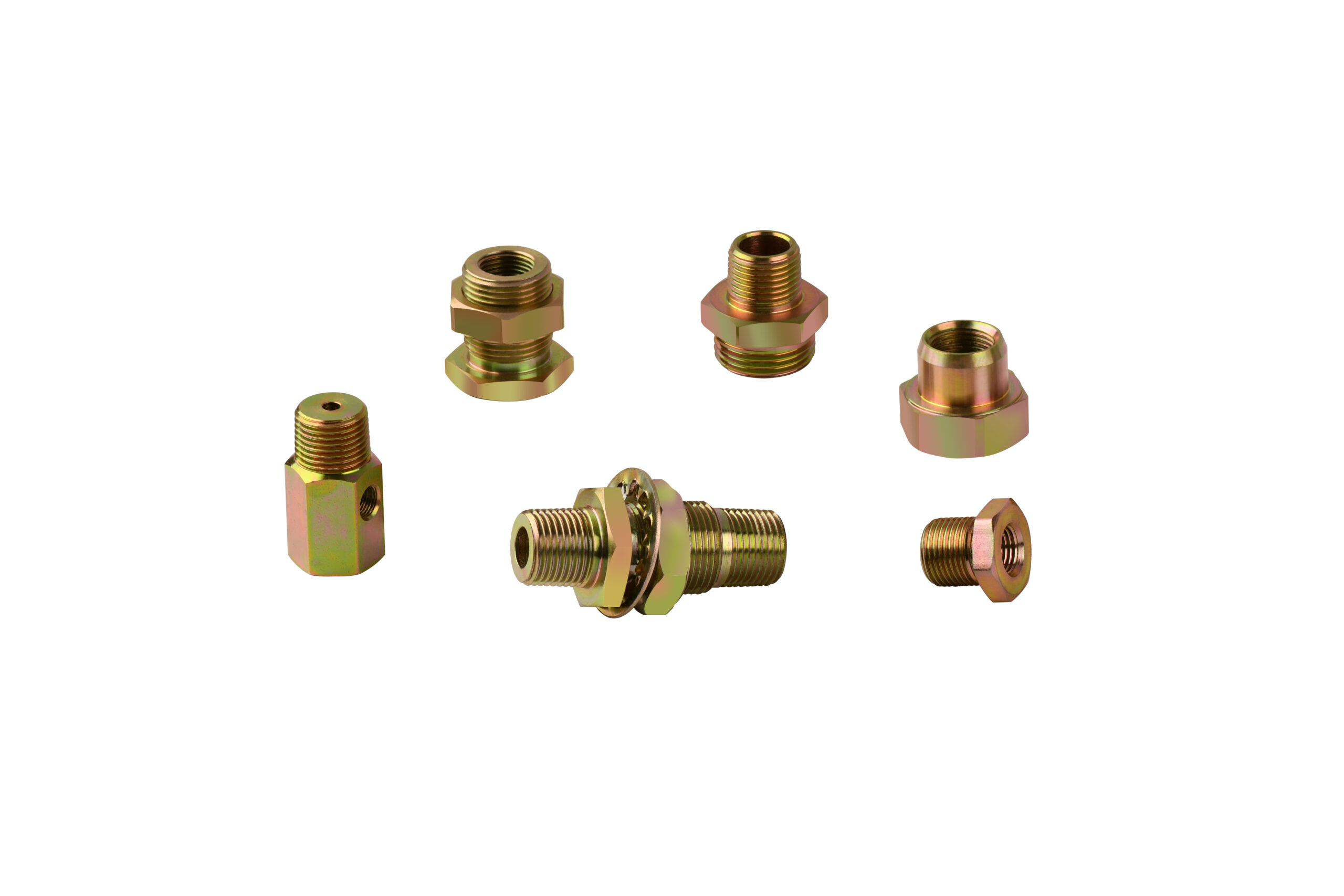
Small CNC Lathe Parts & Fittings: Precision-turned hose barbs, crimp nipples, pneumatic quick-disconnect plugs, and low-pressure carbon fitting adapters.
Figure 1: High-volume production samples of SAE 1010 / S10C components manufactured via cold heading combined with secondary CNC precision machining.
6. The Shop-Floor Reality: Why Machining SAE 1010 / S10C Threads Feels Gummy
Machinists across the precision turning industry share an unavoidable reality: cutting low-carbon steel like SAE 1010 or S10C on a CNC lathe feels like machining gummy rubber.
The Micro-Chip Trap in Single-Point Thread Turning
Because 1010 has high ductility and low shear hardness, it does not fracture cleanly at the tool shear zone:
-
Instead of curling and snapping into tight C-chips, the metal plastically smears, generating excessive friction that forms a Built-Up Edge (BUE) on carbide inserts.
-
During single-point external threading or boring-bar internal threading, torn micro-chips cold-weld themselves directly onto the thread flank or root.
-
This is an intrinsic physical characteristic of low-carbon plain steel, not operator error. These micro-fused fragments result in a rough, grating feel during assembly, preventing smooth hand engagement and failing visual quality audits.
[The Micro-Chip Phenomenon in 1010 Steel]
Soft Ferrite Matrix + High Tool Friction → Built-Up Edge (BUE) on Insert Tip
                                 ↓
Micro-Chips Tear Rather Than Shear → Metal Fragments Cold-Weld to Flanks
                                 ↓
Galling Feel During Thread Assembly / Thread Pitch Diameter Stalls
Tooling Compromises: Thread Rolling vs. Dedicated Tapping
To overcome this material barrier without compromising assembly precision, production setups must adapt:
-
External Threads (Thread Rolling Preferred): Single-point chase cutting should be replaced with high-speed thread rolling dies. Cold rolling displaces the steel plastically into thread crests rather than cutting it, burnishing the flanks to a mirror Ra 0.4–0.8 finish and entirely eliminating chip tear. However, engineers must account for the fact that thread rolling exhibits slightly different lead-in chamfer runout compared to single-point cutting.
-
Internal Threads (Dedicated Tapping): Rather than single-pointing internal threads on a lathe, shops must utilize dedicated cut or cold-forming taps with specialized surface coatings (such as TiCN or AlCrN) paired with high-pressure cutting oil to evacuate chips before they cold-weld to the internal root.
7. The Optimal Production Route: Cold Heading & Forging Combined with Secondary CNC
Understanding that 1010 is difficult to single-point turn directly reveals its true manufacturing strength: it is designed for cold forming.
Why 1010 Excels in Cold Heading Parts & Forging Parts
When manufactured via multi-station cold heading or closed-die forging, SAE 1010 transforms from a machining nuisance into a structural asset:
-
Continuous Grain Structure: Machining from solid bar severs longitudinal grain lines, creating shear vulnerability at hexagonal transitions and neck roots. Cold heading forces the metal’s crystalline grains to wrap seamlessly around part contours, boosting tensile shear resistance and burst ratings.
-
Elimination of Cutting Burrs: Cold heading forms heads, flanges, steps, and internal pilot cavities through high-pressure dies, avoiding the rough, torn surfaces caused by lathe roughing tools.
Small CNC Lathe Parts: Cold Headed Pre-Form + Secondary CNC Finishing
For high-volume components within the carbon steel pipe fitting market—such as straight hex adapters, hydraulic crimp sleeves, and fluid connectors—the optimal process blends both disciplines:
-
Station 1 (Cold Heading): Coil wire is cropped, upset, and extruded to form the outer hex, stepped diameters, and center bore cavity in fractions of a second.
-
Station 2 (Automated CNC Secondary Turning): Gantry-loaded CNC lathes finish the sealing chamfers (such as 37° JIC or 60° cone seats), cut critical O-ring retention grooves, and roll or tap precision threads.
This hybrid workflow delivers a 30% to 50% reduction in raw material scrap compared to hogging out fittings from solid hex bar, drops cycle times dramatically, and circumvents the internal chip-welding traps of low-carbon steel.
8. Surface Finishing and Anti-Corrosion Protection
Plain carbon steels lack chromium and nickel, meaning an unprotected carbon fitting or fastener will develop surface iron oxide within hours of exposure to high humidity. To guarantee field reliability, components undergo specialized surface passivation:
-
Trivalent Zinc Plating (Cr3+ Clear / Yellow): The industry standard for automotive hardware, structural fasteners, and commercial pipe fittings. Provides 72 to 120+ hours of neutral salt spray resistance against white rust while conforming to RoHS and REACH environmental mandates.
-
Electroless Nickel Plating (ENP): Recommended for fluid components operating in corrosive chemical washdowns or hydraulic return lines. ENP provides an ultra-uniform deposit across internal female threads and blind cavities, delivering exceptional wear resistance and hardness.
-
Black Oxide & Manganese Phosphating: A cost-effective anti-galling and cosmetic coating used primarily for internal engine hardware, heavy industrial nuts, and structural washers that operate submerged in oil or grease lubrication.
Frequently Asked Questions (FAQ)
What is the SAE 1010 steel equivalent in European and Japanese standards?
The direct Japanese equivalent is JIS G4051 S10C, and the direct European equivalent is EN 10083 C10E (Material Number 1.1121) or DIN C10. In Chinese manufacturing, it maps to GB/T 699 Grade 10 steel. All share nominal carbon contents near 0.10% and are functionally interchangeable under verified MTR mill certificates.
Can SAE 1010 steel be case hardened (carburized)?
Yes. While SAE 1010 cannot be through-hardened due to its low base carbon, it is an ideal candidate for case hardening (carburizing or carbonitriding). The process diffuses carbon into the outer skin (0.1 to 0.8 mm depth), achieving a hard, wear-resistant surface (upwards of 55–60 HRC) while preserving a soft, shock-absorbing ductile core.
Why is cold heading preferred over single-point CNC lathe turning for 1010 fasteners?
Cold heading eliminates the severe chip tearing inherent to cutting low-carbon steel, leaves unbroken grain flow lines for higher mechanical shear strength, produces zero chip waste in center cavities, and reduces piece cycle times from minutes on a lathe to fractions of a second in a cold-header.
Partner with a Seasoned Cold-Heading & Precision CNC Manufacturer
Navigating raw material equivalencies, managing tool stickiness, and scaling fluid components in the competitive carbon steel pipe fitting market requires more than theoretical handbook data. It requires a manufacturing partner with real floor discipline: one that knows when to cold-form, when to roll threads, and how to verify internal dimensions systematically before parts hit the dock.
Our facility pairs automated multi-station cold heading and gantry-loaded CNC turning centers with strict quality controls—including calibrated thread plug inspections, gauge wear tracking, and complete MTR material pedigree. Whether you are scaling high-volume custom bolts, heavy structural washers, or critical fluid carbon fitting assemblies, we deliver dimensional repeatability from the first piece to the 100,000th.
Need certified SAE 1010, S10C, or C10 components and precision CNC manufacturing?
Submit your 2D engineering drawings (PDF) and 3D models (STEP) to our engineering team today for an in-depth DFM review, blank forming evaluation, and production quotation.