In precision CNC turning and custom metal fabrication, stainless steel is widely favored for high-performance components, especially in
stainless steel pipe fitting manufacturing. Excellent corrosion resistance, high structural strength, and high-temperature tolerance make stainless steel the go-to material for high-pressure fluid systems, hydraulic connectors, and marine hardware.
However, for any CNC machining supplier or precision component manufacturer, processing stainless steel presents severe technical challenges.
| Property / Feature |
Austenitic Stainless Steel (304/316) |
Medium Carbon Steel (1045) |
Impact on Precision CNC Machining |
| Thermal Conductivity |
~15 W/m·K (Low) |
~45–50 W/m·K |
Heat concentrates at tool edge; causes thermal softening & crater wear |
| Thermal Expansion Coefficient |
~16–18 x 10^-6 / K |
~11–12 x 10^-6 / K |
Rapid workpiece expansion; makes ±0.02 mm thread tolerance difficult |
| Work Hardening Tendency |
Extreme (High Cr/Ni/Mn) |
Moderate |
Severe surface hardening; accelerates tool edge chipping |
| Machining Behavior & Chips |
Sticky, continuous long chips |
Stringy to broken chips |
High tendency for built-up edge (BUE); affects fitting surface finish (Ra 0.8 μm) |
Primary Reasons for Stainless Steel Machining Difficulty
High High-Temperature Strength & Severe Work Hardening
Stainless steel contains high proportions of chromium (Cr), nickel (Ni), and manganese (Mn). These alloying elements give the material superior high-temperature yield strength and high ductility. During heavy cutting, the severe plastic deformation induces intense strain hardening. Additionally, hard carbide precipitation during shear deformation accelerates abrasive tool wear.
Elevated Cutting Forces
Due to its high tensile strength and great elongation properties, shearing stainless steel during lathe turning or milling requires significantly higher cutting forces compared to standard carbon steel. This puts extreme mechanical stress on the cutting edge and tool geometries.
Strong Tendency for Material Adhesion (BUE)
Stainless steel exhibits high chemical affinity and sticky cutting characteristics. During high-speed turning, chip material readily fuses onto the tool rake face, forming a built-up edge (BUE). This non-uniform build-up degrades the surface roughness of machined stainless steel pipe fitting threads and sealing surfaces, often causing micro-chipping or flaking on the tool inserts.
High Coefficient of Thermal Expansion
The linear thermal expansion coefficient of austenitic stainless steel (such as 304 or 316) is roughly 1.5 times greater than that of medium carbon steel. Thermal energy generated during high-speed machining causes rapid linear expansion, which leads to localized workpiece distortion and makes tight dimensional tolerances (such as ISO thread fits and precision shoulder depths) difficult to maintain.
Low Thermal Conductivity
The thermal conductivity of stainless steel is only about 1/4 to 1/2 that of medium carbon steel. Heat generated at the tool-chip interface cannot dissipate through the workpiece or continuous chips effectively. Instead, intense localized thermal energy concentrates right at the cutting edge, leading to thermal softening, rapid crater wear, and shortened insert service life.
Manufacturing Solutions from Yuhuan Hongqian
Overcoming the inherent machining difficulties of stainless steel requires specialized tooling, optimized cutting speed and feed parameters, high-pressure coolant application, and deep metallurgical process expertise.
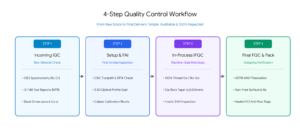
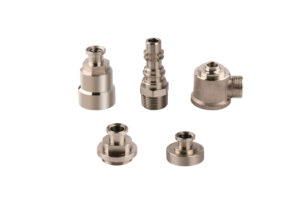
As an experienced precision CNC machining manufacturer and international supplier, Yuhuan Hongqian specializes in turning and milling high-grade stainless steel components, including custom stainless steel pipe fitting parts, hydraulic adapters, and precision turned hardware. By leveraging advanced tooling setups, automated systems, and strict quality control, Yuhuan Hongqian consistently meets demanding dimensional accuracy, thread tolerances, and smooth surface finish standards for global industrial applications.
Frequently Asked Questions (FAQ)
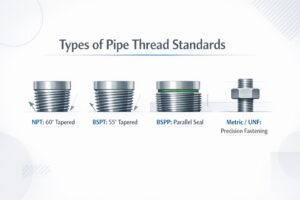
Q: How does Yuhuan Hongqian ensure precision thread tolerances on stainless steel pipe fittings? A: We combine specialized AlTiN-coated carbide inserts with high-pressure coolant delivered directly to the cutting zone, effectively managing thermal expansion and maintaining tight thread tolerances within ±0.02 mm across NPT, BSPP, and Metric profiles.
Q: Which stainless steel grade is best for custom pipe fittings: 304 or 316L? A: Grade 304 offers excellent cost-efficiency for standard hydraulic and fluid applications, while 316L contains molybdenum to provide superior corrosion resistance in severe chemical, marine, and offshore environments.
Q: How do you prevent built-up edge (BUE) during high-speed CNC turning? A: By optimizing cutting speeds, applying sharp positive-rake insert geometries, and maintaining high-flow coolant pressure, we eliminate chip adhesion and ensure surface roughness down to Ra 0.8 μm.
Partner with Yuhuan Hongqian for Precision Machining
Need high-precision stainless steel components with strict tolerances and flawless surface finish? Contact Yuhuan Hongqian today to discuss your project requirements or request an instant quotation for custom stainless steel pipe fittings.