When sourcing high-pressure pipe fittings, hydraulic adapters, and precision threaded plugs, selecting the right raw material is critical to balancing mechanical strength, machinability, and production costs. Among medium carbon steels, material 1045 steel (also referred to as AISI/SAE 1045, UNS G10450, or simply 1045steel) remains the global benchmark.
As a premier custom CNC pipe fitting supplier in China, Yuhuan Hongqian Machinery Co., Ltd. provides a detailed breakdown of 1045 steel properties, international equivalent grades, heat treatment behavior, and machining considerations for industrial pipe fitting manufacturing.
1. What Does AISI 1045 Steel Mean?
The designation 1045 steel follows the standard numbering system developed by the American Iron and Steel Institute (AISI) and the Society of Automotive Engineers (SAE), standardized under ASTM A29:
-
1: Indicates plain carbon steel.
-
0: Indicates no major alloying elements (non-alloyed).
-
45: Represents a nominal carbon content of 0.45% (ranging between 0.43% and 0.50%).
Within the ASTM A29 104X series, AISI 1045 is the most widely utilized grade, followed by AISI 1040. In fluid power and mechanical piping, 1045 material offers the tensile strength and toughness required for high-pressure applications where free-cutting steels (like 1215 or 12L14) or low-carbon steels fail to meet burst pressure requirements.
2. Why 1045 Medium Carbon Steel Can Be Hardened While Low-Carbon Steel Cannot
A common engineering question is why low-carbon steels (e.g., AISI 1018, 1215, Q235 with carbon content ≤ 0.20%) cannot be effectively hardened via standard through-hardening or quench-and-temper (Q&T) processes, while 1045 material achieves substantial strength gains.
The Metallurgical Mechanism
-
Martensitic Transformation & Lattice Distortion: Hardening requires heating the steel into the austenite phase and rapidly quenching it to trap carbon atoms inside the iron lattice, forming martensite. In 1045 steel, the ~0.45% carbon content creates significant body-centered tetragonal (BCT) lattice distortion and high dislocation density, increasing quenched hardness up to 50–55 HRC. In low-carbon steels (≤ 0.20% C), the lack of dissolved carbon generates minimal lattice distortion, resulting in soft lath martensite with negligible strength improvements.
-
Critical Cooling Velocity (CCT Curve): Low-carbon steels transform rapidly from austenite to soft ferrite/pearlite during cooling. Standard quenching media cannot cool low-carbon steel fast enough to bypass the pearlite transformation nose, making through-hardening impossible.
-
Piping Component Impact: Low-carbon fittings require carburizing (case hardening) to improve surface wear, but the core remains ductile and prone to yield failure under cyclic hydraulic pressure. 1045 steel material properties allow full through-hardening and tempering, delivering uniform tensile strength from surface to core.
3. 104X Chemical Composition & Global Equivalent Standards
Chemical Composition Comparison (ASTM A29 / SAE J403)
| Grade | Carbon (C) % | Manganese (Mn) % | Phosphorus (P) Max % | Sulfur (S) Max % | Silicon (Si) % |
| AISI 1040 | 0.37 – 0.44 | 0.60 – 0.90 | 0.040 | 0.050 | 0.15 – 0.35 |
| AISI 1045 | 0.43 – 0.50 | 0.60 – 0.90 | 0.040 | 0.050 | 0.15 – 0.35 |
| AISI 1050 | 0.48 – 0.55 | 0.60 – 0.90 | 0.040 | 0.050 | 0.15 – 0.35 |
AISI 1045 Equivalent Grades Chart: China 45#, EN C45, JIS S45C & BS EN8D
| Country / Standard | Specification | Equivalent Grade | Material / UNS No. | Technical Notes |
| United States (USA) | ASTM A29 / A108 | AISI / SAE 1045 | UNS G10450 | Standard North American specification |
| China (GB) | GB/T 699 | 45# (45 Steel) | – | High-grade carbon steel with tight S/P control (≤ 0.035%) |
| Europe (EN / DIN) | EN 10083-2 / DIN 17200 | C45 / C45E | 1.0503 / 1.1191 | C45E offers restricted sulfur limits for high purity |
| Japan (JIS) | JIS G4051 | S45C | – | Standard engineering grade across Asia-Pacific |
| United Kingdom (BS) | BS 970 | 080M46 / EN8D | – | Common in British engineering drawings |
Quality Verification Note: When substituting AISI 1045 with Chinese standard 45# or European C45, verify the chemical analysis via a formal Mill Test Certificate (EN 10204 3.1 MTC) to ensure full compliance with design parameters.
4. Key 1045 Steel Material Properties & Heat Treatment Parameters
The mechanical performance of material 1045 steel depends heavily on its heat treatment condition:
-
Normalizing (840°C – 880°C, Air Cool): Refines grain structure, relieves internal stress from hot rolling, and improves CNC chip breaking.
-
Annealing (800°C – 850°C, Furnace Cool): Softens the material down to ≤ 187 HB for deep boring or cold forming operations.
-
Quenching & High-Temperature Tempering (Q&T ): Quenched at 820°C – 860°C in water or oil, followed by tempering at 500°C – 650°C. This produces tempered sorbite, ensuring optimal yield strength and impact toughness.
Mechanical Properties Overview
| Condition | Tensile Strength Rm (MPa) | Yield Strength Re (MPa) | Elongation A5 (%) | Hardness (HB) |
| Hot Rolled / Normalized | ≥ 600 | ≥ 355 | ≥ 16 | 167 – 229 |
| Annealed | ~ 550 | ~ 300 | ≥ 20 | ≤ 187 |
| Quenched & Tempered (Q&T) | 700 – 850 | ≥ 490 | ≥ 14 | 200 – 260 |
5. Manufacturing Pipe Fittings with 1045 Steel
-
Raw Material Formats:
-
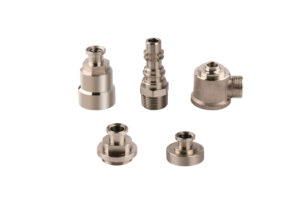
1045 Carbon Steel Bar Stock: Solid hexagonal or round 1045 carbon steel bar stock is ideal for high-precision CNC turned straight adapters, bulkhead fittings, and hex head plugs.
-
Hot Forging / Red Punching: For 90° elbows, tees, and cross fittings, hot forging aligns the metal grain flow along the fitting profile, providing higher burst pressure resistance than welded fabrications.
-
-
CNC Threading & Surface Finish:
-
Due to its moderate ductility, 1045 steel requires rigid tooling with specialized chip breakers and PVD/CVD wear-resistant coatings (such as AlTiCrN) to prevent chip buildup.
-
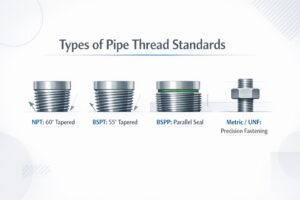
It produces clean, burr-free finishes on BSPP (ISO 228-1), BSPT (ISO 7-1), and NPT (ANSI/ASME B1.20.1) threads, achieving surface roughness values of Ra 1.6 μm to Ra 0.8 μm for reliable metal-to-metal or elastomeric sealing.
-
-
Corrosion Protection:
-
High-pressure 1045 steel fittings are standardly treated with Trivalent Zinc Plating (Cr3+ Clear / Yellow) to exceed 72h–96h Neutral Salt Spray (NSS) testing, or finished with Electroless Nickel Plating (ENP) or Black Oxide with Anti-Rust Oil for enclosed hydraulic circuits.
-
6. Frequently Asked Questions (FAQ)
Can Chinese 45# steel directly replace AISI 1045 for export fittings?
Yes. GB/T 699 45# steel has equivalent carbon content (0.42%–0.50%) and tensile strength (≥ 600 MPa). With an EN 10204 3.1 Mill Test Certificate verifying chemical composition and mechanical properties, it is fully interchangeable.
Why choose AISI 1045 over 1215 or 12L14 for pipe fittings?
While 1215 is optimized for high-speed machining, its lower yield strength makes it susceptible to thread stripping under high pressure. Medium carbon 1045 material offers higher tensile capacity and impact resistance for critical hydraulic systems.
What thread types can be precision-machined on 1045 carbon steel bar stock?
CNC lathe machining easily supports standard and custom thread profiles, including NPT, NPTF, BSPP (G), BSPT (R/Rc), Metric ISO (M), and SAE/UNF threads with position tolerances held within tight manufacturing limits.
Get Custom 1045 Steel Pipe Fittings from Yuhuan Hongqian Machinery
As an ISO-certified OEM/ODM pipe fitting supplier in China, Yuhuan Hongqian Machinery Co., Ltd. specializes in precision CNC machining and hot forging of custom AISI 1045, C45, and 45# steel fittings, BSP/NPT adapters, and hydraulic plugs.
-
Material Traceability: Full Mill Test Certificates (EN 10204 3.1 MTC) provided with every batch.
-
Machining Precision: Automated CNC turning and robotic multi-axis machining with dimensional tolerances within ±0.01 mm.
-
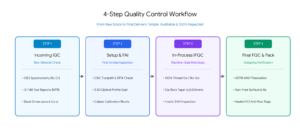
Quality Assurance: 100% thread gauge verification and optical projection testing before packaging.
Looking for a reliable manufacturing partner for medium carbon steel pipe fittings?