1. What is 1045 Steel?
AISI 1045 steel is a medium-carbon, unalloyed engineering steel standardized under ASTM A29 and SAE J403 specifications. With a nominal carbon content of 0.45%, it bridges the gap between ductile, low-strength mild steels (such as AISI 1018 or 1020) and high-hardness, brittle tool steels.
Decoding the AISI/SAE 1045 Designation
-
1: Plain carbon steel base (unalloyed).
-
0: Non-modified, indicating no major added alloying elements like chromium, nickel, or molybdenum.
-
45: Represents a nominal carbon content of 0.45% (chemically specified between 0.43% and 0.50%).
Metallurgical Classification: Hypoeutectoid Microstructure
Is AISI 1045 a hypoeutectoid or hypereutectoid steel? AISI 1045 is strictly a hypoeutectoid steel. Because its carbon concentration (0.43%–0.50%) sits well below the 0.77% eutectoid transition boundary on the iron-carbon (Fe-Fe3C) phase diagram, its room-temperature normalized structure consists of a balanced mix of proeutectoid ferrite (light, ductile phase) and lamellar pearlite (dark, high-strength phase). This microstructure delivers predictable chip shear during CNC turning while maintaining the bulk structural density needed to contain explosive internal pressures.
2. Key Industry Applications: Why Hydraulics & Automotive Rely on 1045
Plain low-carbon alloys and free-machining grades (like 1215 or 12L14) contain high sulfur/phosphorus inclusions, resulting in low shear limits and susceptibility to fatigue fracture. AISI 1045 delivers the structural density and core yield capacity required for critical fluid and mechanical assemblies:
Fluid Power & High-Pressure Hydraulic Systems
Widely specified for 3,000 to 6,000+ PSI hydraulic split-flange fittings, SAE J514 37° JIC adapters, DIN 2353 bite-type fittings, and manifold valve blocks subjected to violent pressure shocks.
Automotive Powertrain & Chassis Connections
Selected for diesel common-rail fuel adapters, transmission fluid connectors, steering tie-rod sleeves, and wheel hub components where cyclic vibration and road fatigue cause softer steels to loosen or micro-crack.
Heavy Equipment & Industrial Piping
Standardized across construction machinery and agricultural tractors for high-pressure threaded plugs (DIN 908, DIN 910, SAE O-ring boss plugs), forged branch outlets (weldolets, threadolets), and quick-disconnect hydraulic couplers.
3. AISI 1045 vs. Low-Carbon Steel (AISI 1020): The Heat Treatment Divide
Mechanical designers frequently ask why low-carbon steels (AISI 1020, 1018, Q235) cannot be through-hardened via quench-and-temper (Q&T) thermal cycles, while 1045 achieves significant mechanical gains.
Martensitic Transformation & Lattice Distortion
Hardening requires heating the steel into the single-phase austenite region and quenching it faster than the critical cooling rate. This traps interstitial carbon atoms inside the iron matrix, creating a supersaturated, distorted body-centered tetragonal (BCT) lattice known as martensite. In 1045 steel, ~0.45% carbon generates immense internal BCT strain and dislocation density, driving quenched hardness to 50–55 HRC. In low-carbon 1020 (carbon ≤ 0.20%), the lack of dissolved interstitial carbon causes almost no lattice distortion, producing soft, ductile lath martensite with negligible hardness improvement.
Continuous Cooling Transformation (CCT) Behavior
On a CCT diagram, 1020 features a pearlite transformation “nose” shifted far to the left. Even aggressive water quenching fails to bypass this nose in thick components, causing soft ferrite to precipitate before martensite can form.
Hydraulic Application Failure Analysis
Low-carbon steel (1020) can only achieve surface hardness via case carburizing. Under 350+ bar dynamic pressure spikes, the soft inner core suffers plastic yield creep. This causes internal port seat tapers to flare outward, leading to bore expansion, stripped threads, and O-ring extrusion blowout. In contrast, 1045 delivers uniform, wall-to-core structural yield integrity.
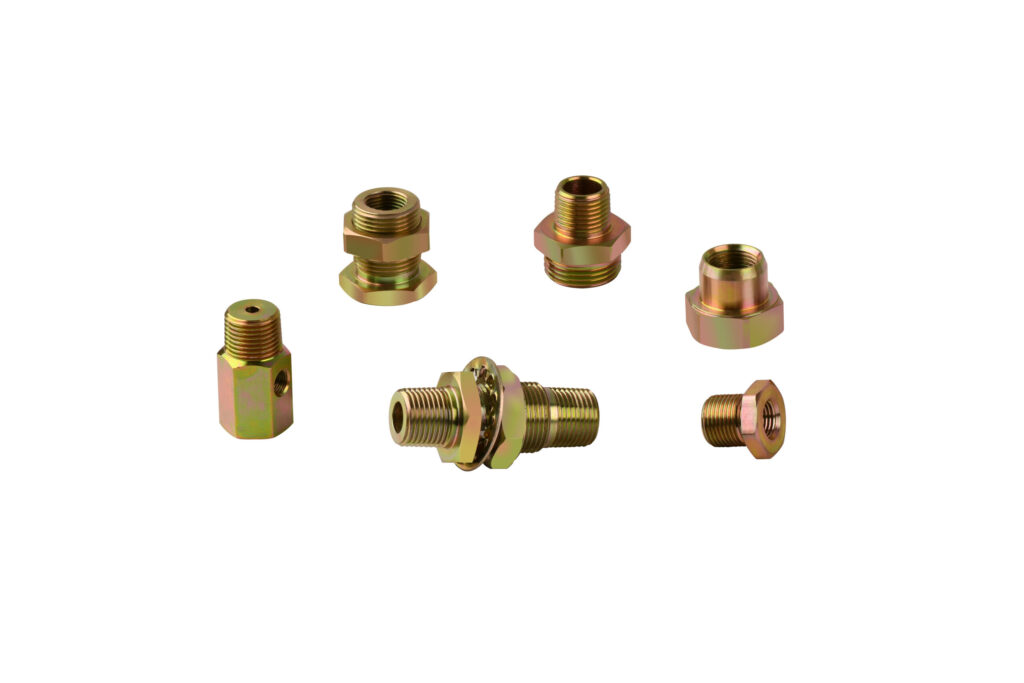
4. Chemical Composition & Global Equivalent Standards
ASTM A29 104X Series Chemical Breakdown
International Equivalent Grades Cross-Reference
Quality Verification Note: Global equivalent grades are chemically and mechanically interchangeable when verified via an authentic EN 10204 3.1 Mill Test Certificate (MTC) documenting spectral heat chemical analysis and mechanical retest data.
5. Heat Treatment Parameters & Mechanical Properties
The practical performance of AISI 1045 depends entirely on its processing condition:
Key Heat Treatment Regimes
-
Normalizing (840°C – 880°C, Air Cool): Refines coarse grain structures resulting from hot rolling, homogenizes internal hardness, and optimizes chip breaking for high-feed CNC turning.
-
Annealing (800°C – 850°C, Furnace Cool): Reduces hardness down to ≤ 187 HB to maximize ductility for deep-hole drilling, internal broaching, or complex cavity profiling.
-
Quenching & Tempering (Q&T): Austenitized at 820°C–860°C.
-
Hardenability & Quenching Alert: Plain 1045 possesses a shallow ruling section (~15–20 mm in oil). For threaded fluid fittings, direct aggressive water quenching introduces high quench-crack risks at sharp internal thread roots. Conversely, standard mineral oil may yield incomplete core hardening across thick wall sections. Specialized polymer (PAG) quenchant or interrupted quenching (water quench followed by rapid oil transfer) is standard practice.
-
Tempering: Soaked at 500°C–650°C to transform brittle martensite into tempered sorbite, ensuring optimal yield limits and impact notch toughness.
-
Mechanical Properties Across Processing Conditions
6. Manufacturing Precision 1045 Fittings: Blank Selection, Machining & Plating
Raw Blank Selection & Grain Flow Optimization
-
Solid Cold-Drawn / Turned Bars: Hexagonal and round solid bars are suited for direct high-speed CNC turning of straight male/female adapters, bulkhead couplings, and threaded hex-head plugs.
-
Hot Forging / Red Punching: For 90° elbows, tees, and cross blocks, hot forging aligns internal metal grain flow along the geometric contours of the fitting body. This directional flow eliminates internal porosity and elevates burst safety factors over multi-piece welded joints.
CNC Threading, Internal Porting & Leak Prevention
In high-pressure fluid circuits, the primary failure modes are thread stripping and internal seat bypass leakage:
-
Tooling Dynamics: Rigid setups utilizing PVD AlTiCrN nano-coated carbide inserts provide the thermal barrier required to resist built-up edge (BUE) and flank wear during high-speed threading.
-
Controlling Internal Seat Taper: Dedicated micro-boring tooling eliminates taper along internal sealing ports, providing 100% surface contact for elastomeric O-rings or 24° cone seats (DIN 2353).
-
Surface Roughness: Thread flanks and sealing chamfers are machined to Ra 1.6 μm – Ra 0.8 μm, preventing micro-grooves that act as hydraulic leak paths under dynamic impulse cycles.
Welding Precautions (Contrast with 1020)
Because 1045 has a higher carbon equivalent (CE ≈ 0.50%–0.65%), rapid heat dissipation into the surrounding mass generates brittle untempered martensite in the Heat-Affected Zone (HAZ). When welding 1045 components into pipelines:
-
Preheat: Maintain a localized preheat temperature of 200°C to 300°C.
-
Consumables: Use low-hydrogen electrodes (such as AWS E7018 or E8018).
-
Post-Weld Heat Treatment (PWHT): Apply a stress-relief soak at 550°C to 650°C followed by controlled cooling to temper the HAZ and relieve residual thermal stresses.
Corrosion Protection Protocols
-
Automotive & Fluid Power Standard: Trivalent Zinc Plating (Cr3+ Clear or Yellow) consistently exceeding 72 to 96 hours of Neutral Salt Spray (NSS) testing before the emergence of white rust.
-
Heavy Chemical & Wear Duty: Electroless Nickel Plating (ENP) for abrasive, corrosive fluid channels, or Black Oxide with rust-inhibiting oils for enclosed transmission sumps.
7. Engineering Selection Guide: When to Choose 1045 vs. 1020
When to Select AISI 1020
Parts require direct in-situ welding without preheating, severe cold swaging/flaring, low-pressure pneumatic venting, or non-critical structural brackets where raw material cost dominates.
When to Select AISI 1045
Components face high-cycle dynamic fluid shocks (>250 bar / 3,600 PSI), require tight bolt torque without thread stripping, resist fluid cavity erosion, or mandate through-hardened core yield performance.
8. Frequently Asked Questions (FAQ)
Is AISI 1045 considered a hypoeutectoid or hypereutectoid steel?
AISI 1045 is a hypoeutectoid steel. Its nominal 0.45% carbon content is below the 0.77% eutectoid transition line on the iron-carbon equilibrium phase diagram.
Can Chinese 45# steel directly replace AISI 1045 for exported pipe fittings?
Yes. Chinese GB/T 699 45# steel shares identical carbon limits (0.42%–0.50%) and equivalent tensile properties (≥ 600 MPa normalized). Cross-border interchangeability is verified when accompanied by an authentic EN 10204 3.1 Mill Test Certificate (MTC).
Why avoid free-cutting steel 1215 in critical high-pressure hydraulic connections?
Free-cutting steels contain intentional sulfur and phosphorus additives that form manganese sulfide (MnS) stringers. While these aid high-speed chip breaking, they act as internal stress risers, significantly reducing impact toughness and causing sudden thread shear or rupture under cyclic pressure spikes exceeding 3,000 PSI.
Can AISI 1045 fittings be welded into hydraulic lines without preheating?
No. Due to its medium carbon content, direct ambient welding produces rapid self-quenching across the weld interface, forming brittle untempered martensite in the heat-affected zone. Preheating to 200°C–300°C is required to prevent catastrophic fatigue cracking.
9. Custom 1045 CNC Machined Fittings & Automotive Solutions
Are you seeking a reliable manufacturing partner for custom hydraulic adapters, metric threaded plugs, or high-pressure CNC components?
Yuhuan Hongqian Machinery Co., Ltd. operates an advanced OEM/ODM manufacturing facility in China, delivering precision metal solutions certified to fluid power and automotive engineering benchmarks:
Manufacturing Capabilities & Quality Assurance
-
Production Capacity: 1,500 m² workshop running 70+ high-precision CNC lathe centers, multi-axis turning machines, vibratory bowl feeders, and automated gantry robotic loading systems producing over 200,000 pieces per month.
-
Tight Tolerances: High-speed turning, bore micro-sizing, and thread chasing consistently held within tight engineering limits of ±0.01 mm, maintaining Ra 0.8 μm sealing faces.
-
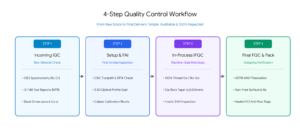
Full Quality Control: Strict 100% thread ring/plug gauge validation, internal groove dial measurement, 2.5D optical profile projection, and lot-traceable EN 10204 3.1 MTCs.
-
Export Packaging: Individually sealed vapor-barrier plastic packaging prevents atmospheric moisture and packaging acid contamination during ocean container transit.
Request an Engineering Review & Quote
Submit your technical drawings (PDF, STEP, DWG) or RFQ requirements to our engineering team:
-
Rapid DFM review and competitive quotation within 24 hours.
-
Fast-turnaround precision prototypes delivered in 7 to 10 days.
-
Zero-leakage fluid sealing compliance backed by comprehensive dimensional and material inspection data.