In the precision manufacturing of custom fasteners and industrial components—like specialized carbon steel fittings, threaded connectors, and custom hardware—controlling production costs without sacrificing quality is essential. For components like the thumb screw featuring a large straight knurled head and a smaller threaded shank, traditional bar stock machining often creates massive material waste and slow cycle times.
This case study breaks down how transitioning a thumb screw project from low-volume CNC turning to high-volume cold heading slashes unit processing costs by 94% and boosts daily output by 20x.
1. Structural Features and Machining Challenges
-
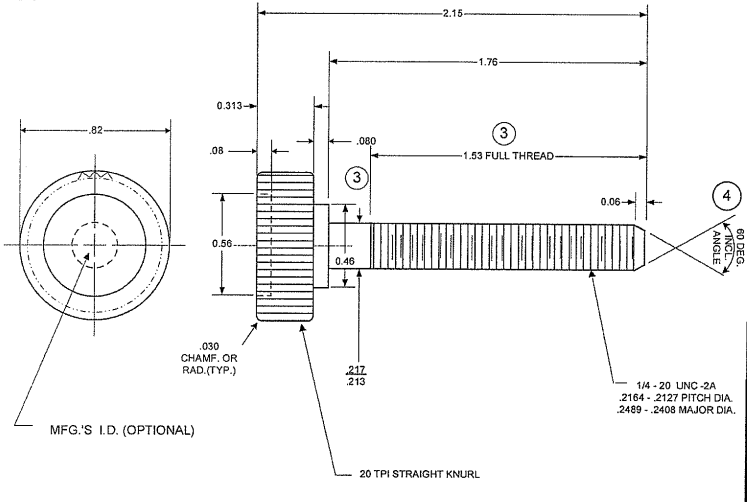
Large Straight Knurled Head: Designed with a 0.82-inch outer diameter and a 20 TPI straight knurl for easy manual tightening without external tools.
-
Precision Shank & Threads: Features a 1/4-20 UNC-2A thread, requiring a strict pre-thread blank diameter of approximately 5.4 mm (0.21 inches).
-
Large Step Ratio: The drastic diameter difference between the head and shank means traditional turning generates heavy metal chips, driving up material costs similarly to heavily machined fittings carbon steel parts.
2.Precision Thread Engineering: 1/4-20 UNC-2A Control
The thumb screw features an ASME B1.1 standard 1/4-20 UNC-2A thread (0.250-inch nominal OD, 20 TPI coarse pitch), delivering high shear strength and anti-galling durability for repeated hand-tightening. The Class 2A tolerance provides a designated allowance that ensures smooth engagement while accommodating post-plate coatings (like zinc plating or black oxide) without binding. During cold thread rolling, holding the pre-thread blank diameter strictly within 5.40–5.50 mm (0.213–0.217 in) is vital to form continuous grain lines, which we verify using calibrated ASME B1.2 Go/No-Go ring gages to guarantee 100% field interchangeability.
3.Manufacturing Route Comparison: CNC machinery vs. Cold Heading
Low-Volume Mode: CNC Bar Stock Machining
-
Raw Material: Uses 20.6 mm drawn bar stock.
-
Process Flow: Raw material cutting → CNC turning (removing excess material) → Head straight knurling → Thread rolling.
-
Knurling Expansion: During head knurling, the outer diameter expands by 0.10 mm to 0.20 mm (10–20um).
-
Output & Cost: Daily output is approximately 500 pcs/day, with labor/processing costs around $0.077 USD/pc.
High-Volume Mode: Cold Heading + Thread Rolling
-
Process Flow: Wire rod feeds directly into a multi-station cold heading machine to form the knurled head and the 5.4 mm pre-thread shank in a single pass → Feeding directly into a thread rolling machine.
-
Material Efficiency: Near-net shape forming means the same raw material weight produces far more blank parts compared to standard carbon steel pipe fittings produced via turning.
-
Output & Cost: Utilizing custom cold heading tooling scales output to 10,000 pcs/day, dropping labor/processing costs down to $0.0046 USD/pc.
4. Cost & Efficiency Comparison Table
| Metric | Low-Volume (CNC Machining) | Mass Production (Cold Heading) | ROI & Business Impact |
| Raw Material | 20.6 mm Bar Stock | Wire Rod | Higher yield per kg of material |
| Daily Output | ~500 pcs/day | ~10,000 pcs/day | 20x Production Capacity |
| Labor/Processing Cost | $0.077 USD/pc | $0.0046 USD/pc | 94% Cost Reduction |
| Cycle Time | Multi-step turning (Slow) | Single-pass heading (Seconds) | Drastically shortened lead time |
5. Frequently Asked Questions (FAQ)
Q1: Why not use cold heading for small-batch thumb screw orders?
Cold heading requires dedicated tooling. For small orders of a few hundred pieces, the upfront tooling cost outweighs the per-part savings. CNC bar stock machining remains the best choice for prototyping and low MOQs.
Q2: How does knurling affect the final head diameter?
Knurling displaces metal through pressure, typically swelling the head outer diameter by 0.10 mm to 0.20 mm. Machining blank diameters and cold heading die dimensions must account for this expansion.
Q3: Does cold heading work for other industrial parts like carbon steel fittings?
Yes. Cold heading and cold forging are widely used for high-volume carbon steel fittings, bolts, and custom fasteners because they improve grain structure, increase mechanical strength, and minimize material scrap.
6. Get Your Custom Manufacturing Quote (Call to Action)
Looking for reliable, cost-effective manufacturing for your thumb screw orders or precision carbon steel pipe fittings?
Whether you need fast-turnaround prototyping via CNC machining or mass-production cost optimization through cold heading, our engineering team delivers tailored DFM analysis and scalable production support.