-
-
-
What Is S235JRH Steel?
-
S235JRH is a non-alloy structural steel grade commonly used for hollow sections, tubes, and structural applications. It is specified under the European steel standard EN 10219, which covers cold-formed welded structural hollow sections.
The designation can be understood as follows:
- S – Structural steel
- 235 – Minimum yield strength of approximately 235 MPa for the relevant thickness range
- J – Impact toughness requirement
- R – Impact test at room temperature (20°C)
- H – Hollow section
S235JRH is known for its good weldability, machinability, and balanced mechanical properties, making it suitable for applications where moderate strength and reliable fabrication performance are required.
For pipe and fitting manufacturers, S235JRH can be used for custom steel components, structural pipe parts, and certain carbon steel fitting applications. At Yuhuan Hongqian Machinery, we work with customers who require customized steel fitting components manufactured according to their drawings and specifications. These projects may involve CNC turning, threading, drilling, chamfering, and surface treatment to meet specific dimensional and application requirements. The final material selection depends on the customer’s design, applicable standards, pressure requirements, and end use.
It is important to distinguish S235JRH from S235JR. Although both grades have similar yield-strength levels, S235JR is a general structural steel grade, while the “H” designation in S235JRH specifically relates to hollow sections.
For custom S235JRH components, the final material selection should be confirmed according to the required EN standard, dimensions, mechanical properties, welding requirements, and application conditions.
-
S235JRH Steel Grade and Standard
- S235JRH is a European structural steel grade specified for cold-formed welded hollow sections under EN 10219-1. The standard defines the technical delivery conditions for structural hollow sections made from non-alloy and fine-grain steels.The designation S235JRH provides information about the material and its intended application. “S” refers to structural steel, while “235” indicates a nominal minimum yield strength of 235 MPa for relevant thickness ranges. “JR” refers to the impact toughness requirement at room temperature, and “H” indicates a hollow section.S235JRH offers a good balance of strength, weldability, and fabrication performance, making it suitable for various structural and tubular applications.
-
Chemical Composition of S235JRH
- The chemical composition of S235JRH is controlled to provide a good balance of strength, weldability, and fabrication performance. The main elements include carbon, manganese, silicon, phosphorus, sulfur, and nitrogen.
Element Typical/Specified Content Carbon (C) ≤ 0.20% Silicon (Si) ≤ 0.04% Manganese (Mn) ≤ 1.40% Phosphorus (P) ≤ 0.035% Sulfur (S) ≤ 0.035% Nitrogen (N) ≤ 0.009% The relatively controlled carbon content contributes to the good weldability of S235JRH, while manganese helps provide the required mechanical strength. The limits on phosphorus and sulfur help maintain the steel’s overall quality and fabrication performance.For custom steel pipe components and fittings, the actual chemical composition should always be verified against the material certificate and the applicable EN standard, rather than relying only on general reference values.At Yuhuan Hongqian Machinery, we can manufacture customized carbon steel components according to customer drawings and material requirements. For projects requiring S235JRH or other specified steel grades, material requirements can be confirmed before machining and production.
-
Mechanical Properties of S235JRH
S235JRH provides a good combination of strength, ductility, and weldability, making it suitable for structural hollow sections and various tubular applications. Its mechanical properties may vary depending on the product thickness and applicable delivery condition.
Property S235JRH Yield Strength (ReH) ≥ 235 MPa* Tensile Strength (Rm) 360–510 MPa Elongation (A) ≥ 26%* Impact Energy ≥ 27 J at 20°C * The minimum yield strength and elongation can vary according to the material thickness. For specific projects, the values should be confirmed against the applicable EN 10219-1 requirements and the material certificate.
The relatively moderate strength of S235JRH makes it easier to form, weld, and machine compared with higher-strength structural steels. This makes it a practical choice for applications where extremely high strength is not required but reliable fabrication and dimensional performance are important.
For custom steel components and pipe fitting parts, Yuhuan Hongqian Machinery can manufacture products according to customer drawings, material specifications, dimensional tolerances, and machining requirements. For each project, the required material grade and mechanical properties can be confirmed before production.
-
S235JRH vs S235JR
S235JRH and S235JR are closely related European structural steel grades, but they are specified for different product applications and standards.
S235JRH is associated with structural hollow sections and is commonly specified under EN 10219-1 for cold-formed welded hollow sections. The “H” in the designation indicates Hollow Section.
S235JR, on the other hand, is a general non-alloy structural steel grade specified under EN 10025-2 and is commonly used for structural plates, sections, bars, and other steel products.
Feature S235JRH S235JR Steel type Non-alloy structural steel Non-alloy structural steel Main application Hollow sections General structural products Common standard EN 10219-1 EN 10025-2 Nominal yield strength 235 MPa class 235 MPa class Impact toughness 27 J at +20°C 27 J at +20°C Typical products Hollow sections and tubular products Plates, bars, sections and other structural products Although both grades belong to the S235 family, they should not automatically be treated as interchangeable. The applicable product standard, manufacturing route, dimensions, mechanical requirements, and customer’s specifications should always be checked before material substitution.
Can S235JRH Be Used for Pipe Fittings?
S235JRH is primarily associated with structural hollow sections, rather than being a universal pressure-piping or pipe-fitting material. Whether it is suitable for a particular fitting depends on the product design, manufacturing process, applicable standard, and end-use requirements.
For custom steel components and fitting parts, customers may specify S235JRH when the application requires a combination of moderate strength, weldability, and machinability.
At Yuhuan Hongqian Machinery, customers can provide drawings, material specifications, thread requirements, dimensions, and surface treatment requirements. We can review these specifications and determine the appropriate manufacturing process before production.
For applications involving pressure, fluid transportation, or safety-critical systems, the material should be selected according to the applicable piping or fitting standard and the customer’s engineering requirements, rather than selecting S235JRH based only on its strength grade.
Common S235JRH Pipe Fitting Applications
S235JRH can be considered for customized tubular and structural components where the material requirements are compatible with its properties and the applicable product standard.
Depending on the design and application, potential components may include:
- Custom steel connectors
- Tubular connectors
- Structural pipe components
- Steel sleeves and bushings
- Machined coupling components
- Threaded steel components
- Custom brackets and connection parts
- Other CNC-machined steel components
For Yuhuan Hongqian, the more important factor is not simply the material name, but whether the customer’s drawing, dimensions, threads, tolerances, and application requirements can be achieved through the selected manufacturing process.
This makes S235JRH-related projects suitable for a custom manufacturing approach, especially when customers need components produced according to their own drawings rather than standard off-the-shelf fittings.
Machining S235JRH Steel Pipe Fittings
S235JRH is a popular standard material for CNC machining. However, if your components require higher strength and durability, medium-carbon steel, high-carbon steel, or alloy steel would be a much better choice.
For customized fitting components, common cnc machinery processes include:
- CNC turning
- Threading
- Drilling
- Boring
- Grooving
- Chamfering
- Facing
- Tapping
- Deburring
-
-
-
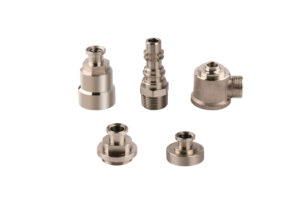
At Yuhuan Hongqian Machinery, we manufacture customized steel components according to customer drawings and specifications. Depending on the part design, CNC turning can be combined with drilling, threading, tapping, and other secondary operations to achieve the required dimensions and tolerances.
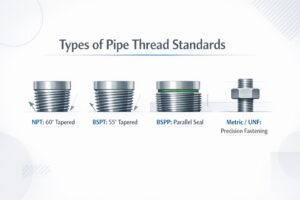
For threaded fitting components, particular attention should be paid to thread type, thread depth, pitch, dimensional tolerance, and gauge inspection. Common customer requirements may include metric threads, NPT, BSP, BSPT, BSPP, UN, and UNF threads.
The machining process should always be selected according to the actual material condition, part geometry, batch quantity, dimensional requirements, and final application.
Surface Treatment Options
After machining, S235JRH components may require surface treatment to improve corrosion resistance, appearance, wear resistance, or service life.
The appropriate treatment depends on the application, environmental conditions, dimensional requirements, and customer’s specifications.
Zinc Plating
Zinc plating is a common surface treatment for carbon steel components. It provides a protective zinc layer that helps reduce corrosion and is widely used for steel fittings, fasteners, connectors, and machined components.
Different zinc plating systems and finishes can be selected according to the required corrosion resistance and appearance.
For threaded fittings, coating thickness should also be considered because excessive coating can affect thread dimensions and assembly performance.
Galvanizing
Galvanizing provides a zinc coating for steel products and is commonly selected when stronger corrosion protection is required, particularly in outdoor or humid environments.
Hot-dip galvanizing is generally more suitable for larger structural steel components and fabricated products than for small precision-machined fittings.
For precision components, the galvanizing process should be evaluated carefully because coating thickness can affect dimensions, threads, and tolerances.
Black Oxide
Black oxide creates a thin black conversion coating on steel surfaces. It is often selected when the customer requires a black appearance with minimal dimensional change.
Black oxide itself provides limited corrosion protection, so it is commonly combined with an appropriate oil or post-treatment when corrosion resistance is required.
This treatment can be suitable for certain CNC-machined carbon steel components where maintaining close dimensional tolerances is important.
Painting
Painting is another option for carbon steel components, particularly for larger parts, structural components, and applications where a specific color or additional corrosion protection is required.
The coating system can be selected according to the operating environment and customer requirements.
For small precision-machined fittings, however, painting may not always be the first choice because coating thickness can affect thread fit, mating dimensions, and assembly.
S235JRH vs S355J2H
S235JRH and S355J2H are both structural steel grades associated with hollow-section applications, but S355J2H provides a higher strength level.
The main difference is the yield-strength class and impact toughness designation. In the European designation system, S235 and S355 indicate different nominal yield-strength levels, while J2 indicates a 27 J impact requirement at −20°C. The “H” indicates hollow section.
Feature S235JRH S355J2H Strength class S235 S355 Nominal yield-strength class 235 MPa 355 MPa Impact designation JR J2 Impact temperature +20°C −20°C Hollow-section designation H H Typical use Moderate-strength applications Higher-strength structural applications S355J2H is not simply a “better” version of S235JRH. The correct grade depends on the required strength, toughness, design conditions, welding requirements, cost, and applicable standard.
For a customized fitting or machined component, using a higher-strength material does not automatically provide a better solution if the application does not require it.
-
S235JRH vs AISI 1020
S235JRH and AISI 1020 are both low-carbon, non-alloy steels with good machinability and weldability, but they are not direct equivalents. S235JRH is a European structural steel grade primarily specified for cold-formed welded structural hollow sections under EN 10219, while AISI 1020 is a carbon steel grade commonly used for bars, shafts, machined components, and other steel products under applicable SAE/AISI or ASTM specifications.
The two materials can have similar characteristics for certain CNC-machined steel components, particularly where moderate strength, good machinability, and weldability are required. However, their chemical composition, mechanical properties, product standards, and required delivery conditions may differ depending on the specific product form and applicable standard.
Feature S235JRH AISI 1020 Material system European EN SAE/AISI Steel type Non-alloy structural steel Low-carbon steel Typical carbon content ≤ 0.20%* Approximately 0.18–0.23%* Typical application Structural hollow sections Bars, shafts, machined components and other steel products Common specification EN 10219-1 SAE/AISI 1020; applicable ASTM product standards Strength level 235 MPa yield-strength class* Depends on product form and condition Machinability Good Good Weldability Good Good * Actual chemical composition and mechanical properties depend on the applicable product standard, material thickness, product form, and delivery condition.
For custom CNC-machined steel fittings and components, AISI 1020 may be considered as an alternative material to S235JRH in some applications. However, AISI 1020 should not be automatically treated as an equivalent or direct replacement for S235JRH.
Before substituting one material for another, customers should confirm the required chemical composition, mechanical properties, product standard, dimensions, welding requirements, pressure requirements, and end-use conditions. For applications where S235JRH is specified because of its structural hollow-section standard, the original material specification should generally be maintained unless an alternative has been formally approved.
At Yuhuan Hongqian Machinery, customers can provide their drawings and material specifications for review. If a customer is considering S235JRH, AISI 1020, or another carbon steel grade, we can evaluate the material and machining requirements before production.
-
How to Choose S235JRH Fittings
When selecting S235JRH components or fittings, the material grade should be only one part of the specification.
Customers should consider:
1. Material Requirements
Confirm whether S235JRH is specifically required by the drawing, specification, or application standard.
2. Dimensions
Provide the required outside diameter, inside diameter, overall length, wall thickness, and other critical dimensions.
3. Thread Requirements
Specify the thread standard, size, pitch, thread length, and whether the fitting requires male or female threads.
4. Mechanical Requirements
Check the required yield strength, tensile strength, elongation, impact toughness, and other mechanical properties where applicable.
5. Surface Treatment
Select the required finish according to the operating environment, such as zinc plating, galvanizing, black oxide, or painting.
6. Tolerances
Clearly identify critical dimensional tolerances, especially for threads, mating surfaces, holes, and sealing areas.
7. Application
Consider whether the component is used for structural connection, mechanical assembly, fluid handling, or another application. Pressure and safety-critical applications require the relevant product and piping standards to be checked.
At Yuhuan Hongqian Machinery, customers can send their drawings, samples, material requirements, and specifications for evaluation before production.S235JRH is easy production material , the mainly problem need concern is tolerance and surface need take care.
Why Choose a Custom S235JRH Fittings Manufacturer?
Standard fittings are not always suitable for applications with special dimensions, thread configurations, materials, or surface treatments. A custom manufacturer can produce components according to the customer’s specific requirements.
At Yuhuan Hongqian Machinery, we focus on customized CNC machined steel components and pipe fitting parts. Customers can provide drawings or samples, and our production process can be arranged according to the required material, dimensions, tolerances, threads, and surface treatment.
Our machining capabilities can include:
- CNC turning
- Thread machining
- Drilling and tapping
- Grooving and chamfering
- Dimensional inspection
- Surface treatment coordination
- Customized packaging
For repeat orders, production specifications can also be maintained to help ensure consistency between batches.
If you are sourcing custom carbon steel pipe fittings or machined steel components, providing a detailed drawing or specification allows us to evaluate the material and manufacturing requirements more accurately.
FAQ
Is S235JRH a carbon steel?
S235JRH is a non-alloy structural steel grade. It is commonly discussed within the broader category of carbon and structural steels, although its formal classification and applicable product standard should be considered when specifying the material.
What does the H mean in S235JRH?
The H stands for Hollow Section. It identifies the grade in the context of structural hollow-section standards.
What standard covers S235JRH?
S235JRH is commonly specified for cold-formed welded structural hollow sections under EN 10219-1. Dimensions and tolerances for cold-formed hollow sections are covered by EN 10219-2.
Is S235JRH the same as S235JR?
No. They are related S235 structural steel grades, but they are associated with different product standards and applications. S235JRH is associated with hollow sections, while S235JR is a general structural steel grade under EN 10025-2.
-
Is AISI 1020 equivalent to S235JRH?
No. AISI 1020 and S235JRH are similar low-carbon, non-alloy steels, but they are not direct equivalents. S235JRH is primarily specified for structural hollow sections under EN 10219, while AISI 1020 is commonly used for bars, shafts, machined components, and other steel products under applicable SAE/AISI or ASTM specifications.
For certain CNC-machined steel components, AISI 1020 may be considered as an alternative to S235JRH. However, material substitution should be confirmed according to the chemical composition, mechanical properties, product standard, application, and customer’s specifications.
-
Is S235JRH suitable for CNC machining?
S235JRH can be machined when the material form and component design are suitable. CNC turning, drilling, threading, tapping, and other machining processes can be used for customized components.
Can S235JRH be galvanized?
Yes, S235JRH components can potentially receive zinc-based corrosion-protection treatments. However, the appropriate process should be selected according to the component size, geometry, dimensional tolerances, thread requirements, and application.
Can you manufacture custom S235JRH fittings according to drawings?
Yes. Yuhuan Hongqian Machinery can evaluate customer drawings and specifications for customized steel fitting components. Material grade, dimensions, threads, tolerances, machining processes, and surface treatment can be reviewed before production.
What information should I provide for a quotation?
For an accurate quotation, customers should provide the 2D/3D drawing or sample, material grade, dimensions, quantity, thread specifications, tolerances, surface treatment, and packaging requirements.
Send Us Your Drawings or Specifications for a Quote
Looking for a supplier for custom S235JRH steel fittings or CNC-machined carbon steel components?
Send us your drawings, samples, material specifications, required quantity, and surface treatment requirements. Our team can review your requirements and provide a suitable manufacturing solution and quotation.
Yuhuan Hongqian Machinery specializes in customized CNC machined components and steel fitting parts for customers in international markets.