Standard commercial pipe components such as ASME B16.11 or DIN fittings often fail under high-pressure pulses, space-constrained manifold layouts, and severe mechanical vibration. Critical fluid circuits in automotive systems, mobile hydraulic power units, and heavy industrial machinery increasingly demand precision OEM (Original Equipment Manufacturing) and ODM (Original Design Manufacturing) custom pipe fittings.
The success, functional integrity, and unit economics of custom fitting manufacturing depend directly on selecting the proper raw blank forming method: solid bar stock CNC machining, hot forging, or high-speed cold heading.
1. OEM vs. ODM in Custom Pipe Fitting Manufacturing
Establishing design ownership and engineering responsibility early determines upfront tooling capital, delivery schedules, and overall time-to-market:
-
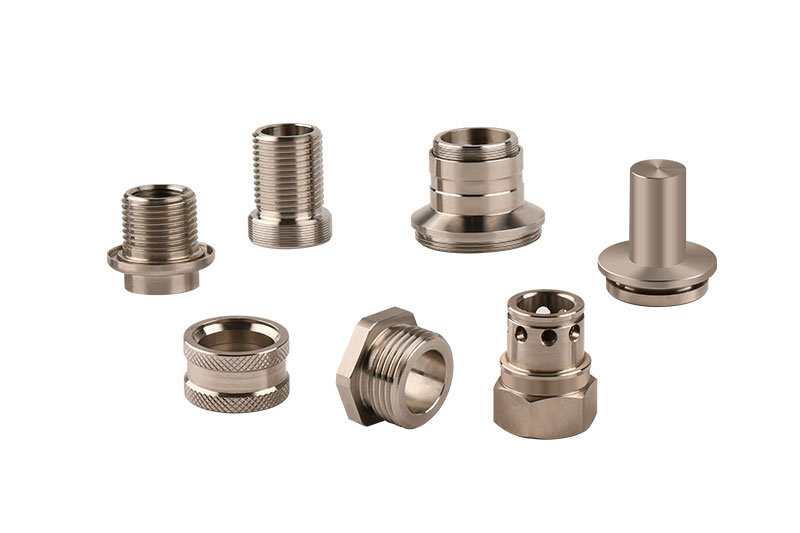
OEM Pipe Fittings (Build-to-Print): The client provides completed 2D manufacturing prints with strict Geometric Dimensioning and Tolerancing (GD&T) along with 3D CAD files (STEP or IGES). The machining manufacturer performs a detailed Design for Manufacturability (DFM) review, engineers custom tooling or chucking fixtures, and executes multi-axis CNC turning, thread cutting, and surface plating.
-
ODM Pipe Fittings (Design-to-Spec): The client supplies operating boundaries—such as 6,000 PSI working pressure, fluid viscosity, flow velocity, pressure-drop targets, and space constraints. The manufacturing engineering team calculates wall thicknesses, designs internal flow geometries, runs flow simulations, and machines working prototype units to eliminate multi-component assembly leak paths.
2. Blank Forming Routes: Bar Stock vs. Forged Fittings vs. Cold Heading
Selecting how your raw blank is formed directly controls continuous grain flow, burst pressure resistance, machine cycle times, and per-unit production cost.
1. Solid Bar Stock CNC Machining (CNC Bar Fittings)
Cutting fittings directly from drawn hexagonal bar, round bar, or heavy-wall seamless tubing is the standard route for fast prototyping and high-mix production.
-
Best Application: Engineering prototypes, pilot production runs, and low-volume orders (1 to 2,000 pieces).
-
Engineering Pros: Zero tooling or die charges ($0); uniform, dense metallurgical structure free of internal shrinkage, porosity, or cold-shuts; reliably holds dimensional tolerances within ±0.01 mm.
-
Economic Trade-offs: Substantial raw material scrap loss (swarf rates frequently reach 50% to 70% on stepped profiles), leading to extended machining cycle times and higher unit costs on large production runs.
2. Hot Forging (Forged Fittings & Forged Carbon Steel Fittings)
The hot forging process heats raw billet stock via induction coils before pressing the material into shape within hardened closed dies on mechanical or hydraulic presses.
-
Best Application: Medium-to-high annual volumes (5,000 to 50,000 pieces) of carbon steel forged fittings, forged brass fittings, asymmetric tees, 90-degree elbows, and flanged adapters.
-
Engineering Pros: Metal grain flow continuously follows the component contour, elevating fatigue endurance and burst pressure ratings by more than 30% compared to equivalent bar stock.
-
Economic Trade-offs: Requires dedicated tooling and die investment ($1,500 to $4,000); near-net shape blanks cut subsequent machining cycle times and chip waste by 25% to 40%.
3. Cold Heading Manufacturing (Cold Headed Parts)
Coiled wire rod feeds into high-speed, multi-station cold heading formers at ambient room temperature. High-tonnage punches progressively upset, expand, and forward/backward extrude the material into near-net shapes, followed by secondary CNC thread rolling or seal-face skimming.
-
Best Application: Ultra-high-volume supply (exceeding 50,000 to 100,000 pieces annually) of symmetrical male adapters, straight couplings, banjo bolts, and compression tube nuts.
-
Engineering Pros: Raw material utilization reaches 95% to 98% with virtually zero chip waste. Plastic deformation work-hardens the steel, raising tensile strength and surface hardness, while production speeds achieve 60 to 150 pieces per minute.
-
Economic Trade-offs: Multi-station tungsten carbide dies require significant upfront capital ($5,000 to $15,000+), restricting geometric feasibility strictly to symmetrical profiles.
3. Technical Comparison Matrix: Blank Forming Methods
| Parameters | CNC Bar Stock Fitting | Hot Forged Fitting | Cold Headed Fitting |
| Tooling & Mold Cost | None ($0) | Moderate ($1,500 to $4,000) | High ($5,000 to $15,000+) |
| Economic Order Volume (EOV) | 1 to 2,000 pcs | 5,000 to 50,000 pcs | 50,000+ pcs |
| Material Utilization | 30% to 50% | 75% to 85% | 95% to 98% |
| Internal Grain Structure | Interrupted by cutting passes | Continuous unbroken grain flow | Highly compressed / Work-hardened |
| Best Geometric Profiles | Deep internal bores, manifold blocks | Asymmetrical tees, 45°/90° elbows | Symmetrical unions, straight nipples |
| Production Speed | Minutes per piece | Seconds per piece | Fractions of a second per piece |
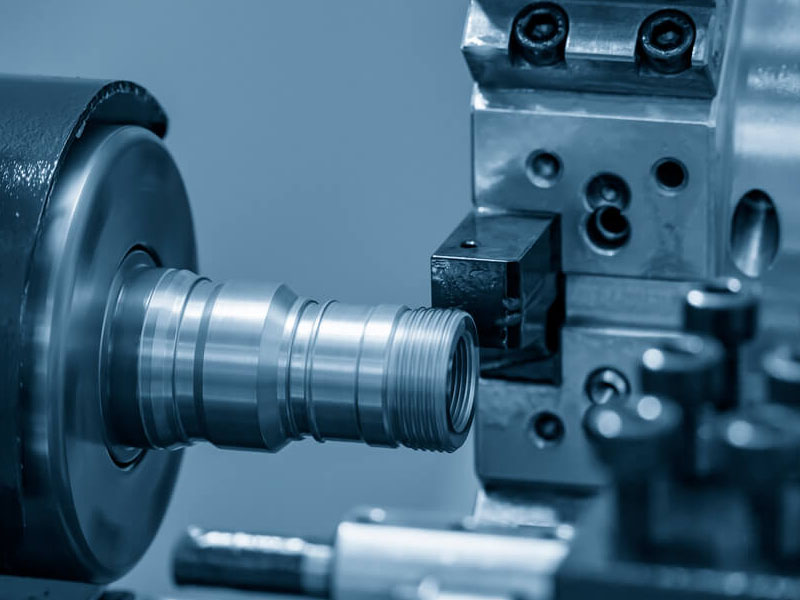
4. Critical Engineering Checkpoints for Custom Steel Fittings
To prevent dynamic fluid leaks and seal degradation, high-performance custom OEM fittings require strict process discipline during secondary CNC operations:
-
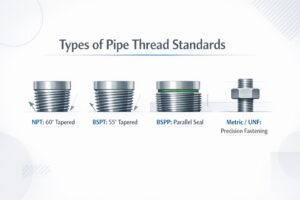
Hybrid Thread Compatibility: Seamlessly transition between BSPP (ISO 228-1), NPT (ASME B1.20.1), Metric (ISO 261), and SAE/UNF (SAE J1926) on a single turned fitting, eliminating stacked conversion adapters.
-
Micro-Finish Sealing Faces: Hold sealing undercut fillets to R0.2 to R0.3 mm and maintain surface roughness at Ra ≤ 0.8 μm (or Ra ≤ 0.4 μm for metal-to-metal conical seats) to stop elastomeric O-ring nibbling under dynamic pressure spikes.
-
Automotive-Grade Plating: Protect carbon steel pipe fittings with environmental Trivalent Zinc (Cr3+) or Zinc-Nickel alloy electroplating to endure 720 to 1,000 hours of neutral salt spray (ASTM B117) testing without red rust formation.
5. Frequently Asked Questions (FAQ)
What is the difference between forged fittings and bar stock fittings?
Forged fittings are formed under heat and high tonnage within closed dies, creating an uninterrupted grain flow that maximizes mechanical fatigue life and burst pressure in high-pulsation lines. Bar stock fittings are machined directly from extruded metal rods; they require zero mold costs and allow faster setup, making them the preferred choice for rapid prototypes, custom port configurations, and lower-volume production batches.
When should an engineer choose cold heading manufacturing over hot forging?
Cold heading is recommended for high-volume orders exceeding 50,000 pieces of axially symmetrical components (such as straight fittings, hollow studs, and flare nuts). It delivers near-100% material efficiency, cycle times measured in seconds or fractions of a second, and work-hardened structural integrity. Hot forging remains necessary for asymmetrical profiles like elbows and branch tees.
Can forged carbon steel pipe fittings be customized with hybrid threads?
Yes. In custom OEM machining, hot forged blanks are secondary-machined on multi-axis CNC turning centers to cut any required thread combination—such as male NPT threads on one port and female BSPP threads with an integrated elastomeric O-ring cavity on the mating port.
Optimize Your Custom Pipe Fitting Production
Evaluating a custom pipe fitting project, experiencing field leaks in dynamic lines, or looking to lower high-volume manufacturing costs through blank optimization?
[Request a Free DFM Review & Instant Factory Quote]
-
Receive an actionable Design for Manufacturability (DFM) assessment, blank selection analysis (bar stock, forging, or cold heading), and factory-direct pricing within 24 hours.
-
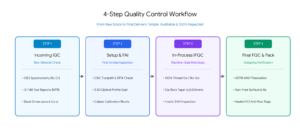
Every production batch includes complete material test reports (MTR), plating thickness certifications, and 100% thread plug/ring gauge inspection logs.