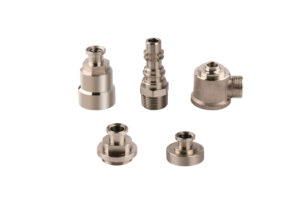
Selecting the appropriate alloy grade for stainless steel water pipe fittings is one of the most critical engineering decisions in municipal water supply, commercial plumbing, and industrial fluid transport. While both Grade 304 and Grade 316 offer lead-free hygiene, high pressure resistance, and an operational lifespan exceeding 50 years, choosing the wrong grade for your water quality can cause premature pitting corrosion, joint leaks, and expensive system downtime.
Whether you need small 1 4 stainless steel pipe fittings for instrumentation, standard 1 2 stainless steel pipe fittings for residential plumbing, or larger 1 1 4 stainless steel pipe fittings for commercial water mains, understanding the trade-offs between 304 and 316 stainless steel ensures long-term reliability and cost efficiency.
Chemical Composition & Corrosion Resistance: 304 vs. 316
The fundamental difference between Grade 304 and Grade 316 stainless steel water pipe fittings comes down to their chemical alloy composition—specifically the inclusion of Molybdenum in Grade 316.
-
Grade 304 (UNS S30400 / EN 1.4301): Formulated with 18% Chromium and 8% Nickel (commonly known as 18/8 stainless). It builds a protective Chromium Oxide surface layer that resists standard atmospheric corrosion and clean water oxidation.
-
Grade 316 (UNS S31600 / EN 1.4401): Formulated with 16% Chromium, 10% Nickel, and 2% to 3% Molybdenum. Molybdenum significantly enhances the fitting’s resistance to chloride pitting, crevice corrosion, and aggressive chemical environments.
Material Specification & Performance Comparison
| Technical Feature | Grade 304 Stainless Steel | Grade 316 Stainless Steel |
| Chromium (Cr) | 18.0% – 20.0% | 16.0% – 18.0% |
| Nickel (Ni) | 8.0% – 10.5% | 10.0% – 14.0% |
| Molybdenum (Mo) | None | 2.0% – 3.0% |
| PREN Value (Pitting Resistance Equivalent) | Approximately 19 | Approximately 23 – 25 |
| Max Recommended Chloride Threshold | Up to 200 mg/L (ppm) | Up to 1,000 mg/L (ppm) |
| Relative Raw Material Price | Baseline Cost | 20% to 35% Price Premium |
Is 304 Stainless Safe for Drinking Water?
Yes, 304 stainless steel is 100% safe, non-toxic, and lead-free for potable water distribution. It fully complies with international drinking water standards, including NSF/ANSI 61, WRAS, and DVGW.
Unlike traditional brass (which may leach trace lead) or carbon steel (which rusts and discolors water), 304 stainless steel water pipe fittings do not contaminate drinking water or alter its taste. As long as the raw water chloride concentration remains below 200 mg/L (ppm)—which covers standard municipal tap water—304 grade is a safe, economical choice for drinking water infrastructure.
What Are the Downsides of 304 Stainless Steel?
While Grade 304 is the most widely used stainless alloy globally, it has specific material limitations:
-
Vulnerability to Chloride Pitting: In high-salinity water, coastal atmospheres, or water treated with high chlorine dosages, 304 stainless steel can experience localized pitting and crevice corrosion.
-
Low Resistance to Reducing Acids: It degrades rapidly when exposed to hydrochloric acid, active chloride solutions, or stagnant marine environments.
-
Potential for Crevice Corrosion Under Thread Joints: In stagnant hot water systems (above 60°C), micro-gaps in threaded NPT or BSPP connections made from 304 can trap chlorides, leading to joint degradation.
What Are the Disadvantages of 316 Stainless Steel?
Grade 316 offers superior corrosion protection, but it also carries a few commercial and technical drawbacks:
-
Higher Purchasing Cost: Due to the market price of Molybdenum and higher Nickel content, Grade 316 fittings cost 20% to 35% more than Grade 304.
-
Unnecessary Expense for Standard Water: Using 316 for basic indoor municipal tap water systems leads to over-engineering and inflated project budgets without practical operational benefits.
-
Limitations in Highly Oxidizing Acid Service: While 316 excels in chloride environments, it offers lower resistance to strong oxidizing acids (like concentrated nitric acid) compared to high-chromium non-molybdenum alloys.
How to Tell the Difference Between 304 Stainless and 316 Stainless?
Visually, Grade 304 and Grade 316 stainless steel water pipe fittings look identical. You cannot distinguish between them by sight, weight, or surface finish. Here are the four reliable ways to verify material grades:
-
Mill Test Report (MTR / EN 10204 3.1 Certificate): Reputable manufacturers stamp heat numbers on fittings and provide full MTR documentation detailing the exact chemical composition (checking for 2.0% to 3.0% Molybdenum).
-
Handheld XRF / PMI Analyzer: Positive Material Identification (PMI) using X-ray Fluorescence (XRF) gun spectrometers provides an instantaneous non-destructive chemical readout of Chromium, Nickel, and Molybdenum content.
-
Chemical Reagent Spot Test: Applying a Molybdenum testing chemical drops a color-changing spot on the metal. Grade 316 turns a distinct dark pink or brown due to the presence of Molybdenum, whereas Grade 304 shows no color change.
-
Permanent Factory Stamp Marking: Precision CNC machined fittings are roll-stamped or laser-engraved with clear grade identifiers (e.g., “304”, “316”, or “CF8M”).
Choosing the Right Size and Grade for Your Piping System
Matching the correct size and alloy grade ensures optimal flow rate, pressure tolerance, and service life:
-
Instrumentation & Sensing Lines (1 4 stainless steel pipe fittings): Used for pressure gauges, sampling valves, and automated control lines. Specify 316 grade if installed outdoors in coastal plants or handling chemical dosing water.
-
Branch Connections & Plumbing Lines (1 2 stainless steel fittings): Standard 1 2 stainless steel pipe fittings serve as the backbone for residential water supply, commercial restrooms, and HVAC chilled water loops. Grade 304 is ideal for indoor tap water applications.
-
Main Water Distribution Lines (1 1 4 stainless steel pipe fittings): Larger 1 1 4 stainless steel pipe fittings handle higher volumetric flow and pressure in commercial water mains and industrial cooling towers. Choose Grade 316 if water stagnation or elevated temperatures occur frequently.
Frequently Asked Questions (FAQ)
Q1: Can 304 and 316 stainless steel water pipe fittings be connected together in the same system?
A: Yes. 304 and 316 stainless steel alloys have nearly identical electrochemical potentials and thermal expansion rates. Connecting 304 and 316 fittings together in standard water service will not trigger galvanic corrosion.
Q2: When should I buy 316L instead of standard 316 stainless steel fittings?
A: Specify Grade 316L (Low Carbon, C ≤ 0.03%) if your piping system requires field welding. The low carbon content prevents Chromium Carbide precipitation during welding, protecting the heat-affected zone (HAZ) from intergranular corrosion.
Q3: Why do 304 stainless steel fittings sometimes show surface rust spots in new water systems?
A: Surface staining on 304 fittings is usually caused by free iron contamination from carbon steel tools used during installation, or failure to perform acid passivation after machining. Passivating the fittings restores the Chromium Oxide protective layer.
Partner with a Certified Stainless Steel Fitting Manufacturer
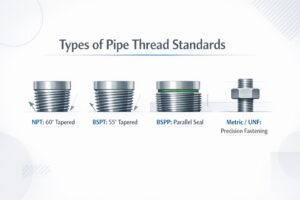
Choosing between Grade 304 and Grade 316 comes down to evaluating raw water chemistry, chloride concentration, operating temperature, and overall capital budget. When you buy stainless steel fittings, working directly with an experienced manufacturer guarantees precise thread tolerances (NPT, BSPP, BSPT), strict wall thickness compliance, and full Material Test Report traceability.
Ready to source high-precision stainless steel water pipe fittings for your next engineering project? Contact our technical sales team today to request CAD drawings, material certificates, and competitive factory-direct quotes within 24 hours!