Accurately calculating part cost requires moving beyond theoretical formulas to evaluate real shop-floor variables. When sourcing parts from a direct cnc machinery factory, an engineering quote is shaped by machine hourly rates, cycle times, automation feasibility, operator inspection frequencies, tooling wear, blank geometry defects, and facility overhead.
Total Part Cost = (Raw Material Cost + Inbound Freight)
                + (Cycle Time × Machine Hourly Rate)
                + Labor Allocation (Automated vs. Manual Clamping)
                + Tooling Consumption (Standard & Secondary Passes)
                + In-Process & Final Inspection (QC Labor)
                + Secondary Operations (Polishing, Lapping)
                + Surface Finishing & Packaging
                + (Facility Overhead + Admin/Tax Allocation)

How Much Does CNC Manufacturing Cost?
For buyers planning budgets, production volume, blank forming methods, and handling procedures heavily dictate the unit price. Experienced cnc machine manufacturers typically structure baseline quotes across volumes as follows:
| Production Stage | Typical Batch Volume | Average Cost per Unit | Key Cost Drivers |
| Prototyping | 1 to 10 pcs | $30 – $120+ | CAD/CAM programming, custom tool setup, single-part manual handling |
| Low-Volume Production | 100 to 1,000 pcs | $8 – $25 | Fixture amortization, cycle time balance, frequent manual QC checks |
| Mass Production (Manual) | 5,000 to 20,000+ pcs | $3.50 – $12 | Complex geometry, manual clamping, GD&T checks every 10-20 pcs |
| Mass Production (Automated) | 50,000+ pcs | $0.80 – $4.50 | Automated gantry loaders, bar feeders, continuous cutting of round/hex profiles |
Direct Cost Drivers on the CNC Machining Machine
1. Raw Material Blank Weight and Inbound Logistics
Material cost is never calculated from finished net weight. It must include clamping margins, cut-off tool kerf allowance, and bar remnants:
-
Gross Blank Weight Formula: Blank weight = Pi × (Outer Diameter / 2)^2 × (Length + Cut-off Allowance) × Density.
-
Blank Type Selection: Choosing between solid cold-drawn bar stock, cold heading preforms, hot forging blanks, or sand castings fundamentally shifts material yield and machining cycle times.
-
Inbound Freight: Local logistics fees to move raw stock from the mill to the factory floor are factored directly into material unit costs.
2. Equipment Tier and Machine Hourly Rates
The capital grade of each cnc machine for manufacturing dictates its hourly operating cost:
-
Standard Lathes vs. Precision CNC Lathe Machines: An entry-level machine ($3,000–$4,500 capital investment) suits loose tolerances (±0.05 mm to ±0.1 mm). High-precision industrial CNC machines equipped with rigid slant beds and linear guideways ($6,000–$10,000+ capital investment) maintain tight tolerances within ±0.01 mm consistently.
-
Depreciation & Rigidity: Higher-end equipment incurs higher hourly depreciation rates, but dampens vibration, reduces scrap rates, and achieves superior surface integrity.
3. Production Method: Fully Automated vs. Manual Labor
Production cost diverges drastically based on whether a part can run unattended:
-
Automated Production (Low Cost, High Minimum Volume): Standard geometries like round or hexagonal bars with low cutting allowances and moderate tolerances run efficiently on automated bar feeders or gantry robots. Materials that generate manageable, short chips (brass, aluminum, free-cutting steel) are ideal candidates. Automated lines typically require minimum runs of 50,000+ pieces to justify gripper tooling, feeder adjustments, and robotic programming, resulting in minimal per-part labor costs.
-
Manual Loading & Clamping (Higher Labor Share): Complex asymmetrical parts, thin-walled designs, or components requiring strict concentricity (within 0.02 mm) and parallelism cannot be reliably fed by vibratory bowls or pushers without scratching or misaligning. Operators must manually position, seat, clamp, and deburr each workpiece. This keeps the manual labor share of total machining cost high, even on production runs exceeding 10,000 pieces.
4. Dedicated Tooling and Cycle Time Trade-offs
High-precision features require extra tooling stations:
-
Finishing Passes: Cutting threads to standard commercial tolerances can be done in fewer passes. Achieving tight thread engagement with zero burrs requires an extra dedicated thread-chasing tool and fine grooving insert.
-
Surface Roughness (Ra) vs. Feed Rate: Hitting a smooth surface finish such as Ra 0.8 μm requires lowering spindle feed rates and running controlled cutting speeds. Slower cycle times directly increase machine hour costs.
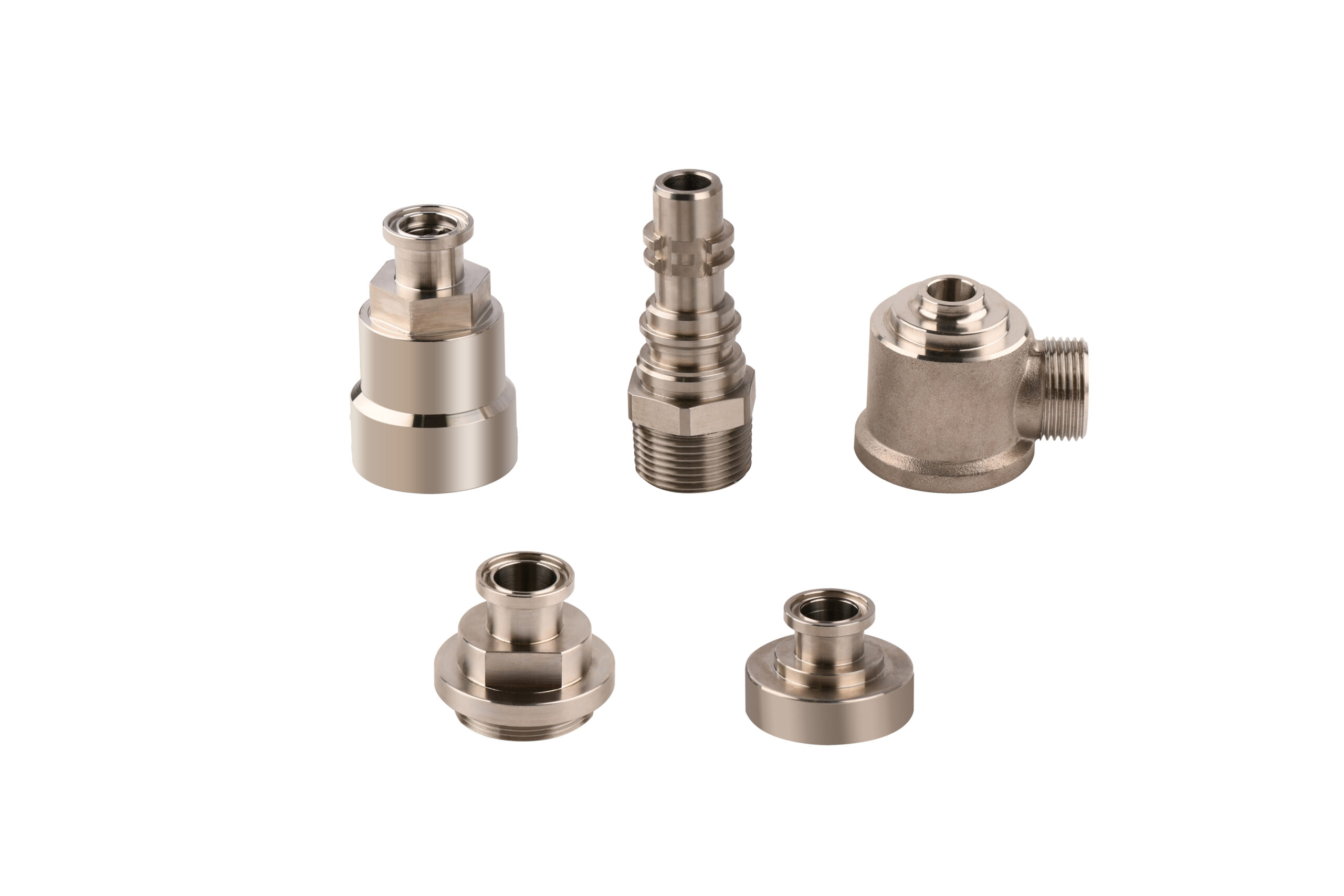
5. Cnc machinery parts Surface Treatment and Finishing
Surface finishing requirements dictate external subcontractor and handling fees:
-
Trivalent Zinc Plating: Standard commercial anti-corrosion protection.
-
Electroless Nickel Plating (ENP): Offers precise layer uniformity, wear resistance, and corrosion resistance at higher chemical bath costs.
-
Passivation and Anodizing: Require strict cleaning, degreasing, and salt spray verification (48 to 96+ hours).
6. Packaging Protection Levels
Packaging protects parts against transit corrosion and cosmetic dings:
-
Bulk Polybag Packaging: Most economical; suited for durable hardware.
-
Blister Trays (Clamshells): Individually isolates threads and critical sealing surfaces from micro-dents.
-
Export Crates and Pallets: Fumigated wooden crates and stretch-wrapped pallets prevent crushing during international ocean freight.
Real-World Shop-Floor Case Studies: Engineering Trade-offs & Cost Reality
Case 1: The Hidden Cost of Blank Out-of-Roundness in Knurled Parts
Buyers frequently ask: “If hot forging saves raw material, why did the machining price increase?”
-
The Issue: A hot-forged brass component required a crisp diamond knurl on its OD. However, hot forgings inherently exhibit parting line drafts and ovality (out-of-round shape).
-
The Failure Mode: When applying the knurling tool directly against the raw forged profile, the blank’s eccentricity caused unequal radial force. The knurl formed cleanly on one side while fading or skipping completely on the other.
-
The Engineering Fix: To eliminate eccentricity, our shop had to add a preliminary precision OD turning pass across all blanks to establish a true concentric reference circle prior to knurling.
-
Cost Impact: This added an extra carbide turning tool, reprogrammed the cycle, and increased cycle time by 18 seconds per piece. Across a 20,000-piece batch, those machine hours directly accounted for the pricing adjustment.
Case 2: Surface Finish Reality Check — Ra 1.6 vs. Ra 0.8 vs. Ra 0.2 μm
A change in roughness symbols on an engineering drawing fundamentally shifts machine selection and process routes:
[Ra 1.6 μm]  ──> Standard CNC Lathe ($3,000–$4,500 Machine) ──> Fast single-pass cut
[Ra 0.8 μm]  ──> Precision Slant-Bed Lathe ($6,000–$10,000 Machine) ──> Fine feed rate + high spindle dampening
[Ra 0.2 μm]  ──> Dual Process: Precision Turn to Ra 0.5 μm ──> Secondary Polishing/Lapping process
-
Ra 1.6 μm (Standard Mechanical Finish): Achievable on economical entry-level lathe equipment ($3,000–$4,500 capital class). Tool paths run at standard feed rates with minimal risk of chatter marks, keeping machine cycle times short and machine hourly rates low.
-
Ra 0.8 μm (Precision Sealing / Hydraulic Fit): Budget machines struggle here due to minute spindle vibrations and guide rail play. This finish demands high-precision, rigid slant-bed industrial CNC machines ($6,000–$10,000+ class). Spindle feed rates must be significantly reduced, running specialized fine-finishing inserts. Equipment depreciation is higher, and cycle time increases by 25% to 40%.
-
Ra 0.2 μm (Mirror / Dynamic Sealing Finish): Pure single-point turning hits a physical boundary here. It cannot be achieved reliably in one continuous lathe cut. The shop must first turn the part with a controlled grinding/polishing allowance to Ra 0.5 μm, then transfer the parts to a secondary station for magnetic tumbling, mechanical buffing, or lapping. This introduces secondary handling, specialized abrasives, and extra labor, which can double the per-part processing fee.
Hidden Shop-Floor Overhead in a CNC Machine Factory
Two machine shops with identical machine tools often provide different quotations due to structural overhead:
1. In-Process Inspection Frequency & Full-Inspection Costs
Inspection intensity directly changes operator pace and labor overhead:
-
Standard Tolerance Inspection: For loose tolerances, operators perform quick batch sampling (e.g., measuring 1 piece every 100 parts) using standard calipers or micrometers, allowing the machine to cycle continuously at top speed.
-
Frequent In-Process Inspection: When prints specify tight concentricity, critical bore diameters, or thread pitch limits, operators must stop the cycle to measure every 10 to 20 pieces. This pauses throughput and ties up operator attention.
-
100% Full Final Inspection on Multi-Dimension Parts: If a print demands 100% verification across multiple dimensions—such as checking internal grooves under 10x/20x measuring microscopes and verifying taper angles on 2.5D optical profile projectors—the final inspection labor cost can equal or even exceed the raw machining cost of the part itself.
2. Facility Footprint & Rent Discrepancies
Established facilities operating on early-acquired property carry minimal plant debt. In contrast, newer shops situated in high-rent modern industrial parks must distribute substantial square-meter facility leasing costs across every machining hour.
3. Engineering & Administrative Staff
Low-cost family workshops lack engineering, quality assurance (QA), and documentation staff. A structured cnc machine factory includes CAM programmers, bilingual project engineers, quality inspectors, and logistics controllers to manage material traceability and compliance.
How Engineers Can Optimize Part Costs
-
Avoid Over-Specifying Surface Roughness: Only specify Ra 0.4 μm or Ra 0.2 μm where dynamic o-ring seals or high-speed bearing interfaces strictly demand it. Specifying Ra 1.6 μm on general surfaces allows parts to run on faster, more economical equipment without secondary polishing costs.
-
Account for Blank Roundness on Cosmetic Profiles: If choosing hot forgings or castings to save material on knurled or patterned parts, allow sufficient machining stock (+0.5 mm to +1.0 mm) for a preliminary cleanup pass, or compare total costs against turning directly from precision cold-drawn round bars.
-
Design for Automated Feeding: Wherever possible, maintain cylindrical or symmetrical hex envelopes and standard OD-to-length ratios so parts can run on automatic bar-fed lathes or gantry robots rather than requiring manual loading.
-
Relax Non-Critical Tolerances: Keep non-critical dimensions at ±0.05 mm or looser. Reserving tight concentricity or runout limits only for functional mating surfaces eliminates the need for operators to pause the machine every 10 pieces for manual gauging.
-
Streamline Inspection Dimensions: Avoid specifying 100% inspection callouts on cosmetic surfaces; confine 100% checks strictly to critical sealing grooves and mating threads to avoid doubled inspection labor charges.
-
Consolidate Order Quantities: For automated parts, aim for batch volumes of 50,000+ pieces to maximize machine continuous running efficiency and drive down per-unit labor allocations.
Frequently Asked Questions
Why does working directly with a CNC machinery factory reduce procurement costs?
Partnering directly with a manufacturing facility cuts out middleman markups and allows direct communication with toolmakers and setup engineers. This transparency ensures material optimization, cycle-time reductions, and realistic tolerance adjustments before production begins.
Why does requiring Ra 0.2 μm cost significantly more than Ra 0.8 μm?
Ra 0.8 μm can be achieved directly on high-rigidity CNC lathe machines by lowering the cutting feed rate. Ra 0.2 μm, however, exceeds standard turning limits and requires a two-step manufacturing route: precision turning to Ra 0.5 μm followed by a secondary mechanical polishing or lapping operation, adding dedicated labor and processing stations.
Why does manual loading cost so much more than automated machining for large runs?
Automated setups using bar feeders or gantry robots allow a single technician to oversee multiple CNC processing machines running continuously. Complex or asymmetrical parts that require manual chucking demand dedicated operator labor for loading, clamping, and deburring every individual cycle, multiplying direct labor expenses.
Can 100% inspection really cost as much as machining the part?
Yes. A turned brass or aluminum fitting may take only 30 to 45 seconds to machine. However, if that part requires 100% manual thread-gauge checking, internal groove inspection under a 20x microscope, and optical projector verification for taper runout, the metrology verification can take 60 to 90 seconds of dedicated manual QC labor per piece.
What volume makes automation cost-effective for CNC lathe machines?
Automation typically becomes cost-effective at batch sizes of 50,000 pieces or higher for simple round or hex profiles. This volume easily absorbs the initial investment in vibratory bowl tooling, custom gantry gripper fingers, and feeder channel changeovers.
Get a Transparent CNC Machining Quote
Need precision CNC turned components from a direct cnc machinery factory with full cost transparency? Send us your 2D drawings (PDF) and 3D files (STEP/IGS) along with your annual volume, material specifications, and packaging requirements. Our engineering team will review your design for manufacturability (DFM) and deliver a detailed quotation within 24 hours. Your intellectual property is protected; mutual NDAs are available upon request.