Buying custom industrial metal components can often feel like navigating a minefield. Standard trading companies often promise tight tolerances, zero-leak guarantees, and ultra-fast turnarounds, only to deliver out-of-spec thread pitches, deformation from improper clamping, or delayed shipments that halt entire production lines.
At Yuhuan Hongqian Machinery Co., Ltd., we believe in radical transparency over marketing fluff. Located in Taizhou, Zhejiang, China, our 60+ CNC machine setup and dedicated team of engineers—led by technicians with over a decade of hands-on precision machining experience—deliver custom carbon steel pipe fittings, stainless steel pipe fittings, adapters, elbows, and custom turning parts built to exact engineering data.
This comprehensive procurement guide breaks down manufacturing routes, uncovers common industry traps, explains total cost calculations, and helps you evaluate qualified pipe fittings suppliers with confidence.
At-a-Glance Comparison: Core Manufacturing Processes for Pipe Fittings
Choosing the right production route directly affects your component’s structural integrity, leak resistance, dimensional precision, and unit cost. The matrix below illustrates how high-precision CNC machining compares against common alternatives.
Manufacturing Process Comparison Matrix
| Process / Solution | Best-Fit Application & Pressure Scenarios | Core Technical Advantages | Quality Verification Method | True All-Inclusive Cost Breakdown |
| High-Precision CNC Solid Barstock Turning (Our Core Specialization) | Thin-walled fittings, high concentricity components, critical seal faces, complex NPT/UNF/Metric threads, and leak-free hydraulic or high-pressure systems. | Stable tolerances within ±0.02 mm. Zero risk of sand holes, internal porosity, or micro-cracks compared to castings. | Batch PMI handheld spectrometer testing + 100% thread gauge verification + Optical projector profile inspection. | Raw material barstock cost + Tool wear amortization + Precision CNC machine-hour rate. |
| Option A: Stainless Steel Investment Casting + Basic Post-Machining | Extremely complex shapes, internal curved fluid flow channels, low-to-medium pressure valves, or structural brackets where gas tightness is non-critical. | Excellent material utilization for irregular shapes; lower initial per-piece cost for complex geometry. | Standard caliper measurements + 5% to 10% batch hydrostatic leak testing. | Pattern/mold tooling fee + Cast blank unit cost + Porosity weld repair fee + Secondary machining costs. |
| Option B: Cold Heading / Hot Forging + CNC Threading | Simple, symmetrical standard hex fittings, high-volume commodity connectors, and non-critical fluid systems. | Ultra-fast cycle times (seconds per piece), minimal scrap material loss, lowest per-unit cost at massive scale. | Standard thread go/no-go plug/ring gauge inspection. | High upfront stamping/forging die amortization + Forged blank cost + Thread machining fee. |
3 Critical Industry Pitfalls in Pipe Fittings Procurement (And How to Avoid Them)
Pitfall 1: Over-Promised Lead Times and Unrealistic Delivery Schedules
A widespread issue in component sourcing is suppliers quoting 20-day delivery windows simply to secure orders, only to push final delivery to 40 or 60 days. In complex custom manufacturing, rushing or underestimating setup time disrupts scheduling and causes costly downtime for buyers.
-
How We Avoid It: At Yuhuan Hongqian Machinery Co., Ltd., our senior master machinists analyze project blueprints, tool setup, and material availability before confirming orders. We maintain realistic production schedules backed by rigorous quality control processes, ensuring your delivery date is protected.
Pitfall 2: Low Upfront Unit Prices offset by Hidden Costs and Scrap Material
Lowball quotes frequently mask hidden trade-offs. Suppliers cut costs by using single-pass rough machining instead of two-step roughing and finishing, underpaying machine operators, and skipping dedicated inspection staff. The result? Excessive burrs, chatter marks, tool-deflection dimensional errors, and damaged threads.
-
How We Avoid It: A lower unit price becomes expensive when 10% of the shipment fails assembly or leaks under pressure. We quote all-inclusive prices that cover proper tool cycling, rough and finish machining, in-process inspection, deburring, and protective packaging.
Pitfall 3: Substandard Material Grades and Recycled Scrap Barstock
To shave 15% to 20% off material costs, some suppliers use recycled or low-grade stainless steel barstock containing oxide inclusions and internal voids. When machining fine-pitch threads, these inclusions cause tool chipping and create microscopic leak paths across sealing faces.
-
How We Avoid It: Every incoming lot of stainless steel (304, 316, 316L) and carbon steel barstock undergoes strict material inspection. We verify chemical composition (such as ensuring Molybdenum content in 316L meets specification) using Positive Material Identification (PMI) spectrometers, providing traceable Material Test Certificates (MTC) with every batch.
Technical Assessment of Pipe Fitting Manufacturing Options
Solution 1: Precision CNC Barstock Turning (Our Core Method)
-
Technical Advantages: Single-setup machining on high-precision CNC lathes allows turning of outer diameters, inner bores, face grooves, and thread profiles simultaneously. This process guarantees concentricity and parallelism within tight limits while achieving surface finishes down to Ra 0.8 μm.
-
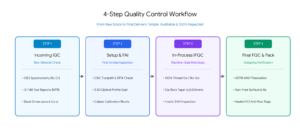
Verification Standards: Every batch includes PMI spectrometer reports, optical projector thread inspections, and 100% thread ring/plug gauge checks.
-
Honest Limitations: For simple shapes ordered in quantities exceeding 50,000 to 100,000 units, barstock machining generates higher scrap material volume than cold heading, making unit costs less competitive at ultra-high volumes.
-
Recommendation: Ideal for high-pressure, anti-leakage, or tight-concentricity applications.
Solution 2: Forging / Cold Heading + Secondary CNC Threading
-
Technical Advantages: Maximizes material utilization, minimizes cycle time, and delivers low cost per piece at high volumes.
-
Honest Limitations: Upfront tooling fees can run into thousands of dollars, making small runs (under 2,000 pieces) cost-prohibitive. Poorly controlled hot forging flow lines can also introduce internal micro-cracks that risk failure under pressure.
-
Recommendation: Recommended for standard, symmetrical pipe fittings produced in continuous runs of over 50,000 pieces.
Calculating Total Cost of Ownership (TCO) for Industrial Fittings
Smart procurement evaluates total landed cost rather than initial unit price alone. Use this formula to calculate true expenditure:
True Total Sourcing Cost = (Base Unit Price x Delivered Quantity)
                         + Tooling and Fixture Amortization
                         + Surface Treatment and Testing Fees
                         + Invisible Risks (Rework, Scrap, Delay Loss)
Cost Factor Breakdown
-
Base Unit Price: Direct material cost (304, 316L, carbon steel) + CNC machine-hour rates (covering roughing, finishing, and tool wear).
-
Surface Treatments: Options range from standard pickling and passivation to electropolishing (for ultra-clean internal bores), e-coating, zinc plating, or black oxide.
-
Quality & Delay Risk Factor: Purchasing a batch that is 10% cheaper but exhibits a 5% thread defect rate creates downtime costs, emergency sorting expense, and freight fees that easily exceed a 20% cost margin.
5 Essential Questions to Ask Machine Shops Before Placing an Order
When requesting quotes for custom pipe fittings, send these five technical questions to evaluate your supplier:
-
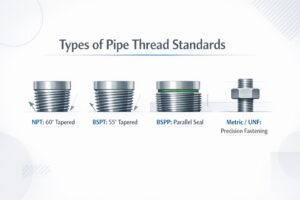
Thread Inspection: “How do you inspect NPT, NPTF, BSPP, BSPT, UNF, UNC, or Metric threads? Do you verify the 1:16 taper angle on an optical profile projector and use calibrated thread ring/plug gauges?”
-
Deformation Control: “What clamping methods do you use for thin-walled fittings to prevent ovality and stress-release distortion (e.g., custom soft jaws or internal expansion collets)?”
-
Material Traceability: “Do you test incoming raw material using a hand-held XRF PMI spectrometer, and do you supply mill test certificates (MTC) with shipment?”
-
Surface Roughness: “What surface finish rating can you guarantee on critical sealing faces and internal bores (e.g., Ra 0.8 μm or better)?”
-
Cost Transparency: “Does your quote explicitly include deburring, ultrasonic cleaning, passivation/plating, specialized packaging, and freight costs?”
About Yuhuan Hongqian Machinery Co., Ltd.
Based in Yuhuan, Taizhou, Zhejiang Province, Yuhuan Hongqian Machinery Co., Ltd. operates over 60 high-precision CNC lathes, automated truss robotic systems, optical projectors, and testing equipment.
We specialize in precision CNC turned parts, custom carbon steel pipe fittings, and stainless steel pipe fittings (304, 316, 316L, 303, Q235, Q355, 42CrMo). Our engineering team excels at working within ±0.02 mm tolerances, handling complex threads across NPT, NPTF, UNEF, UNF, UNC, BSPP/G, BSPT, and Metric standards.
Limitations: What We Do Not Do
To maintain complete honesty, our facilities are optimized for precision CNC turning rather than all types of metalworking.
-
No Nuclear-Grade Pipelines: We do not hold full ASME nuclear-level pipeline certifications and do not manufacture primary nuclear loop components.
-
No Large-Diameter Castings: We do not manufacture large cast flanges or heavy valve bodies above DN500 size.
Frequently Asked Questions (FAQ)
What material grades do you process for pipe fittings?
We regularly machine austenitic stainless steels (304, 316, 316L, 303), carbon steels (Q235, Q355, AISI 1020, AISI 1045, 42CrMo), brass, and aluminum alloys.
What dimensional tolerances can Yuhuan Hongqian Machinery achieve on CNC turned parts?
Our automated CNC lathes and expansion collet clamping setups consistently achieve dimensional tolerances within ±0.02 mm (0.0008 inches) on critical diameters, step lengths, and thread depths.
Which thread standards do you support?
We machine international thread profiles including NPT, NPTF, BSPP (G), BSPT (R), Metric, UNF, UNEF, and UNC. All threads are verified using calibrated pitch gauges and optical projectors.
What surface treatments are available?
Depending on your application, we provide acid pickling and passivation, electropolishing, zinc plating, black oxidation, e-coating, and ultrasonic degreasing/deburring.
Ready to Upgrade Your Pipe Fittings Procurement?
Stop gambling with inconsistent dimensions, leaking threads, and missed delivery schedules. Partner with a precision CNC machining manufacturer that values engineering facts over sales promises.
Contact Yuhuan Hongqian Machinery Co., Ltd. today:
-
Send Us Your Prints: Email your 2D engineering drawings (PDF/CAD) or 3D models (STEP/IGES) for a fast, all-inclusive quote within 24 hours.
-
Request a Machining Review: Speak directly with our senior manufacturing engineers to optimize your design for lower production costs and zero-defect quality.