以下是为您调整为符合标准 Markdown 层级标题(H1
#、H2 ##、H3 ###)的完整英文版本。所有 LaTeX 公式与格式错乱问题均已修复,便于您直接全选复制粘贴:Custom Stainless Steel Pipe Fittings Sourcing Guide (2026): CNC Machining vs. Casting vs. Cold Heading
Author: Senior Industrial Manufacturing Consultant & Technical Operations Team
Published by: Yuhuan Hongqian Machinery Co., Ltd.
Target Audience: Technical Procurement Managers, Mechanical Engineers, and Industrial Supply Chain Directors
Focus Scope: Precision Custom Stainless Steel (304, 316, 316L, 303) Pipe Fittings, Connectors, Flanges, Elbows, and Fasteners (Dimensions up to 200 × 350 mm, MOQ 2,000 pcs)
1. The Honest Disclaimer
We are a precision CNC manufacturing facility located in Taizhou, Zhejiang Province, with over 8 years of dedicated operational experience in machining custom stainless steel (304, 316, 316L, 303) and carbon steel pipe fittings. We do not pretend to be an unbiased third-party testing agency or a neutral industry trade blogger. We build and machine metal components for a living.
Our goal in publishing this guide is straightforward: to provide a rigorous, data-backed engineering comparison based on actual shop-floor data, chemical spectrometer audits, and CMM dimensional verifications. Throughout this document, every technical claim is explicitly categorized into [Theoretical Nominal], [Competitor/Industry Claim], or [Factory Verified Data].
We will clearly state where our manufacturing route excels and, more importantly, where our setup is inefficient or overly expensive for your project requirements. If your application calls for 100,000+ pcs of low-precision, standard sand-cast hose barbs, or heavy-duty welded pipeline spools exceeding 200 × 350 mm dimensions, our precision CNC turning setup is simply not the most cost-effective choice on the market.
2. At-a-Glance Sourcing Comparison
| Manufacturing Route / Solution | Ideal Application | Core Advantage | Evidence Class & Verification Status | Estimated Total Landed Cost Structure |
| Precision CNC Machining with Internal Expansion Collets (Our Factory Route) | Medium-to-small precision fittings (≤ 200 × 350 mm, MOQ 2,000 pcs), round/hex profiles, critical NPT/BSPP/Metric threads. | Eliminates thin-wall clamping distortion; holds ±0.02 mm tolerances and 0.02 mm concentricity; zero internal porosity. | [Factory Verified Data] CMM reports, Direct-Reading Spectrometer heat logs, 100% thread ring/plug gauge audits. | Medium unit cost. Tooling fee $0–$150 (amortized); zero mold costs; low scrap rate risk (<0.5%). |
| Standard 3-Jaw Chuck CNC Turning (Common Supplier Route) | Solid round barstock fittings, thick-wall bushings, non-critical fluid connectors where minor ovality is acceptable. | Lower initial setup complexity; compatible with general job-shop machine fleets without specialized collet design. | [Competitor Claim] Generic QA pass slips; thread pitch verification via optical projector without radial strain monitoring. | Medium-Low unit cost. High risk of thin-wall part distortion (0.05–0.08 mm out-of-roundness) requiring secondary sorting. |
| Precision / Investment Casting (Lost Wax) + Thread Chasing | Asymmetric valve bodies, complex multi-axis elbows, internal fluid channels impossible to turn from barstock. | High geometric freedom for non-cylindrical shapes; reduced raw material scrap on hollow cavities. | [Theoretical Nominal] Material mill test certificates; air-under-water pressure testing logs per production batch. | Low-to-Medium unit price at high volumes. High initial mold fee ($1,500–$3,500); risk of micro-porosity leakage (3%–5%). |
| Cold Heading / Hot Forging + Finish Turning | High-volume standardized fasteners, simple union nuts, or structural elbows requiring directional grain flow. | Rapid cycle times (60+ pcs/min); high mechanical fatigue strength along formed grain boundaries. | [Theoretical Nominal] Destructive tensile testing reports and macro-etch grain flow analysis. | Lowest unit cost at high volume (≥ 50,000 pcs). Tooling/die cost ($2,000–$5,000); impractical for small batches (<10,000 pcs). |
| Low-Cost Commodity Scrap-Metal Fittings | Non-critical agricultural irrigation, low-pressure drainage, non-regulated structural framing. | Lowest initial invoice price on wholesale commercial platforms. | [Industry Claim] Surface visual pass; unverified chemical composition logs. | High hidden failure cost. High risk of material substitution (304 sold as 316L) and thread galling under load. |
3. Industry Truths & Hidden Pitfalls in Stainless Steel Fitting Procurement
Pitfall 1: Unmentioned Thin-Wall Clamping Deformation
Standard 3-jaw hydraulic chucks exert radial point-pressure on raw tubing or turned blanks. While a supplier may claim a nominal machine accuracy of ±0.01 mm, the actual part deforms during clamping. Once the jaws release after thread cutting, the elastic recovery causes the fitting wall to spring back into a “cloverleaf” or oval shape, resulting in out-of-roundness up to 0.05–0.08 mm.
Plaintext
Standard 3-Jaw Radial Pressure         Internal Expansion Collet (Uniform)
       ↓ Force                                    ↑ ↑ ↑
  ┌───┐  ┌───┐                              ┌───────────────┐
  │   └──┘   │  ==> Causes Ovality          │  Uniform 360° │ ==> Holds True
  └───┐  ┌───┐      (0.05-0.08 mm)          │ Inner Radial  │     Roundness
       ↑ Force                              └───────────────┘     (±0.02 mm)
In high-pressure hydraulic or fuel lines, this micro-ovality prevents uniform thread engagement along NPT taper profiles, triggering pressure weeping at high temperatures. Suppliers frequently attribute these leaks to “incorrect installation torque” rather than machine shop clamping strain.
Pitfall 2: Material Grade Substitution (304 Passed Off as 316L)
Austenitic stainless steels look identical to the naked eye. Grade 316L contains 2.0%–3.0% Molybdenum (Mo) and a minimum of 10.0% Nickel (Ni) to prevent pitting corrosion in chloride environments.
To shave 12%–18% off raw material costs, dishonest suppliers use sub-standard stainless alloys with Molybdenum contents below 1.5% or elevated Carbon content (>0.03%). Generic mill test reports provided in PDF format are easily altered; without heat-lot-matched direct-reading spectrometer verification, you risk introducing premature stress-corrosion cracking into marine or chemical processing systems.
Pitfall 3: Post-Processing Exclusion in Quotes
Initial piece-price quotes often exclude mandatory post-processing steps:
-
Chemical passivation (ASTM A967) to clear embedded tramp iron introduced by cutting tools.
-
Electropolishing for smooth micro-inch surface finishes (Ra < 0.4 µm).
-
Protective thread end-caps for overseas transit.
A price that appears 15% cheaper on paper can end up costing 25% more once you factor in secondary deburring, chemical washing, and high warehouse scrap rates caused by damaged NPT thread crests during ocean freight.
4. Modular Evaluation: CNC Machining vs. Alternative Manufacturing Routes
Route A: Precision CNC Machining with Internal Expansion Collets (Our Core Process)
-
Configuration: 60+ CNC lathes integrated with automated truss gantry robots, optical projectors, pneumatic thread gauges, and custom internal expansion collet fixtures.
-
Evidence Class: [Factory Verified Data] verified via Zeiss CMM, Oxford Instruments Direct-Reading Spectrometer, and air-under-water bubble leak testing stations.
-
Strengths:
-
Expands outward against the internal bore across 360° rather than pinching external walls, eliminating clamping deformation on thin-wall connectors.
-
Consistently achieves dimension tolerances within ±0.02 mm and concentricity within 0.02 mm.
-
Solid barstock machining guarantees zero micro-porosity, blowholes, or internal inclusions.
-
-
Limitations: Higher raw material waste when turning deep internal bores from solid barstock compared to hollow casting blanks. Unsuited for complex non-cylindrical asymmetric housings.
-
Decision Rule: If you require pressure-tight, defect-free custom round or hex fittings (2,000–20,000 pcs, dimensions ≤ 200 × 350 mm) with tight NPT/BSPP threads, choose Precision CNC with Internal Collets.
Plaintext
+-----------------------------------------------------------------------------------+
|               PRECISION CNC MACHINING (INTERNAL EXPANSION COLLET)                 |
+-----------------------------------------------------------------------------------+
|  [PROS] Zero Internal Porosity | Holds ±0.02mm Tolerances | No Clamping Distortion   |
|  [CONS] Higher Scrap Rate vs Casting | Restricted to Cylindrical/Hex Geometries    |
+-----------------------------------------------------------------------------------+
Route B: Standard 3-Jaw Chuck CNC Machining
-
Configuration: Standard 2-axis CNC turning centers using generic hard or soft 3-jaw chucks.
-
Evidence Class: [Competitor Claim] verified by basic Vernier caliper and thread plug gauge sampling.
-
Strengths: Fast machine setup time; lower initial fixture cost; ideal for thick-wall solid shafts or heavy carbon steel sleeves.
-
Limitations: Distorts thin-wall tube fittings (<2.5 mm wall thickness), introducing radial runout and thread taper distortion.
-
Decision Rule: If your part has a heavy wall thickness (>5.0 mm) and broad dimensional tolerances (±0.10 mm), standard 3-jaw CNC turning offers an acceptable low-cost solution.
Route C: Investment / Precision Casting (Lost Wax) + Thread Finishing
-
Configuration: Silica-sol investment casting foundry followed by secondary CNC thread chasing.
-
Evidence Class: [Theoretical Nominal] supported by batch material certificates and chemical ladle samples.
-
Strengths: Excellent capability for asymmetrical valve bodies, 90° cast elbows, or multi-port manifolds with complex internal flow channels.
-
Limitations: Susceptible to internal gas shrinkage porosity, which can cause micro-leaks under hydraulic pressure (>1.5 MPa). Requires expensive tooling molds ($1,500–$3,500) and 3–5 week mold setup lead times.
-
Decision Rule: If your fitting features non-cylindrical or complex organic external geometries that cannot be turned from barstock, choose Investment Casting.
Route D: Cold Heading / Hot Forging + Finish Machining
-
Configuration: Multi-station progressive cold headers or hot die forging presses paired with secondary high-speed thread trimmers.
-
Evidence Class: [Theoretical Nominal] macro-etch grain flow documentation and ISO 898-1 mechanical property test logs.
-
Strengths: Ideal for high-stress fasteners (bolts, studs, structural unions); refined grain boundaries offer high resistance to fatigue and shock loads.
-
Limitations: High tooling investment ($2,000–$5,000 per die set); restricted to standard high-volume geometries; non-viable for order volumes under 10,000 pcs.
-
Decision Rule: If your demand exceeds 50,000 pcs annually for standardized fasteners or simple union blanks, choose Forging/Cold Heading.
5. True Cost Calculation Formula for Custom Stainless Fittings
Evaluating suppliers solely on the initial quote per piece frequently leads to budget overruns during assembly. Use this engineering cost formula to calculate your actual landed procurement expense:
True Unit Landed Cost = B + (F + M) / V + S + C + (B × R)
-
B (Base Machining Unit Price): Raw material weight (304/316L barstock) + machine cycle time + direct operator labor.
-
F (Fixture & Tooling Fee): Specialized internal collets, custom soft jaws, or form tools. (For round/hex parts under 200 × 350 mm in our shop, this ranges from $0 to $150).
-
M (Mold / Die Fee): Applicable only to casting or forging routes ($1,500–$5,000).
-
V (Total Production Order Volume): Number of acceptable units in the batch.
-
S (Surface Treatment & Passivation): Electropolishing, chemical passivation (ASTM A967), or E-coating per piece.
-
C (Quality Verification & Packaging): Spectrometer heat analysis, CMM dimensional reports, and protective thread capping.
-
R (Defect & Scrap Risk Factor): Estimated rework/scrap rate upon arrival. (CNC barstock machining averages R < 0.5%, whereas cast components average R = 3.0%–5.0% due to hidden porosity).
Cost Analysis Example: 316L Thin-Wall Hydraulic NPT Connector (2,000 pcs)
| Item | Precision CNC Route | Cast + Machined Route |
| Base Machine Price (B) | $3.20 | $2.40 |
| Tooling/Mold Amortization (F+M)/V | $0.05 ($100 / 2,000) | $1.25 ($2,500 / 2,000) |
| Surface Passivation (S) | $0.18 | $0.18 |
| QA CMM/Spectrometer Certification (C) | $0.07 | $0.10 |
| Defect Risk Allowance (B × R) | $0.016 (R=0.5%) | $0.096 (R=4.0%) |
| TRUE LANDED COST PER PIECE | $3.516 | $4.026 |
Although the cast component offers a lower initial base machining price, the amortized mold fee and higher porosity failure rate make Precision CNC Machining the lower-cost choice for a 2,000-piece run.
6. 5 Mandatory Technical Pre-Purchase Checks for Buyers
Before issuing a Purchase Order to any CNC machining supplier, require written answers to these five technical questions:
-
Workholding Strategy for Thin-Wall Parts:
-
“What workholding method do you use to prevent ovality deformation on thin-wall stainless connectors (<2.5 mm wall) during finish turning?”
-
(Red Flag: The vendor relies on standard 3-jaw hydraulic chucks without soft jaws or internal expansion collets).
-
-
Thread Verification Protocol:
-
“Do you inspect NPT thread taper (1:16 ratio) using optical profile projectors and calibrated ring/plug gauges, and what is your gauge calibration frequency?”
-
(Red Flag: The vendor relies solely on basic Vernier calipers to measure thread outer diameters).
-
-
Material Grade Traceability:
-
“Can you provide a Direct-Reading Spectrometer chemical test report for this specific raw material heat lot showing exact Molybdenum (≥ 2.0%) and Nickel (≥ 10.0%) content for Grade 316L?”
-
(Red Flag: The vendor provides only a generic, unlinked mill test certificate PDF).
-
-
Surface Contamination & Passivation:
-
“What chemical passivation process (e.g., ASTM A967 Citric or Nitric acid) do you run to remove embedded free-iron tramp particles left by cutting tools?”
-
(Red Flag: Raw parts are simply degreased in solvent without chemical passivation).
-
-
Envelope & Batch Efficiency:
-
“Is the part geometry within your primary automation envelope (200 × 350 mm, round/hex stock), and do you utilize automated gantry loading to maintain dimensional consistency across a 2,000-piece run?”
-
(Red Flag: Manual loading on loose, low-rigidity machine setups leads to batch dimensional drift).
-
7. Limitations & Final Procurement Advice
Our Known Operational Limitations
To maintain transparency, we explicitly define the boundaries of our factory capabilities:
-
Over-Sized Pipeline Components: We do not manufacture large-diameter pipeline spools, heavy industrial flanges, or forged fittings exceeding 200 mm in diameter or 350 mm in overall length.
-
High-Volume Commodity Fasteners: We do not compete on price for ultra-high-volume commodity fasteners or simple cold-headed screws requiring quantities above 100,000 pcs.
-
Asymmetrical Cast Bodies: We do not produce raw castings in-house. If your design features non-cylindrical, organic, or asymmetrical outer contours that cannot be efficiently turned from round or hex barstock, our CNC setup is not the optimal process.
-
Aerospace Defense Certifications: While we maintain strict ISO-compliant quality management systems and operate CMM verification equipment, we do not currently hold AS9100 Rev D aerospace certifications.
Final Procurement Recommendation
If your project requires precision-turned, pressure-tight custom pipe fittings, connectors, elbows, or fasteners in 304 or 316L stainless steel within 200 × 350 mm dimensions, an MOQ of 2,000 pcs, and a strict ±0.02 mm tolerance requirement, our precision CNC turning line offers a robust manufacturing path.
However, if your design requires complex asymmetrical casting or high-volume cold heading above 100,000 pcs, we advise you to contract a specialized lost-wax foundry or cold-heading factory. Selecting the right process for your component geometry remains the single most critical factor in controlling long-term manufacturing costs.
Frequently Asked Questions (FAQ)
Q1: What is the difference between 304 and 316L stainless steel for custom pipe fittings?
Grade 304 is a cost-effective austenitic stainless steel suitable for freshwater, food processing, and general industrial applications. Grade 316L contains added Molybdenum (2.0%–3.0%) and higher Nickel content, offering superior resistance to pitting and crevice corrosion in marine environments, chemical processing, and chloride exposure. The “L” in 316L stands for Low Carbon (≤ 0.03%), which prevents carbide precipitation during welding.
Q2: Why is CNC machining preferred over investment casting for pressure fittings?
CNC machining utilizes solid, fully dense barstock, which eliminates internal micro-porosity, gas shrink holes, and slag inclusions common in sand or investment castings. For high-pressure hydraulic or gas systems, turned fittings eliminate fluid weeping and wall failure risks under peak pressure pulses.
Q3: How do internal expansion collets prevent thin-wall tube deformation?
Unlike traditional 3-jaw chucks that apply localized radial point forces—causing thin-wall tubing to spring back into an oval shape—internal expansion collets expand outward uniformly across 360° against the part’s inner diameter. This evenly distributes workholding stress, preserving wall roundness within ±0.02 mm.
Q4: What thread standards can you machine on custom fittings?
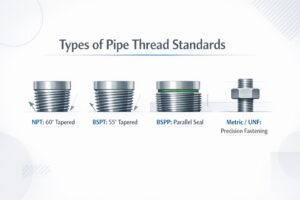
We regularly machine international thread profiles including NPT (ANSI/ASME B1.20.1 taper 1:16), NPTF, BSPP (Parallel ISO 228), BSPT (Taper ISO 7), Metric (ISO 68-1), and UNF/UNEF threads. All threads are verified using optical projectors and calibrated ring/plug gauges.
Q5: What is your standard Minimum Order Quantity (MOQ) and lead time?
Our standard production MOQ is 2,000 pcs per custom part number for precision CNC runs. This batch size allows us to optimize automated gantry setup times, amortize custom collet tooling, and keep unit costs competitive. Standard production lead times average 3 to 4 weeks following sample sign-off.
Ready to Review Your Technical Drawings?
If you are currently sourcing custom stainless steel or carbon steel pipe fittings within 200 × 350 mm dimensions and need to eliminate thin-wall distortion, thread leaks, or material grade uncertainty, submit your 2D/3D CAD drawings to our engineering team today.
What You Will Receive Within 24 Business Hours:
-
A complete DFM (Design for Manufacturability) engineering review analyzing thread clearances, wall thicknesses, and clamping strategies.
-
An itemized pricing proposal detailing raw material costs, machining cycle times, passivation options, and direct-reading spectrometer material traceability reports.
Contact Our Engineering Team:
-
Email: info@sspipefitting.com
-
Technical Inquiries: Direct CAD upload available via our corporate web portal.
-
Factory Address: Precision CNC Machining Division, Yuhuan, Taizhou City, Zhejiang Province, China.