1. The Honest Disclaimer
We are an original equipment manufacturer (OEM) specializing in precision CNC machining and custom carbon steel pipe fittings. We wrote this guide from our daily shop-floor experience rather than as a detached testing agency. We work with raw materials like 1020, 1045, Q235, S235JRH, and 12L14 every day.
Carbon steel offers high strength, excellent machinability, and low raw material cost. However, its main physical limitation is simple: if left unprotected in moisture and air, it will rust 100% of the time. No cheap surface treatment makes carbon steel rust-proof forever. Real engineering is always a balance among tight thread tolerances, corrosion lifespan, and total budget.
2. Complete Guide to Metal Rust Prevention
The Science of Rusting
Rust is an electrochemical reaction. Iron in the steel reacts with water and oxygen (Iron + Water + Oxygen = Iron Hydroxide / Red Rust).
To stop rust, engineers use three core methods:
-
Physical Barrier: Block water, oxygen, and salt from touching the raw metal surface.
-
Sacrificial Protection (Galvanic): Coat the steel with a more active metal (like zinc) that corrodes first to protect the steel underneath.
-
Surface Passivation: Create a thin, stable chemical oxide film on the surface to stop further reactions.
Material Selection and Part Design
-
Alternative Corrosion-Resistant Metals:
-
Stainless Steel: Contains at least 10.5% Chromium (such as 304 and 316L) to form a self-healing protective film.
-
Weathering Steel (Corten) and Alloy Steels: Small additions of Copper, Nickel, and Chromium help form a dense rust layer that slows down further corrosion.
-
Brass and Aluminum: Non-ferrous metals that naturally create protective oxide layers without iron rust.
-
-
Smart Design Rules for Pipe Fittings:
-
No Water Traps: Avoid sharp inner dead zones where liquid or dust settles. Add drain holes if needed.
-
Prevent Galvanic Corrosion: Do not let raw carbon steel directly touch copper or stainless steel in wet areas without insulating washers.
-
Reduce Residual Stress: Relieve internal stress after heavy turning or cold working to prevent stress corrosion cracks.
-
Common Anti-Rust Methods & Surface Treatments
1. Physical Barrier Methods
-
Anti-Rust Oils and Greases:
-
Thin Film / Evaporating Oil: Leaves an invisible protective film. Easy to wash off; best for short-term indoor storage between machining steps (1 to 4 weeks).
-
Heavy Oil and Grease: High thickness and strong adhesion; best for long-term ocean shipping and outdoor spare parts.
-
-
Paints and Industrial Coatings:
-
Zinc-rich epoxy primer (provides sacrificial zinc protection) combined with polyurethane topcoats (resists UV and rain).
-
-
VCI Packaging (Vapor Corrosion Inhibitor):
-
VCI paper, VCI bags, and emitter capsules release harmless rust-inhibiting vapors inside sealed boxes to cover microscopic metal pores.
-
Vacuum sealing with desiccant clay bags prevents air contact.
-
2. Chemical Conversion Coatings
-
Water-Based Inhibitors: Passivation rinses used during cleaning cycles for short-term temporary indoor protection.
-
Phosphating (Zinc/Manganese/Iron): Converts the outer surface into an insoluble crystalline layer. Perfect as a paint primer or for break-in lubrication.
-
Black Oxide (Bluing): Creates a very thin chemical black layer (thickness < 1 μm). It has almost zero rust resistance on its own and requires oil immersion to work.
-
Acid Pickling & Passivation: Used on stainless grades to clean free iron contamination.
3. Electrochemical & Plating Methods
-
Zinc Plating (Electro-Galvanizing): Standard sacrificial coating (typically 5 to 12 μm thick). Bright finish, accurate thread fit, and low cost.
-
Hot-Dip Galvanizing (HDG): Thick zinc layer (typically 45 to 80+ μm). High outdoor durability, but not suitable for small, high-precision threads due to uneven buildup.
-
Nickel and Chrome Plating: Hard, wear-resistant barrier coatings. The coating must be 100% free of micro-pores to prevent severe local pitting underneath.
-
Zinc-Flake Coating (Geomet / Dacromet): Non-electrolytic coating made of overlapping zinc and aluminum flakes. Delivers 500 to 1000+ hours of salt spray resistance with zero risk of hydrogen embrittlement.
-
Cathodic Protection: Using sacrificial zinc/magnesium anodes or impressed electrical currents for buried cross-country pipe networks and ships.
Pre-Treatment Steps: The Real Secret to Success
More than 80% of rust failures happen because of poor surface preparation:
-
Degreasing and Cleaning: Machine coolant, cutting oil, and worker fingerprints contain salt (Sodium Chloride). If oil is applied over salty fingerprints, the fitting will rust underneath the oil layer.
-
Blasting and Pickling: Sandblasting (Sa 2.5) or acid pickling removes old mill scale and initial shop spots.
-
Fast Hot-Air Drying: Parts must be dried immediately at 80°C to 120°C with hot air. Trapped rinse water in internal threads causes fast flash rust.
Application Matching Chart
| Application Scenario | Recommended Rust Prevention | Key Engineering Notes |
| In-House Storage (1 to 4 Weeks) | Water-based inhibitor / Light rust oil | Very thin film; clean to handle; easy to wash off before welding or assembly |
| Ocean Shipping (Export) | Heavy rust oil + Sealed VCI bag + Desiccant | Protects against condensation (“container rain”) and high salt air |
| Outdoor Heavy Equipment | Hot-Dip Galvanizing or Zinc Primer + Topcoat | High UV resistance; watch out for thread fits if hot-dip galvanized |
| Precision CNC Pipe Fittings | Zinc-Flake (Geomet) / Zinc Plating + Sealant | Maintains thread pitch accuracy; avoids thread jamming and hydrogen damage |
Common Mistakes & Quality Testing Standards
-
Two Big Mistakes:
-
Oiling dirty parts: Applying oil over oily residue or sweat spots leads to deep pitting corrosion.
-
Low chemical concentration: Running passivation baths below the target concentration causes localized battery-cell rust spots.
-
-
Testing Methods:
-
Neutral Salt Spray Test (NSS): ASTM B117 / ISO 9227 (measures hours until white or red rust appears).
-
Humidity Chamber Test: ASTM D2247 (evaluates sweating and temperature changes during sea freight).
-
Copper Sulfate Spot Test: Quick test to verify coating density and passivation quality.
-
3. Hidden Industry Pitfalls to Avoid
-
Skipping the De-Embrittlement Bake: Medium-carbon and alloy steels (like 1045, 4140) absorb hydrogen during acid cleaning and electroplating. Cheap suppliers skip the required baking step (190°C to 220°C for at least 4 hours). This causes high-pressure carbon steel fittings to crack suddenly during installation under normal torque.
-
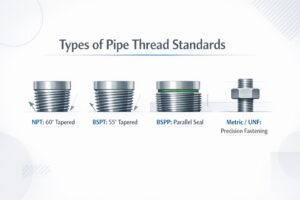
Over-Plating That Jams Threads: Standard pipe threads (such as NPT, BSPP, metric 6g/6H) have tight tolerances. Some plating shops add excessive zinc (15+ μm) to hit salt spray targets. This fills thread roots and causes components to seize up during field assembly.
-
Using Ordinary Motor Oil for Ocean Shipments: Standard motor oil lacks polar film-forming additives. During 30-day ocean voyages across humid tropical routes, regular oil runs off vertical surfaces, resulting in rusty fittings upon arrival.
4. Anti-Rust Coating Options for Carbon Steel Fittings
Option A: Precision CNC Machining + Zinc-Flake Coating (Geomet)
-
Main Advantages: No acid pickling, zero hydrogen embrittlement, uniform thin layer, and high corrosion protection (over 720 hours NSS without red rust).
-
Evidence Level: Verified by third-party ASTM B117 salt spray tests and coating thickness gauges.
-
Limitations: Coating thickness is 8 to 12 μm, which requires programmed pitch diameter compensation during CNC turning. Non-conductive surface.
-
Recommendation: If you need high-pressure fittings for offshore or wet outdoor environments with zero risk of sudden brittle failure, choose Option A.
Option B: Precision CNC Turning + Trivalent Zinc Plating with Topcoat
-
Main Advantages: Bright visual finish, good surface conductivity, and low production cost.
-
Evidence Level: In-house quality control data (coating 6 to 8 μm; 96 hours to white rust, 168 hours to red rust).
-
Limitations: Deep blind holes and internal pipe threads receive thinner plating due to electrical shielding effects. Medium-carbon steels must be post-baked.
-
Recommendation: If you need standard hydraulic fittings for enclosed indoor machinery at an economical price point, choose Option B.
Option C: Turned Bare Steel + Heavy Anti-Rust Oil & VCI Vacuum Pack
-
Main Advantages: Zero coating buildup on micro-precision threads (maintains tolerances of ±0.01 mm); ideal for parts that will be welded on-site or painted after final machine assembly.
-
Evidence Level: CMM measurement records and 30-day humidity chamber tests.
-
Limitations: The customer must clean the oil off before installation, and the part has zero corrosion protection once unwrapped in a damp shop.
-
Recommendation: If you need weld-on fittings or components that will receive integrated system painting later, choose Option C.
5. The True Cost Formula
When buying carbon steel pipe and fittings, the unit quote is only part of your real expense. Calculate your true Total Cost of Ownership (TCO) with this formula:
Plaintext
True Total Cost = Base Machining Price
                + Tolerance Compensation & Tooling
                + Surface Treatment & Baking Fee
                + Salt Spray & Inspection Lab Fee
                + VCI Export Packaging
                + (Assembly Failure Rate x Line Shutdown Cost)
-
Surface Treatment Spreads: Zinc-flake coatings generally cost 2.5 to 3.5 times more than basic blue-white zinc plating. De-hydrogen baking adds small batch furnace fees.
-
Rework Losses: If a shop cuts standard threads and adds 12 μm of coating without pre-machining offset, the thread Go-gage will fail. Stripping the coating and re-machining ruins dimensions and costs more than the original machining run.
6. Shop-Floor Case: Why Low-Grade Coolant Causes 100% Scrap on Bare Steel Fittings
In actual CNC machining operations, substandard cutting fluid is the leading cause of early rust. When low-grade or over-diluted coolant is used, turned carbon steel parts can develop micro-rust spots within 24 hours of production.
The consequences depend heavily on the final surface specification:
-
Plated Parts: If the component is scheduled for heavy electro-zinc plating with relaxed visual requirements, light surface flash rust may be cleaned off during pre-plating acid pickling (though this increases hydrogen embrittlement risks).
-
Bare-Metal Precision Parts: For fittings delivered with raw machined surfaces protected only by anti-rust oil, surface rust creates irreversible damage. Micro-pits penetrate into the metal grain, making rework impossible without violating tight ±0.01 mm tolerances. As a result, entire batches are frequently scrapped.
To prevent these hidden costs, precision bare-metal components must receive immediate in-process rust prevention during production runs. Manufacturers must also enforce strict daily testing of cutting fluid concentration, pH levels, and anti-corrosion properties. Cutting corners on shop consumables to offer lower quotes inevitably leads to catastrophic batch scrap and project delays.
7. Buyer’s 5-Point Quality Checklist
Ask your potential suppliers these 5 technical questions before placing an order for fittings carbon steel:
-
Thread Clearance Offset: Do you adjust thread pitch diameter programs on your CNC lathes before applying thick zinc or zinc-flake coatings?
-
Baking Records for High Strength Parts: For carbon steels with hardness ≥ HRC 32 or tensile strength ≥ 1000 MPa, do you bake parts at 190°C to 220°C within 4 hours after plating? Can you provide the furnace temperature chart?
-
Internal Thread Coverage: For fittings with deep internal cavities (length-to-diameter ratio > 3:1), what is your guaranteed plating thickness inside the bore?
-
Salt Spray Definition: When you state “NSS 120 Hours”, does that mean zero white rust (zinc corrosion) or zero red rust (base steel corrosion)?
-
Export Packaging Specs: Does your export quote include branded VCI film (minimum 80 μm thickness) with matched desiccant, or just plain plastic bags?
8. Limitations & Trust-Building Conclusion
-
Our Honest Limits: We specialize in tight-tolerance CNC turning, custom thread manufacturing, and controlled anti-rust packaging for carbon steel pipe fittings. We do not run in-house high-pollution bulk plating or huge hot-dip zinc pools; all specialized plating and zinc-flake operations are handled by audited regional coating partners. If you are looking for rough, un-machined construction pipe with heavy, irregular hot-dip galvanizing, we are not the cheapest choice.
-
Our Commitment: If your application requires precise thread engagement, verified zero-embrittlement processing, documented salt spray testing, and clean sea-freight packaging, we are ready to support your production.
Request Your Free DFM & Anti-Rust Review
Are you dealing with jammed threads after plating, rusty parts upon container arrival, or brittle failure concerns? Contact our technical team today:
-
Free DFM & Tolerance Check: Send your 2D/3D drawings (STEP, IGES, PDF, DWG) to our engineers. We will return a tolerance offset plan and surface finishing recommendation within 24 hours.
-
Verified Sample Runs: We provide machined prototype samples complete with full CMM inspection data sheets and salt spray certification.
Working on a custom carbon steel fitting project with strict corrosion specs?
Don’t let post-plating thickness ruin your thread fit. [Contact Our Engineers] today for free tolerance offset calculations and surface finishing recommendations.