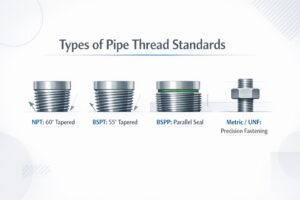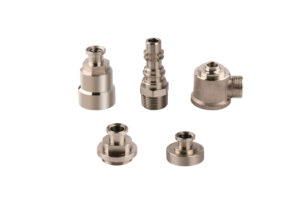
For industrial pipe systems operating under heavy loads, selecting precision NPT threaded fittings is the most direct way to eliminate fluid leaks and avoid costly maintenance downtime.. What are NPT fittings? In industrial fluid handling, National Pipe Taper fittings—governed by the ASME B1.20.1 standard—represent the North American benchmark for 60-degree tapered pipe connections. Designed to establish an interference fit along their mating threads, these components are deployed across high-vibration, high-pressure environments where system failures can cause catastrophic blowouts or unplanned downtime. Across corrosive chemical and marine processing lines, engineering teams routinely standardize on stainless steel NPT fittings (often designated in procurement as NPT stainless steel fittings) to ensure mechanical resilience and corrosion resistance.
At Yuhuan Hongqian Machinery Co., Ltd., situated in the advanced manufacturing hub of Yuhuan, Zhejiang Province, China, we deliver high-precision OEM and ODM contract manufacturing of custom stainless steel and alloy pipe adapters. Operating from a modern 1,500-square-meter facility equipped with 70 to 80 precision CNC turning and turning-milling centers, supported by 15 automated gantry loading systems, our shop floor sustains a reliable monthly production capacity of roughly 200,000 pieces. Mastering the tight tolerances of American national taper pipe threads—particularly the critical distinction between standard NPT and dryseal NPTF—is essential to prevent thread galling, flank distortion, and micro-leakage across all custom-turned stainless steel NPT fittings.
The Core Division: NPT vs. NPTF (Standard vs. Dryseal Mechanics)
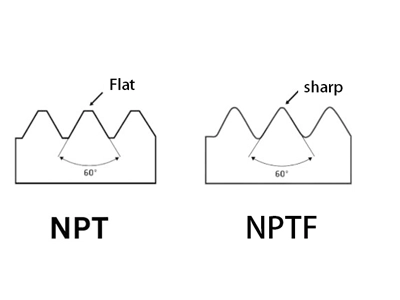
While both thread profiles share identical 60-degree flank angles and a 1:16 taper ratio (an inclination of 1 degree 47 minutes, or 0.75 inches per foot), their sealing physics and flank engagement differ fundamentally:
-
Standard NPT (ASME B1.20.1):
-
Geometry: The crests and roots of standard NPT threads are designed with flat truncations, but manufacturing tolerances allow clearance gaps between the crest of one thread and the root of the mating thread.
-
Sealing Mechanism: As the male and female fittings are torqued together, flank interference occurs. However, because clearance remains at the crests and roots, a continuous spiral leakage path exists through the thread helical spiral. Standard NPT stainless steel fittings strictly require a thread sealant—such as PTFE tape or an anaerobic thread paste—to pack the micro-voids and hold fluid pressure.
-
-
NPTF Dryseal (ASME B1.20.3):
-
Geometry: NPTF specifications dramatically tighten the allowable truncation limits on both crests and roots.
-
Sealing Mechanism: During wrench assembly, the sharp crests of the thread contact the mating roots before the flanks fully seat. Further tightening causes deliberate, controlled metal-to-metal plastic deformation (crush). This crush closes off the spiral void completely. True NPTF joints achieve a leak-tight seal without any tape or sealant, making them mandatory in clean fluid power, aircraft fuel systems, and high-purity hydraulic circuits where loose tape shreds would clog valves and filters.
-
Machining Challenges: Internal Threads, Chip Evacuation & 1:16 Taper Control
Machining tapered pipe threads in tough, work-hardening alloys like 304, 316L, and Duplex stainless steel presents major production hurdles:
-
Internal Threads vs. External Threads: Machining an internal female NPT port is significantly more difficult than turning an external male thread. External tools use rigid, heavy-shank toolholders with abundant chip clearance. Internal boring bars, by contrast, must reach deep into constricted holes with high length-to-diameter overhang ratios. This overhang creates cutting deflection, tool chatter, and surface roughness deterioration.
-
The Stainless Steel Chip Packing Hazard: Austenitic stainless steels produce continuous, tough ribbon chips. In blind internal ports, chips easily wrap around the boring bar or jam against the hole bottom. Jammed chips instantly chip carbide insert cutting edges, tear thread flank finishes, and ruin thread pitch accuracy.
-
Tapping vs. CNC Single-Point Helical Interpolation:
-
Why Tapered Taps Fail in Stainless: Using a full-form tapered NPT tap means the entire cutting profile engages the metal simultaneously as depth increases. Cutting torque spikes exponentially, leading to tap stalling, tooth breakage, and inaccurate thread depth.
-
The CNC Single-Point Advantage: At Yuhuan Hongqian Machinery, tapered NPT and NPTF threads on stainless steel NPT fittings are single-point turned via synchronized two-axis CNC helical interpolation. By taking progressive, multi-pass passes with custom-ground carbide inserts, we maintain precise control over the 1:16 taper slope, minimize cutting pressure, and hold pitch diameter consistency across tens of thousands of parts.
-
-
Controlling Internal Taper & Bore Geometry: Beyond the 1:16 thread taper itself, machined fittings often incorporate internal seat chamfers, counterbores, or straight pilot diameters. CNC tool offsets must be managed dynamically so that internal bore taper and out-of-roundness remain strictly within ±0.005 mm, eliminating the risk of “bell-mouthing” that compromises backup seal faces.
Metrology & Inspection Protocols: Multi-Tier Gaging for NPT Fittings
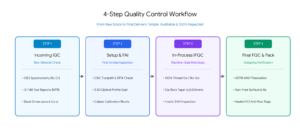
Because tapered threads seal through mechanical interference, a simple caliper check is insufficient. We implement a rigorous, multi-tiered metrology routine for all NPT stainless steel fittings:
-
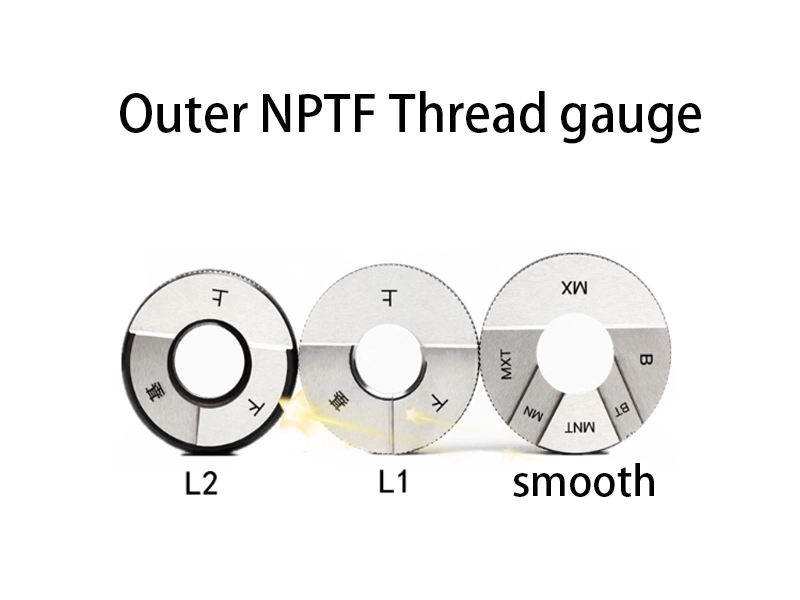
The American Standard Step-Gage System (L1, L2, and L3):
-
L1 Gaging (Hand-Tight Engagement): Checks the functional pitch diameter at the baseline engagement plane. The fitting must hand-thread into the L1 ring or plug gauge until the reference notch aligns within a strict tolerance window of ±1 turn (or ±0.5 turn for precision classes).
-
L2 and L3 Gaging (Wrench-Tight Verification): L1 gages verify only the first few threads. For high-pressure critical joints, we deploy L2 ring gages (for male threads) and L3 plug gages (for female threads) to verify the pitch diameter and full taper slope of the deeper, fully wrenched threads. If a part passes L1 but fails L2/L3, the 1:16 taper angle is out of spec.
-
NPTF 6-Step Crest/Root Gages: For dryseal NPTF parts, dedicated truncation gages verify that crest flats and root flats fall strictly within the truncation limits required to guarantee plastic crush.
-
-
Machine-Side Calibration Blocks: Digital calipers and micrometers on the shop floor must never drift. Every machining center is furnished with calibrated hardened steel gauge blocks. Machine operators verify their tool zero-points at shift changeover, tool swaps, and regular hourly checkpoints.
-
Advanced Optical Profile & Contour Inspection:
-
2.5D Optical Profile Projectors: Magnify the thread profile at 50x to 100x to cross-verify the 60-degree half-angle, pitch linearity, and root radius against digital CAD overlays.
-
Contour Measuring Instruments (Conturographs): A diamond or carbide stylus traces the thread axis directly, outputting an exact digital curve of the 1:16 taper line, actual flank pitch, and microscopic burr formation.
-
Technical Comparison: NPT vs. NPTF vs. BSPT vs. BSPP
Selecting the correct fitting standard requires absolute clarity on mechanical compatibility:
| Engineering Parameter | NPT Fittings | NPTF Fittings | BSPT Fittings | BSPP Fittings |
| Governing Standard | ASME B1.20.1 | ASME B1.20.3 | ISO 7-1 / EN 10226 | ISO 228-1 (G Thread) |
| Thread Flank Angle | 60° | 60° | 55° (Whitworth) | 55° (Whitworth) |
| Crest & Root Form | Truncated (Flat) | Truncated (Controlled) | Rounded | Rounded |
| Taper Ratio | 1:16 (Tapered) | 1:16 (Tapered) | 1:16 (Tapered) | None (Parallel) |
| Sealing Mechanism | Flank Contact + Sealant | Metal Crush Dryseal | Flank Interference + Sealant | O-Ring / 60° Cone Face |
| Interchangeability | Mates with NPT / NPTF | Mates with NPT / NPTF | Incompatible with NPT (55° vs 60°) | Strictly BSPP / Cone ports |
-
The Cross-Standard Hazard: Never attempt to thread a 60-degree male fitting into a 55-degree BSPT female port. Even though both share a 1:16 taper, the mismatch in thread flank angle causes immediate flank galling, incomplete thread engagement, and dangerous high-pressure blowouts.
Frequently Asked Questions (FAQ)
Q1: Can an NPT male thread screw into an NPTF female port?
Yes, mechanically they will thread together because both share the same 60-degree angle, pitch, and 1:16 taper. However, the connection will no longer function as a dry seal. Because standard NPT crests and roots do not maintain controlled truncation limits, you must apply PTFE tape or anaerobic sealant to prevent spiral leakage.
Q2: Why does NPT thread inspection require both L1 and L2/L3 plug and ring gauges?
An L1 gage checks only the initial hand-tight thread engagement zone. It cannot detect whether the taper angle deviates deeper along the thread length. L2 (male) and L3 (female) gages evaluate the deeper threads engaged during final wrench tightening, confirming that the entire 1:16 taper geometry remains linear.
Q3: What causes stainless steel NPT fittings to gall during assembly, and how is it prevented?
Austenitic NPT stainless steel fittings (such as 304 and 316) form a microscopic passive oxide layer that can rupture under high friction and thread flank pressure, causing bare metal surfaces to cold-weld and seize (gall). Galling is prevented by maintaining a fine CNC-turned surface finish (Ra ≤ 0.8 μm), eliminating micro-burrs via precision deburring, and applying high-grade anti-seize paste during field assembly.
Q4: Why is CNC single-point threading superior to tapping for tapered NPT fittings?
Tapping tapered threads forces dozens of cutting teeth to engage the workpiece simultaneously, causing cutting torque to spike and often leading to tool breakage or torn threads in stainless alloys. CNC single-point threading uses progressive, light passes, providing superior surface finishes, precise 1:16 taper control, and extended insert life.
Partner with a Precision CNC Machining Facility
Whether your application demands mass-production runs of standard stainless steel NPT fittings, high-reliability NPTF dryseal connectors, or complex hydraulic manifold blocks with custom cross-ported threads, Yuhuan Hongqian Machinery Co., Ltd. delivers precision contract machining built to strict engineering prints.
-
Production Scale: 1,500 m² workshop equipped with 70 to 80 precision CNC turning and turning-milling centers.
-
Automated Output: 15 automated gantry loading systems sustaining a dependable monthly volume of roughly 200,000 components.
-
Verified Quality Systems: Multi-tier L1/L2/L3 thread gaging, 2.5D optical profile inspection, dial bore taper verification (±0.005 mm), and complete EN 10204 Type 3.1 material traceability.

Submit your 2D drawings (PDF) and 3D CAD files (STEP) today for detailed manufacturability analysis and transparent, factory-direct pricing within 24 to 48 hours.