What Does OEM Mean and What Is an OEM Part?
The Core Division: OEM vs. ODM
-
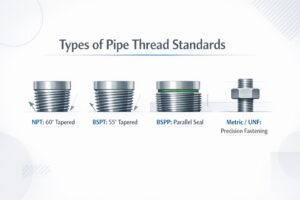
OEM (Build-to-Print Contract Manufacturing): You provide the complete engineering package—2D prints with linear and geometric tolerances, 3D STEP files, raw material standards (such as ASTM A276/A479 Grade 304/304L or 316/316L), thread standards (ASME B1.20.1 NPT, ISO 228-1 BSPP, or ISO 6149 Metric), and finishing requirements. The precision factory operates as your contract production unit.
-
ODM (Catalog Platforms & Private Labeling): The factory designs, tests, and owns the mass-production tooling for standard stainless steel pipe fittings. You purchase proven catalog hardware (such as ASME B16.11 threaded couplings or DIN 2353 bite-type fittings), optionally adding custom laser-etched part numbers, logos, or branded packaging.
Engineering Comparison: OEM vs. ODM
| Evaluation Factor | OEM (Build-to-Print Custom Machining) | ODM (Catalog & Private Label Fittings) |
| Design & Blueprint Ownership | Buyer (100% proprietary prints, CAD, & IP) | Manufacturer (Shared catalog baseline) |
| Component Scope | Custom pipe fittings, manifold ports, valve blocks | Off-the-shelf stainless pipes and fittings |
| Tooling & Setup Investment | Custom soft jaws, dedicated form chasers, custom broaches | Standard collets, off-the-shelf inserts, existing dies |
| Dimensional Flexibility | Full freedom over wall thickness, hex sizes, drop lengths | Fixed to supplier catalog dimensions and standard steps |
| Tolerancing Capability | Precision machining down to ±0.005 mm, hole/shaft classes ($H7/h6$) | Standard commercial tolerances (typically ISO 2768-m) |
| Material Traceability | Certified 3.1 Mill Test Reports (MTR) tied to specific melt heats | General factory batch material conformity sheets |
| Blank Forming Options | Solid bar turning, cold heading, hot forging, or silica sol casting | Fixed by factory platform tooling |
| First Article Lead Time | 3 to 6 weeks (DFM review, tooling setup, FAI sampling) | Immediate to 2 weeks (Existing inventory or running batches) |
| Exclusivity & Protection | Complete (Governed by enforceable Non-Disclosure Agreements) | None (Competitors can buy identical base components) |
Deep Dive: Raw Blank Selection for Custom Fabricated Pipe Fittings
[Raw Stock Selection] ──► [Near-Net Blank Forming] ──► [Precision CNC Turning] ──► [Surface Passivation]
  • Solid Bar (ASTM A276)     • High-Speed Turning (Low-Vol)     • Multi-Axis Live Tooling     • ASTM A967 Citric/Nitric
  • Coiled Wire Rod           • Cold Heading (High-Vol Hex)      • 100% Thread Pitch Gaging   • Ultrasonic Cleaning
  • Round Billet              • Hot Forging (High-Pressure Tees) • Optical Taper Inspection   • Corrosive Salt-Spray QA
-
Solid Bar Turning (CNC Hex/Round Bar):
-
Process: Direct multi-axis CNC turning from cold-drawn solid bar stock (ASTM A276 / ASTM A479).
-
Engineering Advantage: Superior structural density with zero internal shrinkage or gas porosity. Ideal for high-pressure hydraulic adapters and prototypes where upfront tooling cost must remain zero.
-
Tradeoff: Higher material swarf on complex elbows and tees.
-
-
Cold Heading (High-Speed Cold Forming):
-
Process: High-tonnage progressive cold forming directly from wire rod to shape hex blanks, collars, and pre-formed internal bores before secondary CNC thread turning.
-
Engineering Advantage: Grain flow follows the part contour, increasing shear and tensile strength while minimizing raw material scrap.
-
Tradeoff: Requires upfront cold-heading die investment; best suited for annual volumes exceeding 20,000 to 50,000 pieces.
-
-
Hot Forging:
-
Process: Heating round billet to forging temperature and pressing into closed dies to form 90° elbows, tees, and cross fittings.
-
Engineering Advantage: Eliminates directional grain weaknesses, delivering exceptional impact and burst pressure resistance in heavy industrial fluid lines.
-
Tradeoff: Leaves surface scale that requires shot blasting or pickling before secondary machining.
-
-
Silica Sol Investment Casting:
-
Process: Precision lost-wax casting using silica sol binder, followed by CNC machining of threads, sealing seats, and O-ring grooves.
-
Engineering Advantage: Economical for complex internal fluid passages and irregular exterior shapes where subtractive machining is cost-prohibitive.
-
Tradeoff: Lower yield strength compared to wrought or forged bar; requires strict pressure testing to rule out micro-shrinkage.
-
Critical Engineering Scenarios: When to Choose Custom Machined Fittings
-
Non-Standard or Mixed Thread Combinations: Equipment ports that require a male NPT taper thread on the inlet, a metric straight thread ($M18 \times 1.5$) with an elastomeric O-ring seal on the run, and a specialized swivel nut on the branch.
-
Severe Envelope Constraints: Custom-engineered valve manifolds and mobile hydraulic assemblies frequently require shortened hex body lengths, low-profile drop elbows, or integrated mounting tabs to clear structural framing.
-
High-Purity and Clean-in-Place (CIP) Requirements: Pharmaceutical, food-grade, and semiconductor lines require mirror-smooth internal IDs ($Ra \le 0.4\ \mu\text{m} / 16\ \mu\text{in}$), complete elimination of stagnant fluid dead-legs, and electropolishing per ASME BPE standards.
-
Severe Corrosive Environments: When standard SS304/SS316 fails in offshore marine, sour gas ($H_2S$), or acidic process lines, OEM manufacturing allows you to specify high-alloy materials such as 316L, 317L, Duplex 2205, or Super Duplex 2507.
When Does an ODM Model Fit Your Supply Chain?
-
Sourcing Industry-Standard Interchanges: You require ANSI/ASME B16.11 class 3000/6000 threaded couplings, standard DIN 2353 metric compression fittings, or ISO 8434-1 hydraulic connectors that must remain interchangeable with existing field installations.
-
Accelerating Speed-to-Market: You need immediate product availability without waiting 4 to 8 weeks for tooling fabrication, sample turnaround, and First Article Inspection (FAI).
-
Minimizing Initial Capital Risk: You are expanding an aftermarket catalog or launching a regional distribution line and prefer to focus working capital on inventory turnover rather than custom tooling setups.
Quality Assurance & Metrology: Mitigating Risk in Custom Fabrication
-
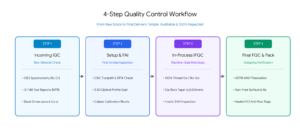
Chemical Verification: Optical Emission Spectrometry (OES) verifies that Nickel, Chromium, and Molybdenum content strictly adhere to ASTM standards, preventing the use of substandard scrap melts.
-
Internal Taper & Bore Verification: Internal groove dial calipers and 2.5D optical profile projectors verify internal taper concentricity, ensuring elastomeric O-rings and metal-to-metal flare seats seal reliably without micro-leakage.
-
Thread Geometry: 100% thread gauging using calibrated working and reference plug/ring gauges (system 21/22 thread inspection per ASME B1.3).
-
Chemical Passivation (ASTM A967): Removing free iron embedded during machining via nitric or citric acid passivation, ensuring rapid formation of the protective chromium oxide passivating layer.
-
Corrosion & Pressure Validation: Neutral Salt Spray (NSS) testing per ASTM B117 (exceeding 240–480 hours without red rust) and hydrostatic/pneumatic pressure decay leak testing.
Frequently Asked Questions (FAQ)
Q1: What does it mean OEM parts when dealing with stainless steel pipe fittings?
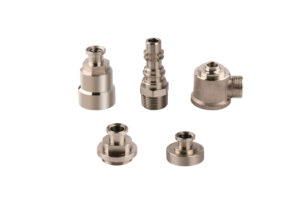
In the fluid-handling and mechanical piping sector, an OEM part refers to an adapter, manifold block, connector, or valve body engineered strictly to a buyer’s proprietary 2D prints and 3D CAD files. The buyer controls the design, revision releases, and intellectual property (IP). The contract manufacturer focuses entirely on production—executing DFM analysis, dedicated tooling/fixturing, CNC turning, and precision metrology without altering the specified geometry.
Q2: What is an OEM part compared to an ODM part?
The fundamental division lies in design ownership and tooling origin:
-
OEM (Build-to-Print): Starts with the buyer’s custom CAD files, thread profiles, and linear/geometric tolerances. You own 100% of the proprietary IP and tooling.
-
ODM (Catalog/Platform): Starts with an existing product platform pre-engineered and tooled by the factory. You purchase field-proven hardware, optionally applying custom laser markings or branded packaging.
Q3: Which is cheaper, OEM or ODM for stainless fittings?
-
Upfront Costs (CapEx): ODM is significantly cheaper initially. The factory has already absorbed tooling, forging dies, stamping fixtures, and performance validation costs. OEM requires upfront Non-Recurring Engineering (NRE) investment for custom soft jaws, dedicated form chasers, gauges, or blank tooling.
-
High-Volume Unit Costs (OpEx): OEM can be more cost-effective at scale. Because you own the complete bill of materials (BOM) and blank-forming path, you avoid built-in supplier design premiums and gain direct control over unit economics as batch volumes grow.
Q4: Is OEM inherently better than ODM?
Neither model is universally superior; the right choice depends on your engineering envelope and business strategy:
-
Choose OEM when your application demands non-standard thread mix, proprietary porting, strict $H7/h6$ slip/press fits, custom internal taper sealing, or absolute IP protection.
-
Choose ODM when sourcing standard interchangeable components (e.g., ANSI/ASME B16.11 couplings, DIN 2353 bite-type fittings) where rapid speed-to-market and low capital outlay take priority.
Q5: Is the ODM model practical for industrial hardware startups?
Yes. For startups launching new equipment lines or aftermarket distribution, ODM minimizes capital risk. It eliminates months of die fabrication and testing cycles, allowing teams to validate commercial demand using standard catalog fittings before investing in proprietary OEM component tooling.
Q6: What does Minimum Order Quantity (MOQ) mean in OEM vs. ODM?
MOQ represents the minimum batch volume a manufacturer will accept to amortize production overhead:
-
OEM MOQs are driven by custom setup parameters: CNC machine changeovers, toolpath optimization, custom blank minimums (e.g., hot forging billet runs or cold-heading wire coil batches), and CMM calibration runs.
-
ODM MOQs are generally lower and more flexible because shops leverage ongoing production runs, off-the-shelf bar stock, and existing tool libraries.
Q7: Which manufacturing route offers greater customization?
-
OEM delivers unlimited customization: You define raw material chemistry (ASTM A276/A479 304L, 316L, Duplex 2205), tight linear/geometric tolerances down to $\pm0.005\text{ mm}$, internal bore finishes ($Ra \le 0.4\ \mu\text{m}$), thread forms (NPT, BSPP, SAE ORB), and specialized surface passivation or plating.
-
ODM allows limited cosmetic customization: Adjustments are confined to laser-etched part numbers, logos, protective cap styles, and outer packaging without changing the core pressure boundary or internal geometry.
Q8: What is Private Labeling compared to OEM and ODM?
Private Labeling is a commercial distribution strategy, whereas OEM and ODM are supply-chain manufacturing methods:
-
Most private-label fluid lines launch via ODM partners, private-labeling catalog fittings directly from the factory floor.
-
As private-label brands scale and require differentiated features, exclusive thread geometries, or proprietary sealing seats to beat commodity pricing, they typically graduate into custom OEM contracts.
Q9: Who owns the intellectual property (IP) in OEM custom manufacturing?
In an OEM arrangement, the buyer retains full ownership of all engineering drawings, 3D models, flow parameters, and proprietary features. To guarantee complete legal protection, this ownership must be formally confirmed via an enforceable Non-Disclosure Agreement (NDA) and Manufacturing Services Agreement (MSA) prior to sharing CAD data.
Q10: Why choose custom machined fittings turned from solid bar stock over cast fittings?
While investment or sand casting is economical for high-volume general utility lines, precision fittings machined from cold-drawn solid bar stock or precision-forged blanks provide a continuous wrought grain structure with zero subsurface blowholes, shrinkage voids, or gas porosity. This structural density is mandatory for high-pressure fluid lines, vacuum systems, and critical metal-to-metal sealing seats.
Q11: How does a precision OEM machine shop prevent cross-contamination in stainless steel?
Experienced stainless steel machine shops maintain strict material segregation: isolated raw material racks, dedicated carbide tooling inserts reserved exclusively for stainless alloys, and segregated cleaning, deburring, and passivation tanks. This eliminates embedded carbon steel particles that otherwise trigger micro-pitting and premature galvanic corrosion.
Q12: What quality documentation should accompany custom fabricated pipe fittings?
A production delivery package for custom fluid components should always include:
-
EN 10204 Type 3.1 Mill Test Reports (MTR): Certifying melt chemistry, heat numbers, and mechanical yield/tensile strength.
-
Dimensional Inspection Reports: First Article Inspection (FAI) data and optical projector/caliper records for thread pitch and internal bore tapers.
-
Surface Passivation Certification: Confirming chemical passivation compliance per ASTM A967.
-
Corrosion & Pressure Validation: Neutral Salt Spray (ASTM B117) records and hydrostatic/pneumatic leak test certificates when specified.