For a precision pipe fittings manufacturer, securing a high-volume manufacturing contract looks like the ultimate commercial milestone—until unbudgeted machine expansions, brutal 90-to-180-day credit terms, and volatile ocean freight disrupt operational stability.
Whether acting as an OEM/ODM pipe fitting manufacturer or partnering through a global industrial trade company, managing risk requires far more than looking at top-line revenue. For high-precision pipe fitting manufacturers, balancing fixed production capacity, raw material financing, and international supply chain shocks determines whether a large purchase order builds long-term equity or triggers enterprise failure.
Below is an unvarnished operational assessment every modern pipe fittings manufacturers enterprise must run before accepting high-volume manufacturing contracts.
1. The Capacity and Asset Expansion Trap
When order volume exceeds shop bandwidth, the immediate reaction is often to buy additional CNC lathes or rent extra plant space. For an expanding pipe fitting manufacturer, this frequently creates an irreversible capital trap.
Fixed Asset Debt vs. Order Lifespan
Adding 10 to 20 CNC lathes or dedicated automation cells to service a single contract creates massive capital expenditure (CapEx). If the buyer cuts quotas after six months or moves production elsewhere, that machinery sits idle while bank financing and depreciation continue.
Cannibalizing Loyal Mid-Tier Accounts
To meet rigid delivery schedules on a giant contract, a stainless steel pipe fittings manufacturer often pushes aside regular, fast-paying small-to-medium clients. When the high-volume order ends, those loyal clients have already qualified other suppliers, leaving the shop floor empty.
The High-Risk Scaling Curve
Scaling volume without enough seasoned setup technicians causes steep spikes in dimensional scrap, tool wear mistakes, and micro-burr defects across automated lines.
2. Cash Flow and Severe Payment Terms
The primary killer of precision machine shops is not a lack of paper profit—it is liquidity starvation. Overseas procurement teams frequently demand Net 60, Net 90, or even payment 180 days after bill of lading (B/L).
The 5% Margin Catastrophe
The Math Behind the Risk:On $3,000,000 in annual output, a contract running at a 5% net margin yields just $150,000 in nominal earnings before overhead variances.
The Negative Yield Equation: Raw Materials vs. Float
Purchasing certified 304 or 316 bar stock requires immediate cash payment. When a pipe fittings manufacturer covers raw bar stock, machine operator wages, and tooling over a 3-to-6-month collection delay, the real cost of working capital (bank interest, inflation, collection fees) easily exceeds 5%. A 5% margin on extended payment terms is a guaranteed net loss.
The Cascade Liquidity Failure
A single late milestone payment or minor technical dispute freezes operational capital across the entire plant, halting material purchases for every other production line.
3. Geopolitical Fractures, Conflict, and Ocean Freight Instability
Global supply chains face ongoing regional military conflicts, shipping bottleneck detours (such as Red Sea rerouting), and erratic tariff policies. For an export-focused pipe fitting manufacturer or industrial trade company, overlooking trade terms creates extreme financial exposure:
| Trade Term / Tool | Direct Risk Exposure | Operational Reality for Manufacturers |
| FOB (Free on Board) | Ocean freight risk sits entirely with the buyer. | Preferred Baseline. Factory liability ends once goods pass the ship’s rail at the origin port. |
| DDP (Delivered Duty Paid) | Factory covers all ocean freight, destination duties, tariffs, and port delays. | Extreme Hazard. A container rate jump (from $2,000 to $8,000+) completely erases manufacturing profit margins. |
| Sinosure | Policy coverage limits and overseas buyer credit evaluations. | Mandatory Protection. Never grant open credit terms if Sinosure rejects or restricts coverage. |
| Letter of Credit (L/C) | Bank-to-bank conditional payment instrument. | Safe Against Insolvency. Demands strict document accuracy to avoid bank payment delays during transit disruptions. |
4. The Hidden Quality and Liability Multiplier on High-Volume Lines
On a 5,000-piece run, a machining defect or tool wear problem affects only a few dozen parts. When custom pipe fitting manufacturers run 100,000 units, the cost of quality changes dramatically.
Compounded Scrap Rates on Automated Spindles
An undetected broken thread insert or raw bar rolling seam can ruin 10,000 parts before optical comparators or CMM audits catch the dimensional drift.
International Return Friction
Shipping rejected pipe fittings back across borders is practically impossible due to customs import rules and prohibitive ocean freight costs. A rejected lot almost always becomes a 100% on-site write-off plus steep customer chargebacks.
Budgeting In-Line Quality Assurance
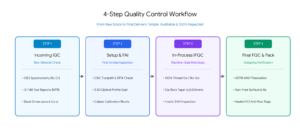
High-volume runs require dedicated inline quality control—PMI alloy testing, calibrated thread ring gauges, and surface roughness verification. An experienced pipe fittings manufacturer budgets these directly into piece pricing rather than absorbing them as hidden plant overhead.
5. Sourcing Qualification Scorecard for Manufacturers and Traders
Before signing any large-volume manufacturing contract, established industrial pipe fittings manufacturers and procurement teams should audit this five-point gate:
-
Financial Hurdle: Gross margin must stay comfortably above 15% to 20% to absorb currency shifts, tooling wear, and financing float. If gross margin is under 10% and net margin is under 5%, decline the order.
-
Payment Security: Require an irrevocable confirmed L/C at sight, a minimum 30% cash deposit, or comprehensive Sinosure policy backing. Never accept unsecured 90-to-180-day open terms from unfamiliar buyers.
-
Logistics Allocation: Default to FOB terms. If a DDP contract is required, include a dynamic container freight adjustment clause.
-
Capacity Safeguard: Keep at least 25% of shop capacity reserved for nimble, high-margin, small-to-medium clients.
-
Material Indexing: Include a contract clause that adjusts piece prices if international steel or nickel prices fluctuate beyond ± 5%.
Frequently Asked Questions (FAQ)
Why is taking a high-volume order with a 5% margin hazardous for an SME pipe fitting manufacturer?
A 5% margin leaves zero buffer for operational variance. Between raw material price adjustments, tool wear, scrap rates, and financing expenses over a 90-day collection cycle, a single delayed shipment or scrap rate above 2% pushes the pipe fitting manufacturer into an immediate net operating loss.
Should a pipe fittings manufacturer accept DDP shipping terms on large overseas contracts?
Only if the agreement includes an enforceable freight adjustment clause. Geopolitical tensions, canal detours, and volatile marine bunker fuel surcharges can quadruple container shipping costs overnight, turning an otherwise profitable production run into a severe liability for the pipe fittings manufacturer.
How do established pipe fitting manufacturers maintain existing customer relationships when a major contract arrives?
Never assign 100% of machine spindles to a single buyer. Reliable pipe fitting manufacturers reserve 20% to 30% of total operational capacity for established, fast-paying, small-to-medium clients, preventing complete operational dependence on any single corporate buyer.
Professional Manufacturing Grounded in Realistic Engineering and Risk Control
At Yuhuan Hongqian Machinery Co., Ltd., we balance advanced production capacity with rigorous commercial discipline. As a specialized stainless steel pipe fittings manufacturer, we operate high-precision CNC lathe clusters with automated gantry robots, delivering custom pipe connectors, fittings, and turned components to precise ASTM, ANSI, and ISO standards.
We do not over-promise capacity or sacrifice quality standards to win low-margin bidding wars. We partner with serious industrial buyers, OEM system builders, and qualified trade company partners who value transparent material traceability, uncompromised dimensional inspection, and reliable long-term delivery schedules.
We execute mutual Non-Disclosure Agreements (NDAs) prior to engineering review. Submit your 2D blueprints, material specifications, and delivery timelines to our technical team for an objective DFM evaluation and reliable factory-direct manufacturing schedule.