Galvanized fittings remain among the most widely specified connection components in fluid power, industrial gas piping, and mechanical assemblies. Carbon steel provides the necessary tensile strength, fatigue endurance, and pressure containment for demanding duty cycles, but its high susceptibility to ferric oxide (Fe2O3 red rust) makes reliable zinc-based surface protection indispensable.
However, assuming that all galvanized fittings provide identical, permanent corrosion resistance is a dangerous engineering misconception. In critical fluid circuits, high-pressure hydraulic fitting bodies operating above 3,000 PSI, commercial gas fitting manifolds, and structural automotive parts, the actual service life of zinc protection depends entirely on coating chemistry, micro-layer thickness, and operational conditions. For an OEM source and precision cnc machinery supplier, guaranteeing performance requires evaluating protective barriers through systematic salt spray testing while engineering dimensional tolerances directly into every cnc machinery part.
1. Corrosion Mechanisms: Why Galvanized Fittings Rust in Field Operation
The service life of galvanized fittings is governed by predictable electrochemical and environmental reactions. When precision-turned carbon steel components degrade in the field, failure typically traces back to four distinct mechanisms:
[Operational Exposure & Atmospheric Attack]
       │
       ├─► 1. Sacrificial Zinc Depletion: Consumption of zinc layer down to bare steel
       ├─► 2. Dust-Induced Electrolyte Pitting: Particulate deposits trap moisture and chlorides
       ├─► 3. Thread Notch Concentration: High-stress micro-grooves speed up grain corrosion
       └─► 4. Assembly Flank Stripping: Tightening torque shears under-dimensioned coatings
-
Sacrificial Layer Depletion: Zinc functions as a sacrificial anode, corroding preferentially to protect the underlying carbon steel. In typical industrial air, standard electroplated zinc depletes at a predictable rate of 1 to 3 μm per year. Once this protective barrier and its passivate film dissolve, bare carbon steel oxidizes rapidly into red rust.
-
Dust Accumulation and Micro-Cell Pitting: Ambient factory grime, exhaust deposits, and road dust contain hygroscopic salts and sulfur compounds. When dust settles on zinc surfaces, it pulls moisture directly from humid air to form micro-droplets of concentrated electrolyte. These tiny galvanic cells trigger severe localized pitting, degrading fittings long before normal atmospheric exposure limits are reached.
-
Machining Micro-Notches and Residual Stresses: Thread roots, sharp O-ring undercut shoulders, and sealing bevels naturally concentrate mechanical stress. The combination of high assembly preload and microscopic lathe tool marks creates ideal initiation sites for localized galvanic pitting and stress corrosion.
-
Mechanical Shearing from Flank Interference: If coating growth is ignored during lathe turning, high makeup torque will abrade or peel the brittle zinc layer off mating thread flanks during installation. This leaves exposed bare steel trapped inside damp thread gaps.
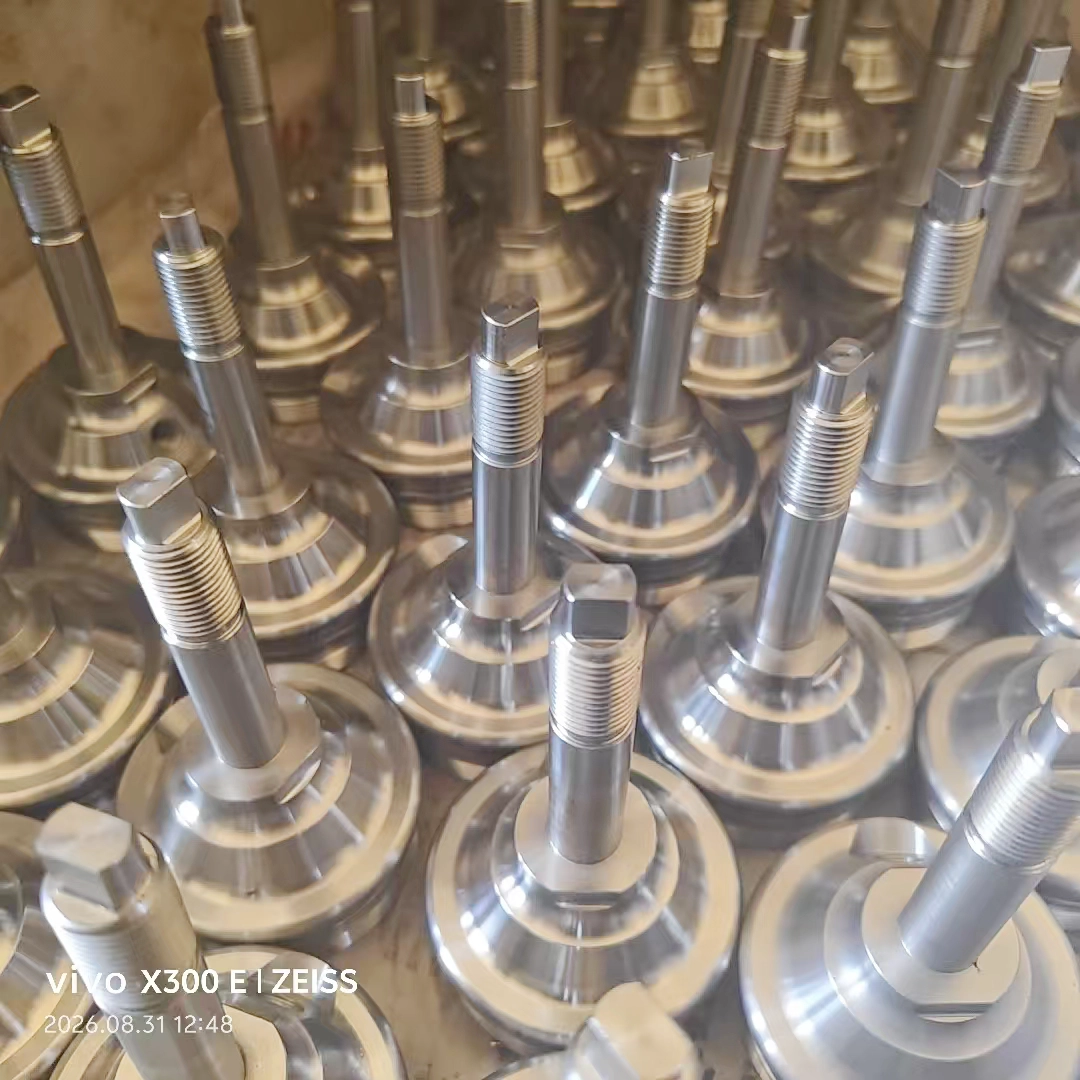
2. Engineering Comparison: Galvanized Fittings Coatings vs. High-Duty Alternatives
Understanding the performance envelope of standard galvanized fittings compared to advanced alternatives prevents costly field failures. The table below compares standard electroplated finishes against high-performance finishes applied to precision carbon steel:
| Surface Treatment Process | Typical Coating Thickness | Neutral Salt Spray (NSS) Performance | Hydrogen Embrittlement & Dimensional Impact | Primary Industrial Applications & Limitations |
| Electro-Galvanized / Trivalent Zinc (Clear/Yellow) | 5 – 12 μm |
White Rust: 24 – 72 h
Red Rust: 96 – 240 h
|
Low-to-moderate embrittlement risk; minimal thread buildup (≤ 0.01 mm per side) | General-purpose fluid lines, pneumatic valves, indoor equipment, standard cnc machinery part orders. Degrades at sustained temperatures > 120°C. |
| Zinc-Nickel Alloy Plating (12–15% Ni) | 8 – 15 μm |
White Rust: 240 – 480 h
Red Rust: 1000 – 1500+ h
|
Requires post-plate de-embrittlement baking; extremely hard and heat resistant to 200°C | Severe-duty high-pressure hydraulic fitting adapters, mobile plant equipment, marine-grade carbon steel fluid manifolds. |
| Dacromet / Zinc Flake Coating | 5 – 15 μm |
White Rust: None (direct barrier)
Red Rust: 720 – 1500+ h
|
Zero hydrogen embrittlement risk (non-electrolytic); provides consistent thread lubricity | Heavy-duty automotive parts, chassis links, high-tensile carbon steel brackets. Unsuitable for small internal threads below M8 due to pooling. |
| High-Phosphorus Electroless Nickel (ENP) | 10 – 25 μm |
Red Rust: 500 – 1000+ h
(Exceptional acid/chemical resistance)
|
Uniform deposit inside deep bores; zero current-density edge effect; hardenable to 60+ HRC | High-precision hydraulic spool bodies, downhole directional tools, corrosive gas distribution blocks. Higher processing cost. |
| Black Oxide / Manganese Phosphate (Oiled) | 1 – 5 μm |
Red Rust: 24 – 72 h
(Completely reliant on oil film retention)
|
Negligible dimensional change; zero embrittlement; predictable friction coefficient | Internally submerged oil-circuit components, transmission splines, short-term factory warehouse inventory. |
3. Thread Plating Allowances in Precision CNC Turning Parts
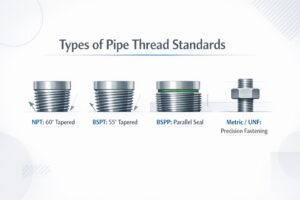
When manufacturing threaded cnc turning parts, protective finishes directly change the functional pitch diameter of the threads. Electroplating does not coat threads flatly; geometry causes coating build-up on thread flanks that changes pitch engagement significantly.
The Pitch Diameter Growth Calculation
For standard 60-degree thread forms (including NPT, NPTF, Metric, UNC, and UNF), coating deposition on the 30-degree flank angles results in an effective pitch diameter change four times larger than the single-side plating thickness:
Pitch Diameter Expansion (External Thread) ≈ 4 × t
Pitch Diameter Contraction (Internal Thread) ≈ 4 × t
For example, applying a 10 μm (0.010 mm) trivalent yellow zinc plate to an external hydraulic connector expands its pitch diameter by approximately 0.040 mm (4 × 0.010 mm).
Pre-Plate Turning Strategy:
Target Finished Thread Pitch Diameter: D
Specified Zinc Layer Thickness per Side: 10 μm (0.010 mm)
Pre-Plate Lathe Programmed Offset: D - 0.040 mm (Class 6e/6f Undersize)
If a lathe operator machines the thread right up to the maximum material limit of a standard Go-gage before sending parts to the plating tank, the finished connector will fail thread ring gauging and seize during field assembly. Precision manufacturing requires intentional pre-plate thread undersizing calculated before turning.
Centrifugal Pooling vs. Electrostatic Edge Effects
While electroplating builds up heavier deposits on sharp outer crests due to electrical field concentrations, dip-spin coatings such as dacromet react differently. Liquid zinc-aluminum slurries can pool in internal thread roots, blind ports, and internal hex sockets under centrifugal processing. For small-bore hydraulic blocks and internal threads under 10 mm, electroplated zinc-nickel or electroless nickel is preferred to avoid channel blockage and thread binding.
Substrate Roughness (Ra) and Salt Spray Testing
A component’s microscopic surface roughness directly dictates its salt spray resistance. A turned surface with a finish of Ra 3.2 μm features micro-peaks that protrude through thin plating layers, causing early white and red rust. By using optimized wiper inserts and rigid tool holding to maintain a clean Ra 0.8 μm to Ra 1.6 μm on sealing shoulders and thread flanks, you eliminate microscopic voids, often extending NSS salt spray endurance by up to 30% under identical plating thicknesses.
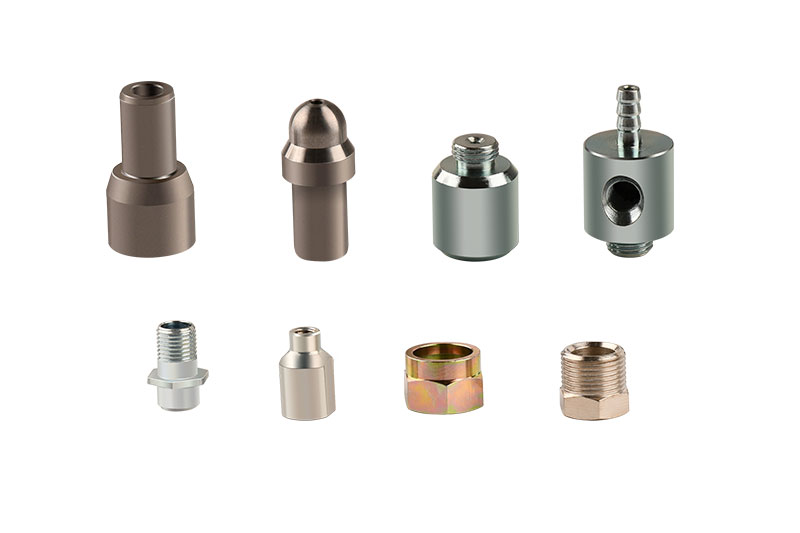
4. Material Selection for High-Pressure Turned Components
Selecting the proper carbon steel grade ensures that finished components handle mechanical loads while accepting surface protection without defects:
-
Free-Machining Carbon Steels (e.g., 12L14, 1215): Ideal for high-speed automated lathe production of standard fluid adapters. However, sulfur and lead inclusions on the surface can create micro-pores during acid etching, requiring careful cleaning to ensure uniform plating adhesion.
-
Low-to-Medium Carbon Steels (e.g., 1020, 1035, 1045): The standard specification for rugged, one-piece hydraulic fitting bodies and high-stress pipe connectors. They provide high core ductility, withstand cyclic pressure spikes, and deliver consistent chemical bonding with both electroplated and zinc flake coatings.
-
High-Strength Alloy Steels (e.g., 4140, 42CrMo): Used extensively for heavy-duty automotive parts and structural hydraulic blocks heat-treated above 28 HRC. Steels with tensile strengths exceeding 1000 MPa are prone to hydrogen embrittlement during acid pickling and electroplating. These components must undergo immediate post-plating de-embrittlement baking at 190°C to 220°C for 4 to 24 hours, or switch to non-electrolytic zinc flake coatings.
5. Technical and Sourcing FAQ
Q1: When should a hydraulic fitting upgrade from standard electro-galvanizing to Zinc-Nickel?
Upgrade to Zinc-Nickel (12–15% Ni) whenever the operating environment involves heavy road-salt spray, marine air, or sustained operating temperatures over 120°C. Standard trivalent zinc chromates dehydrate and develop micro-cracks at high temperatures, causing premature rust. Zinc-Nickel maintains sacrificial and barrier performance up to 200°C and consistently passes 1,000+ hours of neutral salt spray testing to red rust.
Q2: Does Dacromet coating eliminate hydrogen embrittlement risks for high-tensile components?
Yes. Dacromet is a non-electrolytic coating applied through dip-spin immersion and cured thermally at approximately 300°C. Because the process avoids acid pickling (using mechanical shot blasting instead) and uses no electrical current, zero nascent hydrogen enters the steel crystalline lattice. It is the premier protective finish for Grade 10.9 and 12.9 high-tensile fasteners and safety-critical brackets.
Q3: Why is Electroless Nickel Plating (ENP) chosen for complex internal fluid passages despite its cost?
Electroless nickel relies on an autocatalytic chemical reduction rather than electric current density. It deposits with zero current-crowding on edges, maintaining an exact uniform thickness (within ±1.5 μm) across exterior flats, deep blind holes, and internal cross-drilled fluid galleries, while providing strong resistance against sour gas and aggressive hydraulic fluids.
6. Work with an Experienced CNC Machinery Supplier
Inconsistent plating thickness, stripped threads, and premature corrosion cause expensive plant downtime and warranty claims. Partner with a dedicated manufacturing facility that integrates protective plating allowances directly into every CNC machining program.
As an OEM-certified cnc machinery supplier, we engineer, machine, and finish precision carbon steel fluid connectors and mechanical parts to rigorous tolerances:
-
Precision CNC Turning: Advanced multi-axis turning centers holding critical sealing diameters to ±0.01 mm, thread pitch diameters to strict pre-plating allowances, and concentricity within 0.02 mm.
-
Engineered Protective Coatings: Automated Trivalent Zinc (NSS 96–240h), Zinc-Nickel alloy (NSS 1000–1500h+), Dacromet / Zinc Flake, and High-Phosphorus Electroless Nickel.
-
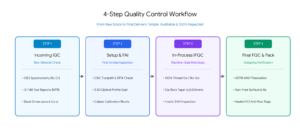
Documented Quality Control: Thread pitch inspection with calibrated Go/No-Go gauges, optical contour analysis, surface roughness verification, and batch ASTM B117 salt spray testing.