Material Metallurgy: Why Grade 303 Cannot Be Electropolished vs. 304/316
1. The Sulfur Trap: Grade 303 Electropolishing Failure
-
Manganese Sulfide Inclusions: Grade 303 is an austenitic free-machining alloy formulated with elevated sulfur (S ≥ 0.15%). This sulfur combines with manganese to form stringers of manganese sulfide (MnS), which enable chip-breaking during high-speed CNC turning.
-
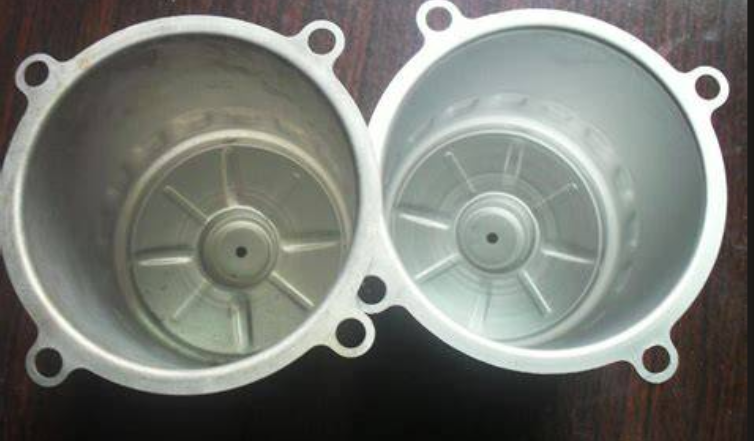
Surface Pitting and “Frosting”: Under the anodic current densities of an electropolishing bath, MnS inclusions dissolve at a significantly higher electrochemical rate than the surrounding iron-chromium matrix. Instead of achieving a smooth, specular sheen, electropolished 303 develops clouding, microscopic cavitation, pitting, and dark streaking.
-
Suitability of 304 and 316: Both 304 and 316 grades maintain tightly restricted sulfur levels (S ≤ 0.030%). In phosphoric-sulfuric electrolyte baths, they undergo uniform anodic dissolution. This removes micro-peaks, smooths micro-burrs, and lowers surface roughness Ra by 30% to 50% without pitting.
2. Base Metal Behavior During Chemical Passivation
-
Grade 303 Sensitivity: Strong nitric acid passivation baths selectively attack exposed sulfide stringers on Grade 303, leaving microscopic voids and a grayish-white frosted haze. Passivating 303 components requires specialized sodium dichromate formulations or citric-acid-based baths with tightly monitored cycle times to avoid acid etching.
-
Grades 304 and 316 Stability: Both alloys tolerate standard ASTM A967 nitric or citric acid solutions. The acid dissolves exogenous free iron and weld slag without pitting the base metal, leaving a clean, uniform satin finish.
1. Mechanical Grinding and Polishing: Physical Weld Seam Removal
Step 1: Rough Grinding and Stock Removal
-
Use pneumatic or variable-speed electric angle grinders equipped with 80# to 120# zirconia alumina or ceramic flap discs.
-
Grind tangentially along the seam profile to eliminate high spots without scalloping the weld fitting wall.
-
Process Guardrail: Never use carbon steel wire wheels or grinding discs previously used on carbon steel. Embedded free iron particles cause rapid galvanic rust blooms on any stainless weld fitting.
Step 2: Intermediate Blending
-
Transition to 240# to 400# non-woven nylon convolute wheels or unitized abrasive discs.
-
Sweep across the blend line in the direction of the original tube draw or CNC turn mark to feather the weld crown into the parent weld fitting body.
Step 3: Fine Finishing (Optional)
-
For sanitary, fluid-contact, or architectural applications requiring Ra ≤ 0.2 μm, follow intermediate blending with flannel buffing wheels loaded with aluminum oxide or chromium green rouge.
-
For directional finishes, use linear finishing drums to generate a uniform #4 architectural satin grain across the entire weld fitting outer surface.
2. Chemical Pickling and Passivation: Oxide Removal and Corrosion Restoration
Localized Pickling Paste
-
For large assemblies or shop-floor touch-ups, apply a thixotropic pickling paste (hydrofluoric-nitric acid base) directly over the weld seam at a thickness of 1 mm to 2 mm.
-
Allow a dwell time of 10 to 30 minutes at room temperature to digest heat tint and the underlying chromium-depleted zone.
Full Immersion Tank Passivation
-
For small weld on fittings, manifolds, and complex custom elbows with inaccessible internal passages, batch immersion in an agitated passivation tank ensures 100% surface exposure.
-
Immersion removes free iron deposits from both the external body and the internal fluid path.
Neutralization and High-Pressure Rinsing
-
Immediately follow acid exposure with a thorough rinse using high-pressure deionized or reverse-osmosis water (chloride content < 50 ppm).
-
Rinse with a dilute alkaline solution (such as 2% to 5% sodium carbonate) to neutralize residual acid trapped inside pipe threads, blind ports, or micro-crevices.
Shop Floor Warning: Why Pickled Welds Flash-Rust (And How to Prevent It)
-
The “Activated” Vulnerability: Standard un-welded stainless steel will not rust after pickling; it quickly passivates when exposed to oxygen. However, pickling strips scale away, leaving raw metal in an “activated” state where any contamination triggers rapid surface oxidation.
-
Micro-Pitting Retention on Prior Rust Spots: Areas that already developed rust blooms or heat tint before pickling behave entirely differently from clean base metal. The previous rust corrosion creates microscopic pits (micro-cavities). Pickling acid dissolves the visual red rust, but the tiny pit geometries hold onto acidic residues via capillary action. Combined with the local chromium depletion caused by welding heat, these micro-valleys act as active galvanic anodes, causing rust spots to re-emerge in the exact same locations within days.
-
Trapped Acid Crevice Attack: Incomplete rinsing leaves aggressive acid residues inside weld undercut micro-pores, thread roots, and capillary clearances. As ambient moisture evaporates, residual acid concentrates and eats away at the substrate.
-
Water Evaporation Halo Rust: Allowing rinsed parts to dry naturally on drainage racks creates localized electrolyte concentration rings around evaporating droplets, leaving circular rust halos.
-
Shop-Floor Mitigation Protocol:
-
Mechanical Pre-Leveling: Lightly blend heavy weld scale or prior rust pits with 240# to 400# abrasive wheels to eliminate micro-cavities before chemical immersion.
-
Mandatory Neutralization: Submerge pickled parts in a dedicated 3% to 5% sodium carbonate (Na₂CO₃) neutralizing bath (ultrasonic agitation recommended) to neutralize acid inside microscopic cavities.
-
High-Pressure DI Rinse: Flush with pressurized deionized water to displace residual neutralizing salts.
-
Chemical Passivation Step: Treat with an oxidizing passivation bath (nitric or citric) to force the immediate growth of a dense chromium-oxide film (Cr₂O₃).
-
Forced Thermal Drying: Blow out blind tapped ports with clean, oil-free compressed air, then immediately dry parts in a forced-air heat tunnel at 70°C to 90°C.
-
3. Weld Cleaners and Electropolishing: High-Purity Fluid Handling
Portable Inverter Weld Cleaners
-
An operator uses a conductive carbon-fiber brush saturated with an electrolyte solution connected to a low-voltage AC/DC power supply.
-
When brushed over the weld bead, the combination of electrical current and mild acid strips heat oxides within seconds, yielding an immediate clean surface without grinding dust.
Full-Immersion Electropolishing (EP)
-
Reserved for low-sulfur alloys (304, 304L, 316, 316L). The completed stainless pipe fittings are submerged as an anode in an acid bath under controlled DC electrical current.
-
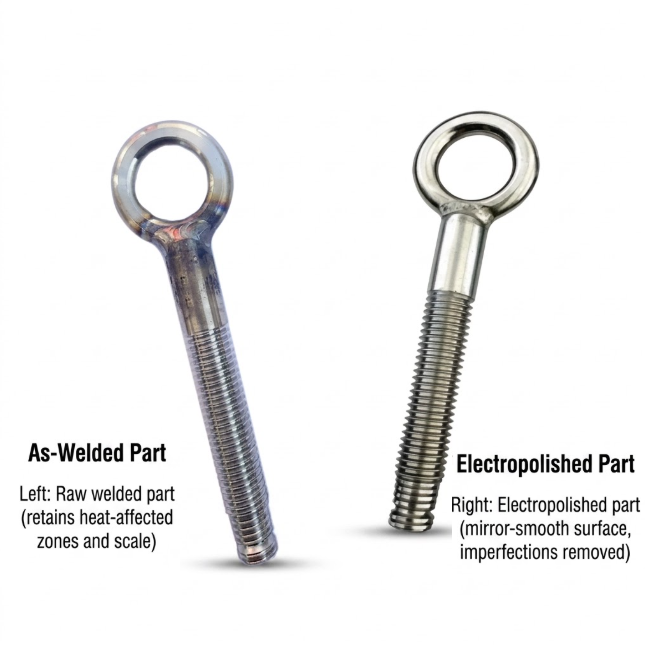
The electrochemical reaction preferentially dissolves microscopic peaks, eliminating microscopic weld spatter, deburring interior orifice edges, and delivering a chromium-rich, mirror-like finish.
4. Engineering Comparison: Chemical Passivation vs. Electropolishing
| Performance Metric | Acid Pickling & Passivation | Full Electropolishing (EP) |
| Visual Appearance | Matte, non-reflective light gray / satin | High-gloss, mirror-reflective finish |
| Light Reflection | Diffuse reflection (no specular glare) | Specular reflection (clear image reflection) |
| Surface Roughness (Ra) | Unchanged (preserves underlying tool marks) | Reduced by 30% to 50% (peaks rounded off) |
| Micro-Cleanliness | Chemical impurities removed; tool valleys remain | Micro-valleys leveled; reduces bacterial adhesion |
| ASTM Test Baseline | ASTM A967 / ASTM A380 | ASTM B912 |
| Salt Spray Life (NSS) | 24 to 96 hours without red rust | 100 to 200+ hours without red rust |
| Material Compatibility | Excellent for 304/316; requires care for 303 | Excellent for 304/316; prohibited for 303 |
| Target Application | General chemical lines, fluid piping spools | Semiconductor, bio-pharma, cleanroom lines |
5. Quality Inspection and Rust Prevention Protocols
| Inspection Gate | Test Standard | Acceptance Criteria |
| Free Iron Verification | ASTM A967 Practice D (Copper Sulfate Test) | Zero copper plating or pink discoloration within 6 minutes of droplet application. |
| High-Humidity Testing | ASTM A380 High-Humidity Chamber (48 Hours at 97% RH) | No red iron oxide staining, pinpoint spotting, or corrosion along weld seams. |
| Roughness Verification | Surface profilometer traverse across weld HAZ | Ra strictly within customer drawing tolerances (e.g., Ra ≤ 0.4 μm or Ra ≤ 0.8 μm). |
| Dimensional Verification | Air gauges, micrometers, and optical comparators | Wall thickness, ovality, and bore tolerances comply with ASME B16.11 or B16.9. |