A hex nipple (hexagonal nipple) is one of the most fundamental pipe fittings in industrial fluid conveyance, high-pressure hydraulics, and process engineering. When two in-line components with female ports must be coupled securely without compromising flow capacity or structural rigidity, a solid male-to-male hex nipple fitting delivers a direct, leak-tight connection.
Unlike hollow, thin-walled pipe nipples, heavy-duty carbon steel hex nipples are manufactured from cold-drawn solid hex bar stock or cold-headed blanks. This design provides the wall thickness, grain density, and wrenching geometry required to withstand continuous hydraulic impulse and tight assembly torque without distortion.
What Is a Hex Nipple?
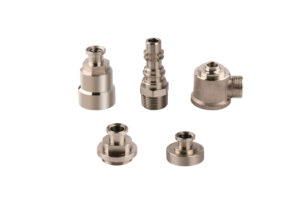
A hex nipple is a male-by-male threaded pipe fitting with an integral hexagonal section in the middle, engineered to join two female-threaded ports along the same axis. The integrated hex flat serves as a dedicated wrenching pad, allowing installers to use open-ended or calibrated torque wrenches to secure the fitting without scarring the external threads or crushing the fitting body.
Plaintext
         ◄──────── Overall Length (OAL) ────────►
         ┌───────────┬──────────────┬───────────┐
         │  Thread 1 │  Hex Wrench  │  Thread 2 │
    ═════╡   Male    │     Flat     │   Male    ╞═════
         │    NPT    │  (Hex A/F)   │    NPT    │
         └───────────┴──────────────┴───────────┘
         ◄───────────►              ◄───────────►
          Thread L1                  Thread L2
Key Mechanical Features
-
Dual External Threaded Ports: Available with identical thread profiles on both ends (Equal Hex Nipple) or unequal steps (Reducing Hex Nipple).
-
Integral Hexagonal Body: Sized to standard metric and imperial wrench openings, enabling installation in dense manifold blocks and valve clusters.
-
Full Through-Bore: Concentric internal fluid passage machined to match the inner diameter of adjoining schedule pipe or high-pressure hose tails, minimizing pressure drop and cavitation.
Hex Nipple vs. Pipe Nipple (Barrel Nipple)
Understanding the functional difference between these fittings prevents common site assembly failures:
-
Pipe Nipple (Barrel Nipple): Cut from straight, hollow seamless or welded pipe with threads machined onto both ends, leaving an unthreaded round center. Because it lacks flat wrench surfaces, tightening requires a pipe wrench with serrated teeth, which can crush the pipe wall, strip protective zinc plating, and initiate rapid oxidation.
-
Hex Nipple: Formed from solid hex steel. The robust center hex absorbs high installation torque and permits precise torque-limiting assembly without touching the fluid-carrying walls or protective finishes.
Blank Forming & Manufacturing Economics: Cold Heading vs. Hex Bar CNC Machining
In carbon steel fitting production, choosing between multi-station cold heading and CNC turning from cold-drawn bar stock directly affects structural integrity, lead times, and unit costs.
Plaintext
[ Cold Heading Process (High Volume) ]
Raw Wire Coil ──► Multi-Station Cold Header ──► Near-Net Blank ──► CNC Threading ──► Plating
(Zero raw stock waste; unbroken grain flow lines)

[ Solid Bar CNC Machining (Low Volume / Custom) ]
Hex Bar Stock ──► High-Speed Band Saw ──► CNC Turning & Drilling ──► Deburring ──► Plating
(Flexible; zero tooling cost; ideal for exotic sizes & big steps)
Multi-Station Cold Heading (Cold Forming)
For mass-production runs (typically 1/4″ to 1″ standard sizes), multi-station cold heading is the industry standard for cost-effective manufacturing:
-
Material Yield & Raw Material Savings: Cold headers feed steel wire rod through sequential dies, plastically forming the hex profile, stepped body, and through-hole in fractions of a second. This process generates virtually zero metal shavings compared to traditional hole-drilling.
-
Cost Reduction on Reducing Hex Nipples: When machining a reducing nipple (e.g., 1″ Male NPT stepped down to 1/4″ Male NPT) from solid bar, over 50% of the bar stock is machined away into low-value scrap. Cold heading forms near-net shape blanks directly, cutting raw material consumption by up to 40%.
-
Superior Grain Flow & Fatigue Strength: Cold extrusion forces the metal’s crystalline grain structure to contour smoothly around the hex transitions and thread roots. The unbroken grain flow provides higher tensile yield and impact resistance under hydraulic pressure spikes.
Solid Cold-Drawn Hex Bar CNC Machining
For non-standard configurations, small batches, or larger diameters (1-1/4″ to 2″ and above), CNC turning directly from solid cold-drawn hexagonal bar (ASTM A108) remains the optimal approach:
-
Zero Tooling Expense: Eliminates the need for expensive cold-heading dies, making it practical for short prototype runs and custom modifications.
-
Dimensional Versatility: Readily accommodates extreme size jumps, non-standard lengths, and cross-standard conversions (e.g., Male NPT to Male Metric/BSPP).
-
Bore Concentricity: Rigid CNC turning centers maintain concentricity tolerances within ±0.03 mm between the internal bore and outer thread pitch diameters.
Carbon Steel Grades, Plating & Corrosion Defense
Carbon steel fittings strike a practical balance between high mechanical burst limits and manufacturing economy in hydraulic oil, fuel conveyance, and industrial gas applications.
Standard Material Specifications
-
ASTM A108 Grade 1020 / 1045: Cold-drawn carbon steel bar stock providing uniform machinability, high surface finish, and predictable tensile yield properties.
-
JIS G4051 S20C–S45C: Carbon steel specifications matching Japanese and international mobile hydraulic machinery standards.
-
ASTM A105: Forged carbon steel chemistry frequently specified for high-temperature and high-pressure process plant pipework.
Protective Surface Platings
Because raw carbon steel oxidizes quickly in humid environments, finished hex nipples undergo electroplated surface treatments:
-
Trivalent Yellow Zinc Plating (Cr3+): The global standard for hydraulic fluid power fittings. Delivers 96 to 120 hours of neutral salt spray resistance to white rust, provides thread lubrication during assembly, and complies with RoHS and REACH environmental mandates.
-
Clear / Trivalent Blue-White Zinc: Offers a clean, bright appearance favored in pneumatic lines, factory automation, and commercial equipment.
-
Black Oxide / Phosphate Coating: Designed for assemblies intended to run continuously submerged in petroleum-based fluids, or parts scheduled for subsequent line painting.
1/2″ NPT Hex Nipple Dimensions & Engineering Sizing Chart
The 1/2″ NPT hex nipple is one of the most widely specified fittings across American and international hydraulic manifolds. Below are the standard manufacturing dimensions for high-pressure carbon steel hex nipples:
| Nominal Thread Size | Thread Standard | Hex Across Flats (Hex A/F) | Overall Length (OAL) | Internal Bore (ID) | Base Working Pressure |
| 1/8″ NPT | ASME B1.20.1 | 11 mm (7/16″) | 27.0 mm (1.06″) | 4.8 mm (0.19″) | 420 bar (6,000 psi) |
| 1/4″ NPT | ASME B1.20.1 | 14 mm (9/16″) | 36.5 mm (1.44″) | 7.1 mm (0.28″) | 420 bar (6,000 psi) |
| 3/8″ NPT | ASME B1.20.1 | 19 mm (3/4″) | 37.0 mm (1.46″) | 9.7 mm (0.38″) | 420 bar (6,000 psi) |
| 1/2″ NPT (Core) | ASME B1.20.1 | 22 mm (7/8″) | 47.0 mm (1.85″) | 11.9 mm (0.47″) | 420 bar (6,000 psi) |
| 3/4″ NPT | ASME B1.20.1 | 27 mm (1-1/16″) | 49.0 mm (1.93″) | 15.7 mm (0.62″) | 420 bar (6,000 psi) |
| 1″ NPT | ASME B1.20.1 | 36 mm (1-7/16″) | 59.0 mm (2.32″) | 22.4 mm (0.88″) | 350 bar (5,000 psi) |
| 1-1/4″ NPT | ASME B1.20.1 | 46 mm (1-13/16″) | 63.0 mm (2.48″) | 30.0 mm (1.18″) | 280 bar (4,000 psi) |
| 1-1/2″ NPT | ASME B1.20.1 | 50 mm (2.00″) | 68.0 mm (2.68″) | 35.0 mm (1.38″) | 210 bar (3,000 psi) |
| 2″ NPT | ASME B1.20.1 | 65 mm (2-1/2″) | 75.0 mm (2.95″) | 46.0 mm (1.81″) | 175 bar (2,500 psi) |
Note: Custom overall lengths, extended hex flats, and special step-down combinations are produced to customer 2D prints.
Pressure Ratings & Temperature Derating Guidelines
Cold-formed and CNC-turned carbon steel hex nipples maintain an ambient baseline pressure rating of PN 420 (420 bar / 6,000 psi) at 37 °C (100 °F) for sizes up to 1/2″. Elevated operating temperatures reduce the yield strength of the steel, requiring the application of a formal derating factor:
Allowable Working Pressure = Nominal Base Pressure (420 bar) × Thermal Derating Factor
| Operating Temperature | Carbon Steel Derating Factor | Adjusted Working Pressure (1/2″ Base) |
| 38 °C (100 °F) | 1.000 | 420 bar (6,000 psi) |
| 93 °C (200 °F) | 0.940 | 395 bar (5,640 psi) |
| 149 °C (300 °F) | 0.900 | 378 bar (5,400 psi) |
| 204 °C (400 °F) | 0.860 | 361 bar (5,160 psi) |
Critical Operating Limit: Carbon steel bodies must not exceed 204 °C (400 °F) in continuous industrial service. For operations exceeding this limit, switch to austenitic stainless steel (SS316), which operates safely up to 537 °C (1000 °F). Additionally, ensure that anaerobic thread pastes or PTFE tape used in the assembly do not break down below the fitting’s physical temperature limit.
Quality Inspection & Thread Protection Standards
Thread integrity determines whether a high-pressure system seals on the first assembly or leaks during proof testing.
-
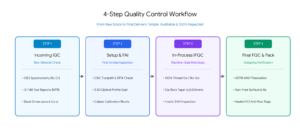
100% Thread Gage Inspection: Every production batch undergoes inspection using calibrated, hardened steel Go/No-Go thread ring gauges (working to ASME B1.20.1 for NPT and ISO 7/1 for BSPT). This checks pitch diameter, taper angle, and thread depth.
-
Smooth Chamfers & Deburring: All external lead threads are precision-chamfered at 45° to eliminate hanging burrs, ensuring easy hand engagement and preventing cross-threading.
-
Heavy-Duty Protective Plastic Caps: Male threads are vulnerable to impact damage during transit. Every carbon steel hex nipple is packed with custom-fit polyethylene caps on both threaded ends to keep thread crests intact from factory to line.
Frequently Asked Questions (FAQ)
What is the difference between a hex nipple and a hex coupling?
A hex nipple features external male threads on both ends, designed to screw into female manifold blocks or valves. A hex coupling features internal female threads on both ends, designed to connect two male pipe ends together in a straight line.
Can a carbon steel hex nipple join NPT to BSPP?
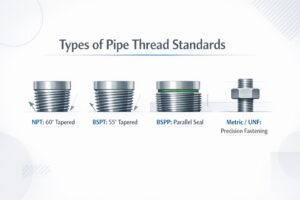
Yes. These are called conversion hex nipples. One end is machined with a 60° tapered NPT thread, while the opposite end features a parallel BSPP (G) thread equipped with an undercut and spotface shoulder for a bonded elastomeric seal or copper crush washer.
How much torque should be applied to a 1/2″ NPT carbon steel hex nipple?
Tapered threads seal on metal-to-metal flank interference and rely on the Turns Past Finger Tight (TPFT) method. For 1/2″ NPT carbon steel fittings, standard practice is to hand-tighten the fitting and then advance it 2 to 3 full turns using an open-end wrench. Avoid overtightening, which can split female cast iron or aluminum blocks.
When should cold heading be selected over CNC machining?
Cold heading is recommended for standard catalogue sizes with order quantities exceeding 5,000 to 10,000 pieces, as high-speed forming offsets tooling costs and cuts material waste. CNC bar machining is better suited for low-to-medium volume orders, custom thread combinations, or large bore sizes above 1-1/4″.
Source High-Pressure Carbon Steel Hex Nipples Directly
Streamline your supply chain with cold-formed and CNC-machined carbon steel hex nipples engineered to your exact thread specifications, pressure ratings, and plating requirements.
-
High-Volume Capacity: Advanced multi-station cold formers for cost-effective standard production, alongside automated CNC lathe cells for fast-turnaround custom runs.
-
Certified Quality Assurance: Full material traceability with EN 10204 3.1 Material Test Reports (MTRs), plating thickness verification, and 100% Go/No-Go thread gauging.
-
Ready-to-Assemble Packaging: Protective plastic caps fitted as standard, sealed in anti-corrosion barrier packaging for long shelf life.
Upload your 2D/3D CAD files or thread schedule. Our mechanical engineers will verify blank forming feasibility, review pressure margins, and provide a formal volume quotation within 24 hours.