Connecting two fluid lines that were never designed to mate is a daily reality in industrial piping, power instrumentation, and hydraulic circuits. When two ports present conflicting thread standards, asymmetrical gender orientations, extreme dimensional jumps, or require an immediate diagnostic test point, a precision-machined adapter fitting delivers a zero-leak transition in a single, rigid component without re-piping the system.
Machined from solid, cold-drawn hexagonal bar stock, high-pressure pipe fitting adapters eliminate the mechanical vulnerabilities, stack-up tolerances, and multiple leak paths inherent in threaded bushing assemblies.
What Is an Adapter Fitting?
An adapter fitting is a fluid connector engineered to join two or more mating ports that differ in thread geometry, nominal size, or gender configuration. Unlike straight couplings that link identical pipes, a pipe fitting adapter bridges fundamentally incompatible fluid interfaces across international standards.
Key industrial capabilities include:
-
Cross-Standard Thread Conversion: Seamlessly mating parallel profiles like British Standard Pipe Parallel (BSPP / ISO 228-1) with tapered systems like National Pipe Taper (NPT / ASME B1.20.1), Metric (ISO 6149 / DIN 3852), or JIS.
-
Asymmetrical Gender Transitions: Providing rigid Male x Female, Male x Male (hex nipples), or Female x Female connections, specifically in designs where the female port is equal to or larger than the male port—a geometry standard hex bushings cannot accommodate.
-
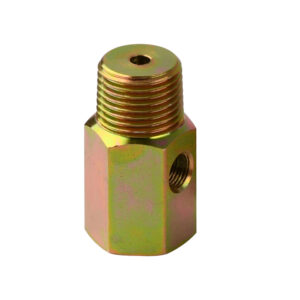
Integrated Gauge & Diagnostic Ports: Specialized adapters incorporate an auxiliary side port precision-drilled into the hex flat. This integrates a dedicated 1/8″ or 1/4″ NPT/BSPP tap for pressure gauges, transducers, or bleed valves without breaking the main run or installing an oversized tee.
What Are the Four Types of Fittings?
The four primary types of pipe fittings in fluid conveyance are transition adapters/reducers, extension couplings/nipples, directional elbows/tees, and termination plugs/caps. Every hydraulic line or process piping run relies on a combination of these four functional groups:
-
Adapters & Reducers (Transition Fittings): Components designed to bridge mismatched thread standards (such as metric adapter fittings to NPT), nominal flow diameters, and gender orientations.
-
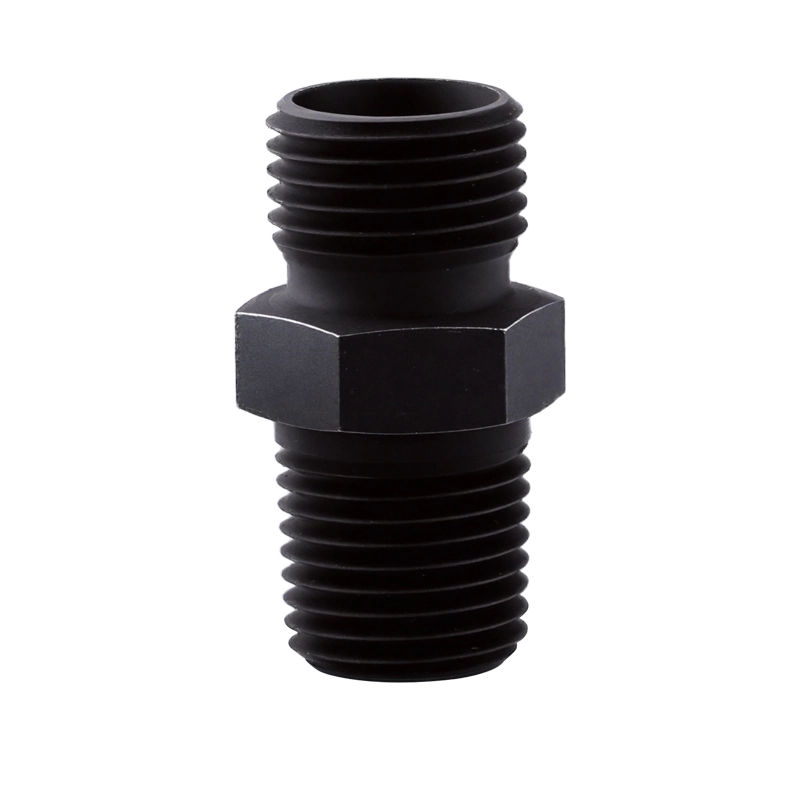
Couplings & Nipples (In-Line Extension Fittings): Symmetrical components used to extend pipe runs in a straight line within the same thread family and size. Couplings connect two male ends (Female x Female), while nipples connect two female ports (Male x Male).
-
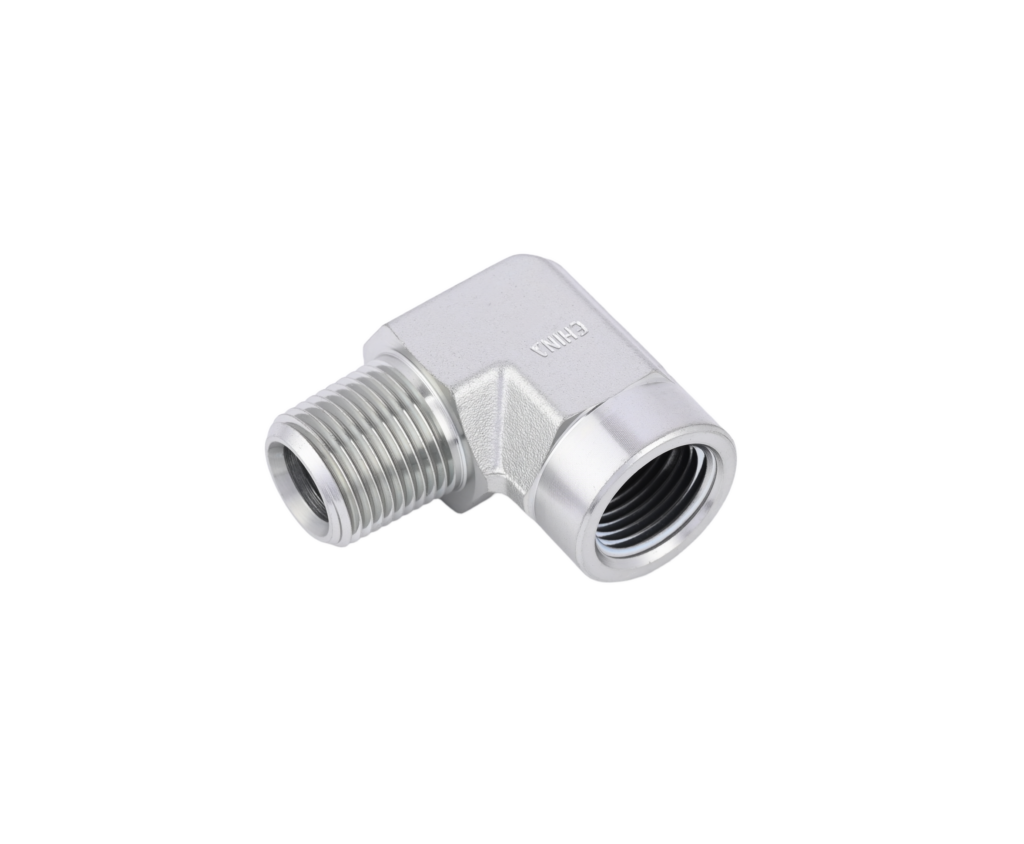
Elbows & Tees (Directional & Branching Fittings): Angled bodies (45° or 90° elbows) that reorient flow direction, and multi-port fittings (equal tees, reducing crosses) that divide or merge fluid circuits.
-
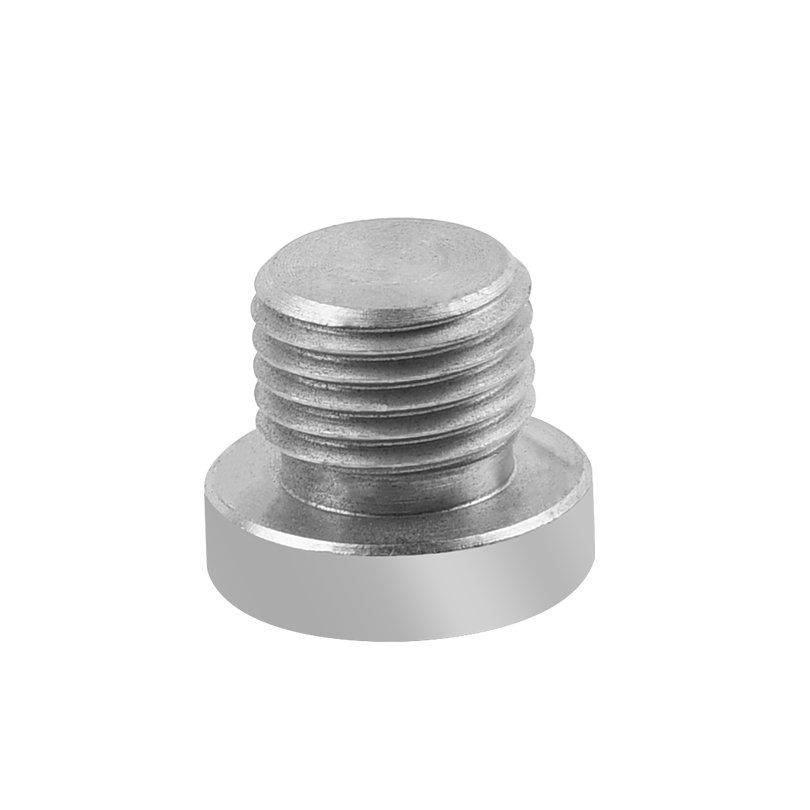
Plugs & Caps (Termination Fittings): Threaded end closures used to isolate active circuits, blank unused manifold ports, or seal diagnostic taps. High-pressure socket-head plugs utilize O-rings or bonded seals to seat flush against valve blocks.
What Is the Difference Between an Adapter Fitting and a Reducer Fitting?
The primary difference is that a reducer alters line diameter within a single thread standard, while an adapter bridges fundamentally different thread forms, gender setups, or diagnostic branch ports.
| Engineering Parameter | Reducer Fitting (Hex Bush / Reducer) | Adapter Fitting |
| Thread Compatibility | Uniform standard on both ends (e.g., NPT to NPT, BSPP to BSPP). | Mixed standards supported (e.g., Male BSPP to Female NPT). |
| Port Gender Setup | Primarily Male x Female (hex bush) or Female x Female (reducing coupling). | Universal: Male x Female, Male x Male, Female x Female, and custom steps. |
| Size Progression Rule | A standard hex bush strictly requires the male thread to be larger than the female. | Unrestricted: Accommodates small male into large female (“big jump”) configurations. |
| Auxiliary Function | Linear fluid reduction only; no auxiliary branch. | Can feature integrated radial side ports for direct gauge and sensor mounting. |
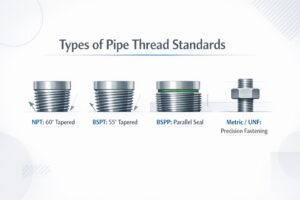
Engineering Tip on Thread Mating: Never force a 60° NPT tapered thread into a 55° BSPT (RC) port. Although the pitches may appear close on sizes like 1/2″, the flank angle mismatch will gall the threads, produce micro-leak channels, and risk catastrophic thread stripping under hydraulic impulse. Always use a dedicated cross-thread adapter fitting.
What’s the Difference Between a Coupling and an Adapter?
A coupling joins two identical pipes of the same size and thread standard in a straight line, whereas an adapter joins connections that cannot mate directly due to differences in thread type, size, or gender.
-
Coupling (Socket): Symmetrical female-by-female fitting. It functions purely as a straight pipe joiner without altering thread pitch, flow geometry, or port orientation.
-
Adapter: The non-symmetrical problem-solver. It resolves female-to-male transitions, connects European equipment (BSPP/Metric) to American piping (NPT), and provides single-piece size jumps that eliminate leak-prone bushing stacks.
Technical Specifications & High-Pressure Performance
High-pressure instrumentation adapters must withstand extreme internal hoop stress, mechanical vibration, and thermal cycling.
Material Grades & Manufacturing Integrity
-
Cold-Drawn Hex Bar Machining: Straight adapters and side-ported gauge adapters are CNC-machined exclusively from solid cold-drawn hexagonal bar stock (never cast blanks). Solid bar turning guarantees structural density, uniform wall thickness, and eliminates internal voids around side-drilled holes.
-
Carbon Steel (ASTM A108 / JIS S20C–S45C): Finished with eco-friendly trivalent yellow zinc or clear zinc plating (Cr3+) for corrosion protection, salt-spray durability, and anti-galling lubrication. Body temperature limit: 204 °C (400 °F).
-
Stainless Steel (SS316 / ASTM A479 / ASTM A276 Type 316): Fully passivated austenitic stainless steel designed for harsh chemical processing, corrosive fluids, and offshore marine installations. Body temperature limit: 537 °C (1000 °F).
-
Brass (ASTM B16 C36000): Economical choice for pneumatic controls, water systems, and low-pressure lubrication circuits. Body temperature limit: 190 °C (375 °F).
Pressure Derating Under Elevated Temperatures
Straight adapters machined from solid bar maintain a base rating of PN 420 (420 bar / approx. 6,000 psi) at 37 °C (100 °F). Operating at higher temperatures decreases allowable working pressure according to the material derating factor:
Allowable Working Pressure = Base Nominal Pressure (420 bar) × Material Derating Factor
| Operating Temperature | SS316 Derating Factor | Carbon Steel Derating Factor | Brass Derating Factor |
| 38 °C (100 °F) | 1.000 (420 bar) | 1.000 (420 bar) | 1.000 (420 bar) |
| 93 °C (200 °F) | 1.000 (420 bar) | 0.940 (395 bar) | 0.780 (328 bar) |
| 149 °C (300 °F) | 1.000 (420 bar) | 0.900 (378 bar) | 0.690 (290 bar) |
| 204 °C (400 °F) | 0.960 (403 bar) | 0.860 (361 bar) | 0.130 (Failure Warning) |
Engineering Rule: Brass derates rapidly above 149 °C and is unsafe near 204 °C. Carbon steel loses 14% of its structural containment at 204 °C. SS316 maintains 96% of its pressure rating at 204 °C and remains the sole viable alloy up to 537 °C.
Sealing Interfaces: Tapered Threads vs. Face Seals
An adapter is only as heat-resistant as its weakest sealing component:
-
Tapered Threads (NPT / BSPT): Seal via metal-to-metal flank contact with anaerobic thread sealant or PTFE paste. The temperature ceiling is governed by the sealant compound (typically up to 200 °C).
-
Parallel Threads with Bonded Washer (BSPP / Metric): Requires a smooth spotface on the female port. Nitrile (NBR) bonded washers top out at 110 °C; Fluoroelastomer (FKM) washers operate up to 204 °C.
-
Metallic Crush Gaskets (Annealed Copper): Serviceable from -198 °C up to 204 °C for cryogenic and high-vibration applications.
Standard Dimensional Reference: Integrated Gauge Port Adapters
| Primary Run Port 1 (Male) | Primary Run Port 2 (Female) | Auxiliary Gauge Port | Hex Body Width (Flats) | Baseline Pressure Rating |
| 1/4″ NPT / BSPP | 1/4″ NPT / BSPP | 1/8″ NPT / BSPP | 19 mm (3/4″) | 420 bar (6,000 psi) |
| 3/8″ NPT / BSPP | 3/8″ NPT / BSPP | 1/4″ NPT / BSPP | 22 mm (7/8″) | 420 bar (6,000 psi) |
| 1/2″ NPT / BSPP | 1/2″ NPT / BSPP | 1/4″ NPT / BSPP | 27 mm (1-1/16″) | 420 bar (6,000 psi) |
| 3/4″ NPT / BSPP | 3/4″ NPT / BSPP | 1/4″ NPT / BSPP | 32 mm (1-1/4″) | 420 bar (6,000 psi) |
| 1″ NPT / BSPP | 1″ NPT / BSPP | 1/4″ NPT / BSPP | 41 mm (1-5/8″) | 350 bar (5,000 psi) |
How to Specify an Adapter Fitting for RFQ
When requesting quotations or custom machining for non-catalog adapter combinations, specify the following parameters:
-
Port 1 (Primary Run): Nominal thread size, gender (Male/Female), and thread standard (e.g., 1/2″ Male NPT).
-
Port 2 (Secondary Run): Nominal thread size, gender, and thread standard (e.g., 1/2″ Female BSPP).
-
Auxiliary Side Port (If Required): Thread specification and on-center placement on the hex flat (e.g., 1/4″ Female NPT gauge port).
-
Material & Surface Treatment: Carbon steel with trivalent yellow zinc plating, SS316 passivated, or C36000 brass.
-
Operating Parameters: Maximum system pressure, continuous operating temperature, and process fluid.
Source Monolithic High-Pressure Adapters — Direct Factory Supply
Stop compromising system integrity with stacked bushings. Source precision-machined, single-piece adapter fittings custom-manufactured to your exact thread combinations and tightest geometric tolerances.
-
100% Thread Verified: All threads verified using hardened Go/No-Go plug and ring gauges before dispatch.
-
Full Traceability: Complete EN 10204 3.1 Material Test Reports (MTRs) and dimensional inspection reports supplied with every batch.
-
Thread Protection: Heavy-duty protective plastic end caps fitted standard on all external male threads to guarantee zero shipping damage.
Send your required thread pairings, operating conditions, or 2D/3D part drawings. Our engineering team reviews pressure limits and delivers quotation feedback within 24 hours.