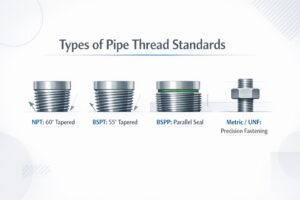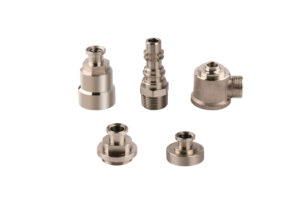
In global fluid power, industrial process piping, and pneumatic systems, the NPT fitting (National Pipe Taper) remains the premier American connection standard. Governed by ASME B1.20.1, NPT threaded fittings are engineered to form a reliable, pressure-tight seal through mechanical thread deformation.
What is an NPT Fitting? Key Geometric Characteristics
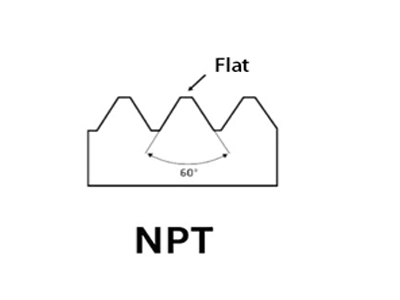
NPT Thread Geometry Profile:
├── Taper Angle  ──> 1° 47' (1.7899°) measured from the centerline axis
├── Taper Rate   ──> 3/4 inch per foot (1/16 inch per inch of length)
├── Thread Angle ──> 60° included V-thread angle between flanks
└── Crest & Root ──> Truncated flat crests and flat roots (requires sealant)
How to Know if a Fitting is NPT: Step-by-Step Identification
Because nominal pipe sizes date back over a century, a 1/2″ NPT fitting does not measure 0.500 inches on any caliper face. Follow this comprehensive step-by-step identification and verification process:
Method 1: Manual Measurement & Sizing Verification
Step 1: Check for Thread Taper
Step 2: Measure the Thread Outer Diameter (OD)
Step 3: Determine the Thread Pitch (TPI)
Step 4: Cross-Reference with the Standard NPT Sizing Chart
Method 2: Calibrated L1 / L2 Thread Plug & Ring Gauges (Workshop In-Process Inspection)
For in-process manufacturing checks and rapid batch screening, calibrated master gauges verify the pitch diameter, taper rate, and thread truncation simultaneously:
-
L1 Thread Ring & Plug Gauges: Hand-tighten the gauge onto the NPT thread until snug. The end face of the fitting must align with the notch on the gauge within a tolerance of ±1 turn (±1 flush step).
-
L2 Thread Gauges: Used to inspect the full functional thread length and overall taper consistency across deeper thread engagements.
Method 3: 2.5D Optical Profile Projector & Optical Video Measuring (First-Article & Lab Inspection)
To obtain precise numerical readings of the taper rate and individual flank angles during tooling setup or first-article inspection (FAI):
-
Optical Contour Measurement: The threaded component is mounted on a 2.5D optical video measuring machine or profile projector under high-contrast contour illumination.
-
Flank Half-Angle Verification: Metrology software measures the included 60° thread angle and individual 30° flank half-angles to detect cutting tool wear.
-
Taper Angle Calculation: By capturing multiple coordinate points along the outer thread crests and roots across the longitudinal axis, the system measures the exact 1° 47′ taper angle (1:16 taper ratio) and verifies flat root/crest truncation.
| Nominal NPT Size | O.D. of Male Threads (in.) | O.D. of Female Threads (in.) | Threads Per Inch (TPI) | Pitch (mm) |
| 1/8″ NPT | 0.405 | 0.360 | 27 | 0.941 |
| 1/4″ NPT | 0.540 | 0.470 | 18 | 1.411 |
| 3/8″ NPT | 0.675 | 0.590 | 18 | 1.411 |
| 1/2″ NPT | 0.840 | 0.750 | 14 | 1.814 |
| 3/4″ NPT | 1.050 | 0.950 | 14 | 1.814 |
| 1″ NPT | 1.315 | 1.200 | 11.5 | 2.209 |
| 1-1/4″ NPT | 1.660 | 1.560 | 11.5 | 2.209 |
| 1-1/2″ NPT | 1.900 | 1.800 | 11.5 | 2.209 |
| 2″ NPT | 2.375 | 2.270 | 11.5 | 2.209 |
How High-Precision NPT Fittings Are Produced on CNC Lathe Machines
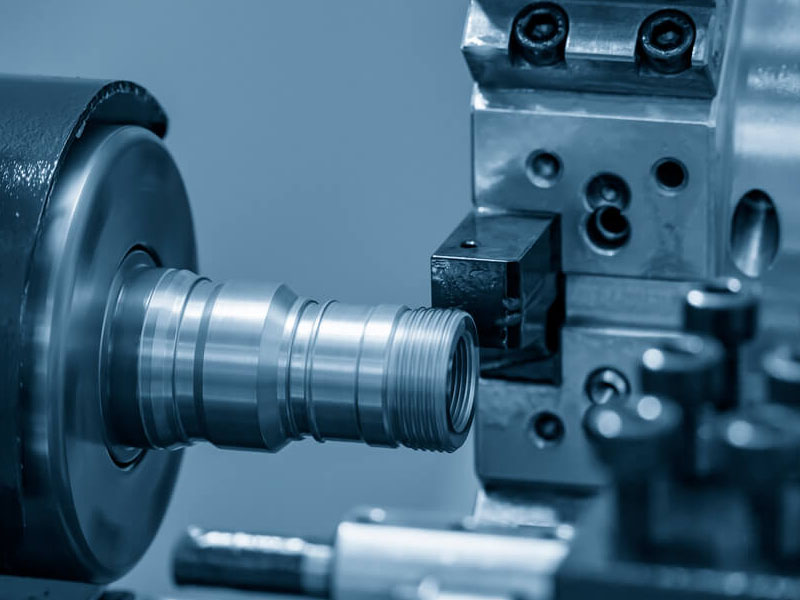
1. Multi-Axis CNC Lathe Machine Turning
-
Single-Point CNC Threading: Multi-axis CNC lathe machines utilize carbide threading inserts with specialized PVD coatings (such as AlTiCrN) to single-point turn the taper and thread profile simultaneously.
-
Tight Tolerances: Automated CNC turning maintains linear tolerances within ±0.01 mm, eliminating root-radius chatter and micro-flank irregularities.
-
Surface Roughness: The CNC lathe machine achieves a smooth surface finish of Ra 1.6 μm to Ra 0.8 μm across thread flanks and sealing tapers, ensuring maximum surface contact area under low assembly torque.
2. In-Process Thread Verification
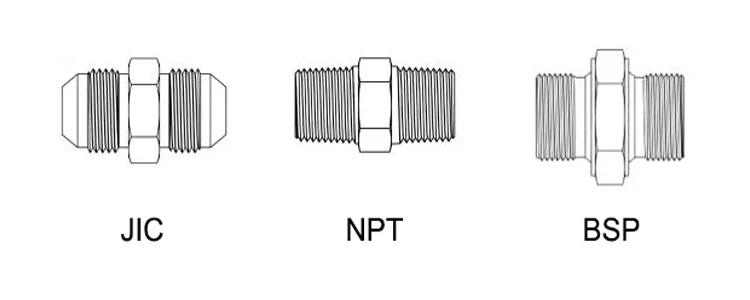
Thread Compatibility: NPT vs. NPS vs. BSP
Thread System Comparison:
├── NPT (National Pipe Taper)    ──> 60° Angle | 1° 47' Taper | Interference Seal (Requires PTFE tape)
├── NPS (National Pipe Straight) ──> 60° Angle | Parallel (No Taper) | Requires O-Ring or Gasket
└── BSP (British Standard Pipe)  ──> 55° Angle | Whitworth Profile | Incompatible with NPT (Never mix)
-
NPT vs. NPS: Both share a 60° thread angle and identical TPI, but NPS threads are parallel. Male NPT will engage loosely in female NPS, but it will not create a pressure-tight seal without a sealing washer.
-
NPT vs. BSP (BSPT/BSPP): BSP uses a 55° thread angle and different pitch standards (e.g., 1/2″ NPT is 14 TPI; 1/2″ BSP is 14 TPI but differs in tooth angle, while 1″ NPT is 11.5 TPI vs. 1″ BSP at 11 TPI). Never force an NPT fitting into a BSP port, as cross-threading will strip the threads and create leak paths.
Common Industrial Applications of NPT Pipe Fittings
-
Process Pumps & Compressors: Inlet and outlet fluid ports (standard 1/2″, 3/4″, and 1″ NPT).
-
Instrumentation & Pressure Gauges: 1/4″ NPT bottom and back mount connections.
-
Industrial Valves: Carbon steel and stainless steel ball valves, needle valves, and check valves.
-
Hydraulic Adapters: NPT to JIC 37° flare, NPT to BSPP swivel adapters, and NPT hex nipples.
Installation Best Practices for NPT Fittings
-
Apply PTFE Teflon Tape Correctly: Wrap thread tape 3 to 4 turns in a clockwise direction (when facing the male thread end) so the tape does not uncoil during tightening. Leave the first 1 to 2 threads bare to prevent tape fragments from contaminating internal fluid circuits.
-
Torque by Turns, Not Brute Force: Tighten the NPT fitting hand-tight, then use a wrench to turn it an additional 1.5 to 3 turns. Overtightening can split female cast ports or cause thread galling.
-
Use Dual Wrenches: Always support the valve or pump housing with a backup wrench while tightening the fitting NPT to prevent putting torsional stress on connected equipment.
Frequently Asked Questions (FAQ)
How to know if a fitting is NPT?
Will NPT screw into NPT?
Can I use Teflon tape on NPT fittings?
Are PVC pipe fittings NPT?
Source Custom CNC Machined NPT Fittings from Yuhuan Hongqian Machinery
-
Advanced CNC Lathe Machine Cells: High-speed multi-axis turning lines holding linear and diameter tolerances within ±0.01 mm and thread roughness down to Ra 0.8 μm.
-
Material Integrity & Traceability: Full EN 10204 3.1 Mill Test Certificates (MTC) supplied for 20# carbon steel, AISI 1045, Q235B, and 316L stainless steel.
-
Corrosion Protection: Trivalent zinc plating (Cr3+ Clear / Yellow) for 72h–120h NSS, or heavy-duty zinc-nickel alloy plating for 720h–1000h NSS.
-
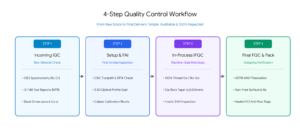
Strict Quality Control: 100% thread ring/plug gauge verification and optical projection inspection on every production lot.