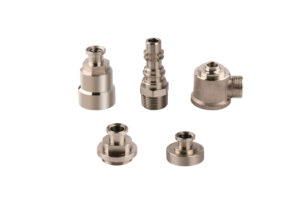
When sourcing custom stainless steel valve bodies, fluid connectors, or high-pressure components, selecting the correct blank forming method directly governs your mechanical safety factor, secondary CNC cycle times, tool wear rates, and total landing cost.
As a manufacturing engineer with over 15 years on the shop floor overseeing CNC turning, automated loading cells, and precision blank sourcing, I frequently see engineering teams struggle with this specific trade-off: Silica Sol Investment Casting versus Hot Punch Forging (often referred to as hot forging or red punching).
Both processes handle austenitic and duplex stainless steels (such as SS304, SS316, and 2205), but their mechanical properties, structural capabilities, and machining challenges are completely different. Here is a candid, engineering-driven comparison to help you choose the right blank for your next manufacturing run.
1. Process Fundamentals: Liquid Solidification vs. Plastic Deformation
[Silica Sol Casting]  Raw Ingot  --> Liquid Pouring (1600°C) --> Ceramic Shell Cooling --> Near-Net Shape Blank
[Hot Punch Forging]   Round Bar  --> Induction Heating       --> Closed-Die Forging    --> Heavy Secondary CNC
Silica Sol Investment Casting (Lost-Wax)
Silica sol casting relies on liquid-phase forming. A wax pattern is dipped into high-purity colloidal silica slurries to build a multi-layered ceramic shell. Once dewaxed and sintered at high temperatures, molten stainless steel is poured directly into the hollow cavity.
-
Primary Advantage: Liquid metal fills microscopic contours with high precision.
-
Key Characteristic: Produces a near-net shape with high dimensional stability.
Hot Punch Forging
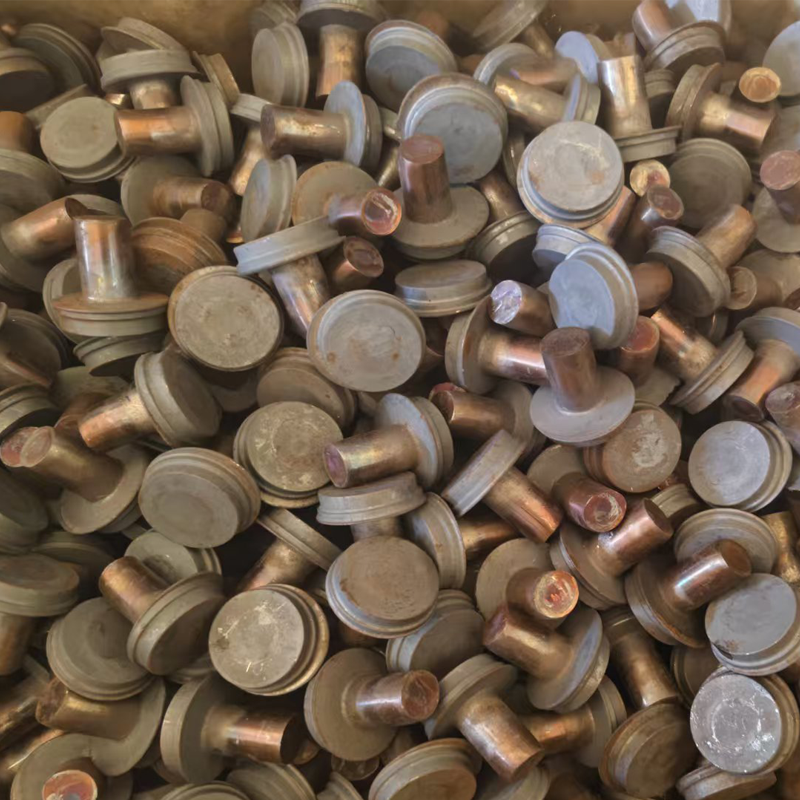
Hot punch forging relies on solid-state plastic deformation. A stainless steel bar is sheared into precise billets, heated to its forging temperature window (typically 1150°C to 1200°C for austenitic grades) via medium-frequency induction heating, and forged under heavy mechanical presses into a closed die cavity with a penetrating punch.
-
Primary Advantage: Massive mechanical tonnage crushes internal voids and aligns grain boundaries.
-
Key Characteristic: The resulting forged fitting possesses exceptional structural density and dynamic fatigue resistance.
2. Geometric Freedom & Internal Flow Passages
+--------------------------+-------------------------------+-------------------------------+
| Feature                  | Silica Sol Casting            | Hot Punch Forging             |
+--------------------------+-------------------------------+-------------------------------+
| Internal Channels        | Curved, undercut, diverters   | Straight bores or solid only  |
| As-Formed Surface        | Ra 1.6–3.2 µm (clean & bright)| Ra 3.2–6.3 µm (dark oxide)    |
| External Contours        | Freeform & thin-walled        | Restricted by draft angles    |
+--------------------------+-------------------------------+-------------------------------+
Complex Internal Geometry
-
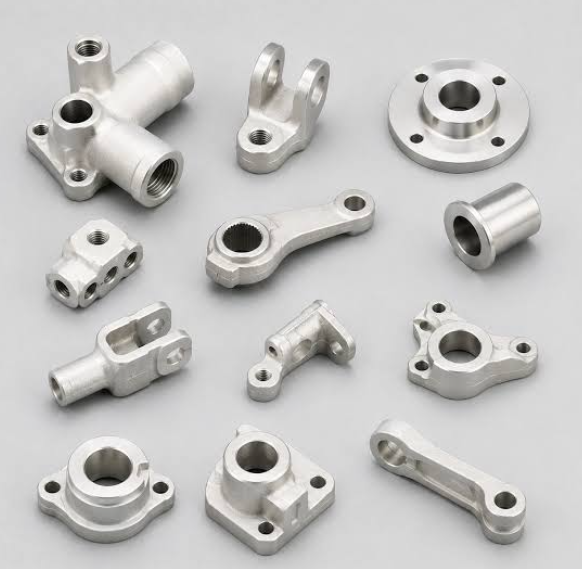
Silica Sol Casting: Excels at forming complex 3D internal geometries. It easily forms curved waterways, internal diverter vanes, non-concentric chambers, and thin-walled hollow pockets that standard cutting tools cannot reach.
-
Hot Punch Forging: Highly constrained by tool extraction kinematics and draft angles. The punch can only drive straight blind or through cavities. For multi-port diverters or sweeping 90-degree elbows, the forged blank must either remain solid or feature a basic pre-punched indent, leaving the rest to secondary CNC turning.
Surface Roughness Consistency
-
Silica Sol Casting: Delivers uniform roughness across both internal passages and external walls (Ra 1.6–3.2 µm). Logos, flow arrows, and batch markings cast sharply with no secondary deburring required.
-
Hot Punch Forging: Blanks exit the die with a dark, scaled oxide surface (Ra 3.2–6.3 µm). All sealing faces, critical mating diameters, and cosmetic exteriors require complete machining or abrasive shot-blasting.
3. Internal Integrity, Porosity Risks, and Pressure Testing
+-----------------------------------------------------------------------------------------+
| [Silica Sol Casting Quality Rule]                                                       |
| Liquid Cooling -> Risk of Shrinkage Porosity / Pinholes -> MANDATORY 100% Hydro-Testing|
+-----------------------------------------------------------------------------------------+
| [Hot Punch Forged Fittings Rule]                                                        |
| Solid Tonnage  -> Grain Flow Alignment / Zero Voids     -> Zero Gas/Fluid Leakage       |
+-----------------------------------------------------------------------------------------+
Silica Sol Casting: The Porosity Variable
During liquid-to-solid phase transition, stainless steel experiences volumetric shrinkage. If thermal gradients or venting paths are uneven, micro-shrinkage porosity or pinholes can form within thick-to-thin transition zones.
-
Quality Control Measure: For pressure-retaining valve bodies, water manifolds, and instrumentation fittings, 100% pneumatic air-under-water and hydrostatic pressure testing is mandatory before shipment to intercept micro-leak paths.
Hot Punch Forging: Zero-Pinhole Reliability
High mechanical tonnage crushes internal cast structures, refining austenite grains along the contour of the part.
-
Where It Matters: In mission-critical forged steel fittings, high-pressure hydraulic connections, flammable gas lines, and automotive chassis components, forged fittings eliminate blowholes, micro-fissures, and catastrophic burst risks.
4. Secondary CNC Machining: Tool Life, Concentricity, and Scrap
From a CNC machining standpoint, raw blank consistency determines cycle times and tool replacement intervals.
Machining Silica Sol Cast Blanks
-
Material Removal: Minimal. Because the blank is near-net shape, CNC machines only need to cut threads, face sealing steps, and bore critical O-ring grooves.
-
Tool Wear Considerations: While material removal is low, casting scale or micro-inclusions from the ceramic shell can occasionally cause micro-chipping on carbide insert cutting edges during the first interrupted cut.
Machining Hot Punch Forged Blanks
-
Material Removal & Scrap: High. Forging hollow fittings often starts from solid or semi-solid billets, requiring deep drilling and boring that converts a large portion of the blank into scrap chips.
-
Eccentricity & Tool Crash Risks: The forging punch can shift due to billet temperature variations or mechanical press guide clearances, creating punch eccentricity. If the pre-punched hole is off-center, CNC boring tools encounter uneven cutting loads, leading to vibration, uneven wall thickness, accelerated insert breakage, or even tool crashes.
       CONCENTRIC BLANK                     ECCENTRIC FORGED BLANK
      +-----------------+                     +-----------------+
      |   +---------+   |                     | +---------+     |  <-- Thin wall
      |   |  Bore   |   |                     | |  Bore   |     |      High tool chatter
      |   +---------+   |                     | +---------+     |
      +-----------------+                     +-----------------+
     Uniform Cutting Force                   Uneven Force -> Tool Crash Risk
5. Tooling Investment, Lead Times, and Production Flow
+------------------------------------+------------------------------------+
| Silica Sol Investment Casting      | Hot Punch Forging                  |
+------------------------------------+------------------------------------+
| Step 1: Tooling Design & Tool Cut  | Step 1: Heavy Die Machining        |
| Step 2: Wax Injection              | Step 2: Bar Shearing               |
| Step 3: 4-6 Ceramic Dip/Dry Layers | Step 3: Medium-Freq Induction Heat |
| Step 4: Dewax & Sintering          | Step 4: Press Forging Stroke       |
| Step 5: Pouring & Knockout         | Step 5: Flash Trimming             |
| Lead Time: 35-50 Days              | Lead Time: 20-35 Days              |
+------------------------------------+------------------------------------+
-
Silica Sol Casting: Tooling is precision-machined from aircraft-grade aluminum. However, the multi-day shell drying cycle, burnout, and labor-intensive ceramic removal extend overall initial lead times.
-
Hot Punch Forging: Employs high-strength hot-work die steels (such as H13). While initial die setups require substantial tuning, once running, production output per hour is exceptionally fast.
6. Comprehensive Engineering Selection Matrix
| Comparison Parameter | Silica Sol Investment Casting | Hot Punch Forging |
| Material Types | SS304, SS316, Duplex, Superalloys | Carbon Steel, Alloy Steel, SS304, SS316, Brass |
| Geometry Freedom | Outstanding (Under-cuts, thin walls, 3D internal flow) | Moderate to Low (Symmetrical, straight axes) |
| Pinhole / Sand-Hole Risk | Moderate (Requires 100% pressure testing) | None (Dense, continuous grain flow lines) |
| Surface Finish ($R_a$) | Ra 1.6–3.2 µm (Smooth, uniform metallic finish) | Ra 3.2–6.3 µm (Heavy oxidation scale) |
| Blank Dimensional Tolerance | High precision ( ±0.1mm-±0.3mm) | Standard forging tolerance ( ±0.5mm- ±1.5 mm) |
| CNC Material Removal Rate | Low (10% – 25% chip removal) | High (40% – 65%chip removal on hollow parts) |
| Primary Machining Risk | Occasional ceramic micro-inclusions | Punch eccentricity causing tool crashes/chatter |
| Tooling Cost & Lead Time | Higher initial tooling cost; 35–50 day sample cycle | Moderate-to-high die cost; faster batch output |
| Best-Fit Applications | Complex valves, multi-port manifolds, thin-wall parts | Forged pipe fittings, hydraulic adaptors, gas lines |
Summary: Making the Right Engineering Call
-
Choose Silica Sol Investment Casting if: Your stainless steel fitting has internal diverter geometry, complex multi-axis contours, requires fine external aesthetic details without extensive milling, or is made from high-hardness alloys where drilling out massive cores would destroy tool life.
-
Choose Hot Punch Forging if: Your parts are critical forged pipe fittings, high-pressure hydraulic adapters, or explosive gas distribution components where zero internal porosity is a hard engineering requirement and the part geometry allows high-speed turning on twin-spindle CNC lathes.
Frequently Asked Questions (FAQ)
1. Why do cast stainless steel valve bodies leak even when they look perfect on the outside?
Casting defects such as micro-shrinkage, cold shuts, and subsurface pinholes often reside inside the wall section. Under normal shop lighting, the cast surface looks clean, but under 0.6–2.0 MPa pneumatic or hydrostatic pressure, fluid finds microscopic capillaries between dendrite boundaries. That is why pressure-bearing cast valves require 100% pressure-testing fixtures.
2. Can hot punch forging produce hollow stainless steel elbows directly?
No. Forging punches can only enter straight along the axis of ram stroke or side-action slide cylinders. A 90-degree curved internal passage cannot be stripped off a rigid metal punch. Forged elbows are either forged solid and machined using specialized multi-axis CNC setups, or manufactured using seamless pipe hydroforming/hot-bending techniques.
3. Which process provides lower piece-part costs for large volumes?
It depends on part geometry. For simple, symmetrical shapes (such as hex plugs, straight male-female nipples, and heavy union nuts), forged fittings combined with automated CNC turning provide faster cycle times and lower costs. For complex components with deep internal cavities, silica sol casting saves significant machine run time and material loss, offsetting its higher mold cost.
Optimize Your Pipe Fitting & CNC Machining Sourcing
Choosing between casting and forging is only half the equation—the real challenge is machining those blanks accurately, on schedule, and without tool chatter or dimensional drift.
Whether you need custom CNC turned parts, precision forged steel fittings, or fully tested stainless steel valve components, our engineering and manufacturing team is equipped to support your program:
-
Production Capacity: 80+ high-precision CNC turning centers, multi-axis live-tooling lathes, and fully automated robotic loading cells.
-
Strict Quality Assurance: 100% hydrostatic and pneumatic leak testing, 2.5D optical profile projectors, and material spectrometry verification.
-
Full Process Control: From blank forging and casting verification to precision CNC turning and surface passivation.
Have an upcoming project or technical drawing to evaluate?
Send your CAD/PDF drawings and annual volume requirements to our engineering team today to receive a detailed DFM analysis, blank selection assessment, and competitive quote.