“Bulk orders of 304 stainless steel pipe fittings can go sideways fast: one wrong NPS, schedule, connection, or standard multiplied across pallets means rework, delays, and extra cost.
304 offers practical corrosion resistance and durability, but fit-for-service still rules. Yuhuan hongqian is a professional 304 stainless steel pipe fittings supplier with mroe than 10 years exeprience .
ASTM A403 and ASME B16.9 define key requirements; this guide turns specifications, inspections, and supplier comparisons into smarter purchasing decisions.”
Quick Insights: 304 Stainless Steel Pipe Fittings
➔ ASTM A403 and EN 10253 compliance ensures correct grades, dimensions, and testing protocols.
➔ Elbows, tees, reducers, couplings, and caps must match Nominal Pipe Size and schedule requirements.
➔ Surface treatments—pickling, passivation, electropolishing—boost corrosion resistance and cleanability.
➔ Choose butt-weld for permanent, high‐pressure runs; threaded fittings suit smaller‐bore, serviceable connections.
Why Choose 304 Stainless Steel Pipe Fittings
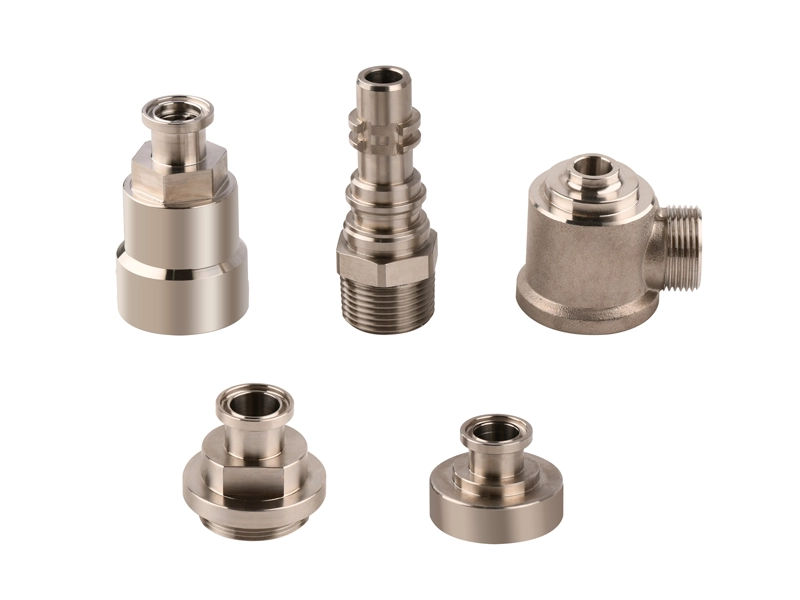
304 stainless steel pipe fittings are a go-to choice for piping that needs dependable strength, clean surfaces, and practical corrosion control. Made from chromium-nickel stainless steel, these fittings serve industrial, sanitary, and pressure piping jobs. Material grade, surface finish, operating temperature, and fluid chemistry still matter when making the final call.
Corrosion-Resistant Metal for Long-Lasting Performance
304 stainless develops a thin chromium oxide layer that reforms when oxygen reaches a clean surface. This natural barrier provides strong oxidation resistance and practical rust prevention during normal atmospheric exposure.
- Surface condition
- Pickling removes scale and embedded contamination.
- Passivation supports the protective surface and chemical durability.
- Service conditions
- Chloride-rich fluids can cause pitting corrosion.
- 316 stainless fittings may be a better bet when chloride exposure becomes severe.
Food-Grade Alloy: Ensuring Safe Fluid Transport
For sanitary application and beverage processing, 304 pipe fittings offer useful hygienic properties when correctly fabricated and cleaned.
- Start with a smooth surface that leaves fewer places for residue to stick.
- Specify electropolished or mirror-polished stainless fittings where easier cleaning is needed.
- Match the fitting design to applicable food-contact rules and cleaning procedures.
As a widely used non-toxic material for suitable food-contact systems, 304 stainless supports contamination control. Still, claims such as bacterial resistance or “contamination-free” operation depend on system design, sanitation, and handling rather than alloy grade alone.
Austenitic Alloy Strength in Harsh Environments
The austenitic structure gives 304 stainless steel pipe fittings a useful mix of ductility, impact resistance, and structural integrity. Its cryogenic performance is particularly handy at low temperatures.
| Property | Typical value | Unit | Design relevance |
|---|---|---|---|
| Tensile strength | ≥515 | MPa | tensile strength |
| Yield strength | ≥205 | MPa | Load capacity |
| Elongation | ≥40 | % | ductility |
| Density | 8.0 | g/cm³ | Weight estimate |
These typical annealed 304 values are a useful reference, not a fitting’s certified limits.
- For demanding service:
- Check thermal stability across the operating range.
- Confirm the fitting’s pressure rating rather than inferring it from tensile data.
- Use PMI and pressure testing when required by the specification.
Compliance with ASTM A403 and EN 10253 Standards
Buying 304 stainless steel pipe fittings by alloy name alone can miss key details. ASTM A403 covers wrought austenitic stainless fittings for pressure piping, while EN 10253 contains European requirements for butt-welding fittings.
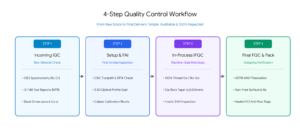
- Documentation matters: check material certification, heat identification, and required standardized testing.
- Dimensions matter too: verify dimensional tolerance and ASME B16.9 compatibility when specified.
- For solid quality assurance, confirm applicable manufacturing specifications, grade, manufacturing route, inspection, and regulatory compliance before ordering stainless steel fittings.
Types of 304 Stainless Steel Pipe Fittings
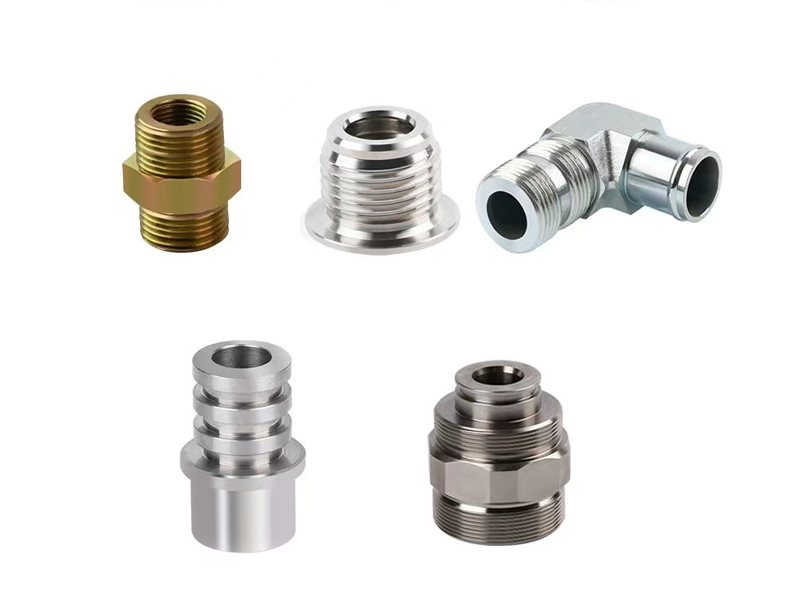
Choosing 304 stainless steel pipe fittings gets easier when connection type, size, and pressure needs are checked together. Stainless steel pipe parts may look pretty straightforward, but small dimensional differences matter in real piping work. From bends to closures, the right 304 steel fitting should match the pipe, joining method, applicable standard, and service conditions.
Elbows: Radius Options in 304 Stainless Steel
For 304 stainless steel pipe fittings that change flow direction, elbow radius affects both space and flow.
- Radius choice
- A long radius elbow gives a smoother pipe bend.
- A short radius saves room in tight layouts.
- Angle choice
- 90 degree elbow fittings make sharp turns.
- A 45 degree elbow makes a gentler change.
Check NPS, schedule, OD tolerance, and ASME B16.9 dimensions before matching this stainless steel fitting to pipe.
Equal Tees with Socket Weld Connections
An equal tee creates a same-size branch connection at a pipe intersection.
- Connection
- Socket weld ends allow compact assembly.
- Correct socket depth supports a sound, leak-proof joint.
- Service
- For high pressure work, confirm pressure class and bore.
- Match the industrial fitting to the governing socket-weld standard.
These checks keep 304 stainless steel pipe fittings properly matched to the system.
Concentric Reducers and Schedule 40 Wall Fit
A concentric reducer handles a pipe diameter transition while maintaining an aligned centerline.
- Pipe fit
- Confirm schedule 40 dimensions.
- Match reducer ends to pipe wall thickness.
- Installation
- Check inner bore and butt-weld geometry.
- Keep alignment steady for predictable flow control in industrial piping.
That saves a lot of hassle when 304 stainless steel fittings reach fabrication.
Threaded Couplings for Quick Assembly
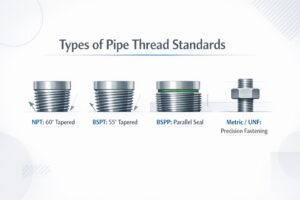
A threaded coupling is a practical pipe connector when welding is not desirable. Female threads permit quick installation, while an npt thread must match its mating pipe correctly.
- Check pressure rating and service fluid.
- Confirm ISO 4144 where applicable.
- Treat the mechanical joint according to maintenance needs rather than assuming it is maintenance free.
For threaded 304 stainless steel pipe fittings, correct thread form matters as much as nominal size.
Welding Caps for Secure End Sealing
A welding cap provides a fixed pipe end closure.
- Match the stainless steel cap to NPS and wall thickness.
- Prepare the butt weld cap edge for the specified weld.
- Inspect the finished joint for pressure containment and permanent seal quality.
Proper welding also improves pipe protection at closed ends. With 304 stainless steel pipe fittings, a correctly fitted cap makes the termination simple, secure, and ready for its intended pressure service.
3 Key Benefits of 304 Pipe Fittings
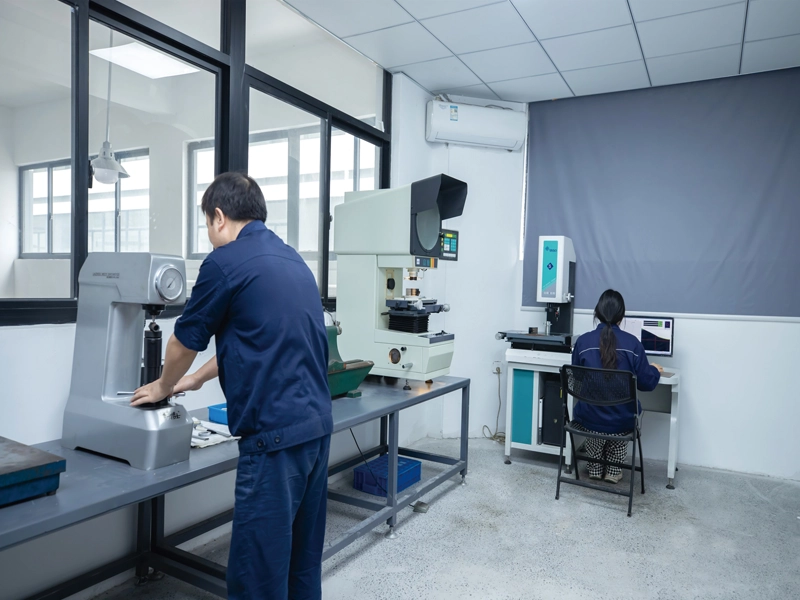
Choosing 304 stainless steel pipe fittings comes down to more than finding parts that simply fit. Wall thickness, corrosion behavior, and dimensional accuracy affect safety, service life, and repair costs. For buyers comparing stainless fittings, these three practical benefits show why careful specifications and quality checks really matter when the job gets tough.
Enhanced Durability with Schedule 80 Pipe Size
Schedule 80 gives a pipe a greater wall thickness than Schedule 40 at the same nominal pipe size, helping properly engineered systems handle demanding service.
- For practical specification:
- Check the required pressure rating rather than assuming thicker automatically means suitable.
- Match the 304 fitting with the connected pipe.
- Greater wall thickness can improve mechanical strength.
- Correct sizing supports long-term structural integrity.
Good-quality 304 stainless steel pipe fittings pair this strength with the useful properties of 304 stainless steel, making them a solid pick for many industrial lines.
Superior Corrosion Resistance Verified by Ultrasonic Testing
The chromium in 304 forms a thin passive surface layer that supports strong corrosion resistance and oxidation resistance. That chemistry does the corrosion-fighting work; ultrasonic testing serves a different job.
UT, a form of non-destructive examination, sends sound waves through metal to help identify thickness changes or internal discontinuities. In demanding industrial application settings, it can support defect detection without cutting open a fitting. Material grade and surface condition still need separate checks to confirm material quality.
Cost-Effective Maintenance via Dimensional Verification
Accurate stainless pipe fittings can save a fair bit of hassle during installation and later repairs.
- Dimensional verification supports quality assurance by checking:
- precision measurement of outside diameter and bore;
- wall thickness and fitting geometry;
- tolerance control against the applicable specification.
- Those checks can improve:
- installation accuracy, reducing poor fit and rework;
- lifecycle performance, helping control maintenance cost over time.
For buyers sourcing 304 fittings, yuuhuan hongqian can be evaluated against these same measurable criteria rather than price alone.
Butt Weld vs. Threaded Fittings: Which?
Choosing between welded and threaded connections comes down to operating conditions and maintenance needs. For 304 stainless steel pipe fittings, pressure, heat, pipe size, and leak control all matter. Stainless steel fittings can handle demanding service, but connection design can make day-to-day inspection and repair much easier.
Butt Weld Fittings
Butt weld designs join matching pipe ends into one continuous path, making them a practical choice where strength and low leakage matter. 304 stainless steel pipe fittings with welded connections are common in process piping.
- Connection design
- A prepared bevel end gives the welder space to create full penetration, meaning the weld extends through the joint thickness.
- Good pipe alignment helps maintain a smooth internal bore.
- A compatible seamless pipe can reduce internal flow disturbance.
- A prepared bevel end gives the welder space to create full penetration, meaning the weld extends through the joint thickness.
- Service demands
- System design must match the fitting and pipe pressure rating, rather than assuming every 304 stainless steel component handles the same load.
- Proper welding supports long-term structural integrity.
- A welding neck flange may be used where a flanged transition is needed.
- System design must match the fitting and pipe pressure rating, rather than assuming every 304 stainless steel component handles the same load.
Weld inspection can include radiography or ultrasonic testing when the governing piping code calls for it. That extra work is a trade-off: installation takes more skill, but the finished joint has no threaded leakage path.
Threaded Fittings
Threaded connections are handy when smaller piping needs routine removal. A male connector screws into a female adapter, with compatible NPT threads commonly used in North American systems.
- Check pipe diameter and the permitted pressure-temperature limits.
- Provide enough maintenance access for tools and later replacement.
- Use approved sealant tape or thread compound suited to the fluid; good sealing supports leak prevention.
| Nominal NPS | OD, in | NPT threads/in |
|---|---|---|
| 1/4 | 0.540 | 18 |
| 1/2 | 0.840 | 14 |
| 1 | 1.315 | 11.5 |
| 2 | 2.375 | 11.5 |
For 304 stainless pipe fittings, thread compatibility deserves close attention because stainless steel threads can gall during assembly. Compared with welded 304 fittings, threaded parts are generally easier to swap out, but added joints create more potential leak points.
Frequently Asked Questions (FAQ)
What is the main difference between 304 and 316 stainless steel pipe fittings?
Which manufacturing standards apply to 304 pipe fittings?
-
ASTM A403 / ASME B16.9: Wrought austenitic stainless steel butt-welding fittings (dimensions, tolerances, and heat treatment).
-
ASME B16.11 / ISO 4144: Forged and threaded / socket-weld fittings.
-
EN 10253: European standard for butt-welding pipe fittings.
How do I choose between Butt Weld and Threaded (NPT) fittings?
-
Butt Weld Fittings: Best for high-pressure, critical fluid lines, high-temperature service, or permanent process piping ($NPS \ge 2″$). They create a continuous, leak-proof joint with zero internal crevices.
-
Threaded Fittings: Best for low-to-medium pressure, smaller-bore piping ($NPS \le 2″$), and lines requiring frequent disassembly or routine maintenance.
How do you prevent thread galling on 304 stainless steel fittings?
-
Using high-quality, nickel-based or PTFE anti-seize paste/tape suited to your media.
-
Slowing down rotational speed during assembly.
-
Ensuring mating threads (NPT/BSPT) are clean, deburred, and properly aligned before tightening.
Can 304 stainless steel fittings be used in food, beverage, and dairy systems?
Call to Action (CTA)
Streamline Your Next Bulk Fitting Order with Zero Rework
-
Full MTR & Traceability: Mill Test Reports (EN 10204 3.1) and PMI certification with every heat lot.
-
Exact Dimensional Compliance: 100% inspected against ASME, ASTM, and ISO tolerances.
-
Competitive Bulk Pricing: Direct-from-manufacturer supply chains for large-scale industrial projects.
Upload your bill of materials (BOM) or speak with our piping technical specialists today to confirm sizes, schedules, and delivery schedules.