1. Quick Reference: 201 vs. 304 Performance & Specification Matrix
| Technical Parameter / Feature | 201 Stainless Steel | 304 Stainless Steel (AISI 304 / 1.4301) |
| Chromium (Cr) Content | 16.0% – 18.0% | 18.0% – 20.0% |
| Nickel (Ni) Content | 3.5% – 5.5% | 8.0% – 10.5% |
| Manganese (Mn) Content | 5.5% – 7.5% | ≤ 2.0% |
| Carbon (C) Content | ≤ 0.15% | ≤ 0.08% |
| Hardness (Brinell HB) | ~200 – 220 HB | ~180 – 200 HB |
| Yield Strength (MPa) | ≥ 310 MPa | ≥ 205 MPa |
| Elongation (%) | ≥ 40% | ≥ 40% (Superior cold plasticity) |
| Corrosion Resistance | Moderate (Dry / Indoor only) | High (Moisture, chemicals, food-grade) |
| CNC Machinability & Threading | Moderate (Rapid work hardening) | Excellent (Clean threads, tight tolerances) |
| Magnetic State (Annealed / Worked) | Non-magnetic / Weak-to-moderate | Non-magnetic / Slight magnetism |
| Relative Material Cost | Baseline (Economical) | +30% to +50% higher |
| Applicable Industry Standards | ASTM A240 / AISI 201 | ASTM A182 / ASTM A312 / AISI 304 |
2. Chemical Composition Differences
-
201 Stainless Steel (
17Cr-4.5Ni-6Mn-N):A lower-cost, nickel-saving austenitic alloy where manganese and nitrogen partially replace nickel to maintain an austenitic phase. It contains higher carbon (up to 0.15%) and elevated manganese (5.5%–7.5%). -
304 Stainless Steel (
18Cr-9Ni):The global benchmark for industrial stainless pipe fitting manufacturing. Formulated with 8.0%–10.5% nickel and 18.0%–20.0% chromium, with low carbon (≤0.08%) and controlled manganese (≤2.0%).
3. Corrosion Resistance and Environmental Durability
Passivation Film Stability
-
304 Grade: High chromium and nickel levels create a continuous, self-healing chromium oxide ($Cr_2O_3$) passive layer. This shield repels moisture, chlorides, and mild acidic/alkaline media, preventing rust in rigorous environments.
-
201 Grade: Lower nickel and elevated manganese compromise the density and healing speed of the passive film. Under humid or chemical exposure, 201 pipe fittings quickly suffer from pitting and surface tarnishing.
Environmental Compatibility Matrix
| Operating Environment | 201 Pipe Fitting Suitability | 304 Pipe Fitting Suitability |
| Dry Indoor Transfer / Light Duty | ✅ Suitable (Cost-Effective) | ✅ Highly Suitable |
| High Humidity / Condensation Areas | ❌ Prone to rust spotting | ✅ Recommended |
| Food & Beverage Sanitary Lines | ❌ Not Food Grade | ✅ Industry Standard |
| Chemical & Acid Processing | ❌ Fast pitting / Degradation | ✅ High Resistance |
| Outdoor Architectural / Fluid Systems | ❌ Vulnerable to weathering | ✅ Long-term durability |
4. Mechanical Properties & CNC Machinability
Hardness vs. Ductility
-
201 Grade: Higher carbon increases hardness (HB ~200–220) and yield strength, but decreases elongation. It is prone to micro-cracking during heavy cold bending, flaring, or deep deformation.
-
304 Grade: Moderate hardness (HB ~180–200) paired with superior ductility allows reliable cold forming, complex stamping, and deep expansion for heavy-duty ss pipe fittings.
Precision Threading and CNC Turning Performance
| Machining Aspect | 201 Stainless Steel | 304 Stainless Steel |
| CNC Turning Performance | High tool wear; requires rigid tooling setup | Smooth chip-breaking; stable cutting cycles |
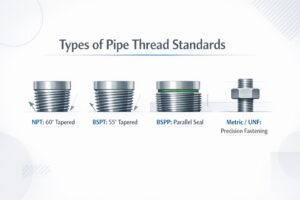
| Thread Precision (NPT/BSPT/Metric) | Prone to micro-burrs and crest tearing | Crisp thread profiles; excellent sealing surfaces |
| Work-Hardening Tendency | Severe (Accelerated by manganese content) | Moderate (Easily controlled by proper speeds/feeds) |
5. Visual Appearance and Surface Quality
Appearance of 201
Appearance of 304
6. Industry Application Comparison
Common Applications for 201 Pipe Fittings
-
Low-pressure utility lines in dry, climate-controlled interiors
-
Architectural handrails, decorative framing, and non-wetted hardware
-
Cost-sensitive temporary piping layouts
Common Applications for 304 Pipe Fittings
-
Food, dairy, and beverage sanitary transport systems
-
Chemical reactors, storage vessels, and fluid metering lines
-
Medical, pharmaceutical, and high-purity water systems
-
High-pressure municipal and industrial stainless pipe fitting networks
7. How to Test and Verify 201 vs. 304 Material
-
Acid Reagent Spot Test: Drop specialized stainless steel chemical reagent on the surface. Grade 201 turns red within seconds due to manganese reaction; grade 304 remains neutral or changes color very slowly.
-
PMI Spectrometer Verification: XRF or Optical Emission Spectrometry (OES) provides quantitative elemental percentages of Ni, Cr, and Mn for complete material traceability.
-
Visual Inspection: High-glaze, dark-grey reflection typically indicates 201, while uniform, neutral silver satin denotes genuine 304.
8. Summary: Selecting the Ideal SS Pipe Fitting
-
Choose 304 Pipe Fittings: When your process requires hygiene certification, outdoor weatherproofing, continuous moisture tolerance, or critical pressure sealing.
-
Choose 201 Pipe Fittings: Exclusively for non-corrosive, dry, indoor installations where initial budget savings outweigh long-term corrosion resistance.
9. Frequently Asked Questions (FAQ)
Do you provide stainless steel welding and assembly services?
Yes. We offer professional stainless steel TIG/MIG welding and tubular assembly services. Whether you require pre-welded pipe assemblies, welded flanges, or custom tube-to-fitting joints, we provide integrated machining and welding solutions according to your technical drawings.
How do you remove weld spots and heat tint after welding (303 vs. 304)?
Post-weld heat tint and weld spot removal depend heavily on the stainless steel alloy grade:
-
304 Stainless Steel: Offers excellent weldability. Weld spots, scale, and heat discoloration can be completely removed using chemical/electrochemical pickling and electropolishing (EP). This restores a clean, uniform surface finish while fully regenerating the protective chromium oxide passive layer.
-
303 Stainless Steel: Contains elevated sulfur (S) for free machining, which causes sulfur inclusions and hot-cracking risks during welding. Electropolishing cannot completely eliminate 303 weld marks and may cause pitting around inclusions. Therefore, 303 weld seams must be treated primarily through manual/mechanical grinding and physical abrasive polishing.
Do you provide custom precision CNC machining services?
Yes. Custom CNC machining is our core capability. We manufacture custom pipe fittings, connectors, adapters, and fluid components from standard grades (304, 316, 303, carbon steel, brass) to exact 2D/3D CAD tolerances.
Can I weld a 201 pipe fitting to a 304 pipe?
While technically possible using standard austenitic filler wire (such as ER308L), it is not recommended for high-pressure or corrosive systems. The 201 side will remain vulnerable to accelerated galvanic corrosion and localized oxidation along the Heat-Affected Zone (HAZ).
Is 304 stainless steel completely rust-proof?
304 provides exceptional corrosion resistance across most industrial environments due to its self-healing passive layer. However, for high-salinity marine environments or heavy chloride exposure, grade 316 / 316L stainless steel (with 2–3% molybdenum) is recommended.
Why do some CNC-machined 304 fittings exhibit slight magnetism?
In its fully annealed state, 304 is non-magnetic. However, heavy CNC turning, deep threading, or cold rolling can induce a mild strain-induced phase transformation to martensite. This results in weak magnetic attraction, which is normal and does not degrade alloy corrosion resistance.
10. Custom CNC Machining & Welding Solutions by Yuhuan Hongqian
At Yuhuan Hongqian Machinery, we specialize in high-precision CNC machining, custom stainless pipe fittings, and integrated fabrication services. We support OEM/ODM projects with rigorous quality standards:
-
Full-Spectrum CNC Machining: High-capacity production lines equipped with CNC lathes, truss robots, and automatic lathes capable of maintaining tight tolerances across complex NPT, BSPT, BSPP, and custom metric thread configurations.
-
Integrated Welding & Surface Finishing: Professional TIG welding, mechanical mirror polishing, and electropolishing services to ensure structural integrity and flawless aesthetic finishes.
-
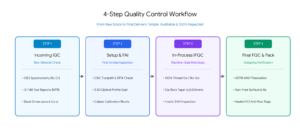
Certified Material Assurance: In-house PMI optical spectrometers (OES) ensure 100% genuine material compliance (304, 316, 303, carbon steel, brass) accompanied by verified Mill Test Reports (MTR).
-
OEM & ODM Custom Manufacturing: Rapid prototyping, custom DFM engineering feedback, and high-volume serial manufacturing tailored to your exact drawings.
Request a Custom Quote for Your Stainless Pipe Fittings
Need custom CNC-machined or welded 304 / 316 stainless pipe fittings with guaranteed material integrity and tight tolerances?
-
Send us your CAD drawings or technical specifications.
-
Receive a competitive factory-direct quote and DFM feedback within 24 hours.
👉 [Contact Yuhuan Hongqian Machinery] to discuss your project requirements or request standard sample parts today.